2019 KNUCH UNESCO Chair
International Conference

Survey Research Papers on Materials and Techniques in the UNESCO Chair Programme
Traditional Gold Leaf in Myanmar
-Research on Materials and Techniques in Asia-Pacific Regions
Survey of Weaving Technique on the Vietnam Border Region
A Survey and Scientific analysis of natural adhesives in Myanmar
The Construction of Database for Asia-Pacific Traditional Materials and Technique
-DB Construction for Asia-Pacific Traditional Materials and Technique
Thesis in the 2019 KNUCH UNESCO Chair International Conference
Suggesting the Preservation and Management of Architectural and Urban Heritage
UNESCO Chair on Heritage Future: a presentation of our work 2017~2019
UNESCO Chair in Cultural Resource Management, Southeast University, China
Historic Urban Landscapes and Heritage Impact Assessments
Sustainable Cultures in times of transition
Special Articles
Role of Digital Cultural Heritage for the Sustainability in Cultural Heritage
Philosophical Study of the Restoration of Gongju-mok Site for the Sustainable
Conservation of the Ancient City, Gongju
The Analysis of Foreign UNESCO Chair Programmes
The Sustainable Conservation of UNESCO World Heritage Mireuksaji
Hwaryeongjeon Shrine Story to Become a Heritage Treasure
The Sustainable Conservation of Cultural Heritage
Sanghyun Lee | Jeeyeon Kim | Hyesu Park | Sehee Song
Yeon Ok Sim | Sun Yong Lee | Geun Il Park | Ji Hee Roh
Yong Jae Chung | Jia Yu | Gyu Hyuk Cho | Seong Eun Kim
Young Jae Kim | Junghee Lee | Byeongsu Ryu | Mikyong Kwon | Jihyeon Lee
Young Jae Kim
Cornelius Holtof
WANG Yan | DONG Wei
Michael Kloos
Luísa Arroz Albuquerque
Jaehong Ahn
Sujeong Lee
Taeyoung Kim
Jiwon Jeon
Dongmin Han
Beomhyeon Lee
8
42
70
92
122
132
146
156
168
182
184
186
188
190
192
Ⅰ
Ⅱ
Ⅲ

Title
International Journal of Asian-Pacific Heritage
Studies Sustainable Conservation of Cultural Heritage
Organizer
International Heritage Education Center,
Korea National University of Cultural Heritage
Cooperation
Cultural Heritage Administration of Korea
Korean National Commission for UNESCO
Publication Date
December 30, 2019
Editing/Printing
ASCENDER
Publication Registration Number
11-1550215-000030-01
ISBN
978-89-299-1767-8 93600
Traditional Gold Leaf in Myanmar
-Research on Materials and Techniques in Asia-Pacific Regions
Survey of Weaving Technique on the Vietnam Border Region
A Survey and Scientific analysis of natural adhesives in Myanmar
The Construction of Database for Asia-Pacific Traditional Materials and Technique
-DB Construction for Asia-Pacific Traditional Materials and Technique
Gold leaf is an ornamental material used in various fields, including
architecture, painting and crafts, and religious art, regardless of whether
it is from the East or the West. Although it has been used in various types
of Buddhist statues, paintings, and textiles in Korea, its craftsmanship
production has been cut off. Therefore, it is necessary to study the
techniques, materials, and tools of handmade gold leaf for restoring and
reproducing traditional one.
“
Myat Par Yat,” located in Mandalay, Myanmar, is an area packed with
handmade gold leaf workshops. It produces gold leaf of 100 percent purity
through intensive manufacturing processes, sold throughout Myanmar,
widely used in buildings, crafts and cosmetics. In particular, it is used
mainly to decorate Pagoda, the important Buddhist structure of Myanmar,
where Buddhists visit Pagoda to put the gold leaf on the Buddha statue
and offer worship services.❶
Thus, gold leaf is closely related to the religious life of Myanmar people.
Today, however, handmade gold leaf faces a number of problems,
including the import of machine-made gold leaf and the operation of
unstable workshop caused by rising gold price.
Myanmar’s handmade gold leaf is an important intangible cultural
heritage that must be maintained and preserved because it is built with
traditional tools, materials and unique technique. But now Myanmar
lacks state or government-level support for intangible cultural heritage.
Therefore, continuous and systematic research, studying and archiving of
these materials should be used to leave a record of handmade gold leaf
and its craftsmanship to be passed on to future generations.
Furthermore, based on this, we will prepare basic data for use in the
restoration and reproduction of Korean craftsmanship manufacturing
technique.
Traditional Gold Leaf
in Myanmar - Research on
Materials and Techniques
in Asia-Pacific Regions
KNUCH, Dept. of Heritage Conservation
and Restoration, Graduate School
of Cultural Heritage
Prof. Sanghyun Lee
Senior Researcher. Jeeyeon Kim
Researcher. Hyesu Park
Researcher. Sehee Song
1. Purpose of research
Gold leaf is a very important decorative material that has long been used
for religious purposes, as well as for symbolic values of royal authority and
dignity. Therefore, it can be easily found in many relics and cultural heritage
such as royal relics, religious artworks, and architectures.❷
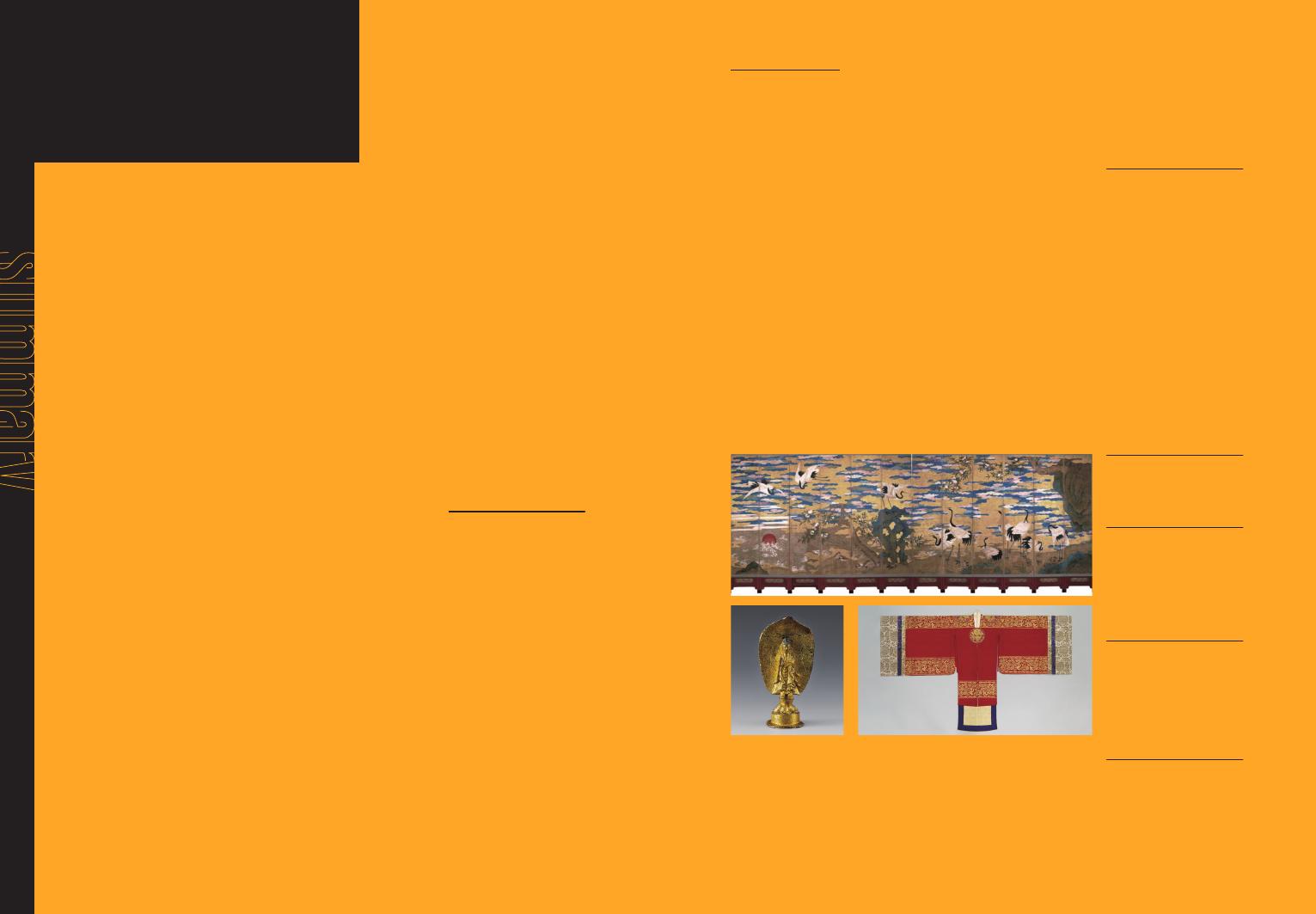
It is also easy to find various examples of gold leaf used in relics
of paintings, royal robes, and Buddha statues in Korea, including
Cranes and Peaches (Haehakbandodo in Korean)(pair of six-
fold screens, the Honolulu Museum of Art in the U.S.), National
Treasure 119, Gilt-bronze Standing Buddha with Inscription
of “Yeonga Chilnyeon”(the National Museum of Korea) and
Ceremonial Robe of the Consort of Imperial Prince Yeong (the
National Palace Museum of Korea).
However, there are no specific records of the nation's traditional gold leaf,
making it difficult to restore and reproduce traditional techniques as the
tools and techniques used in handmade gold leaf manufacturing are
different from before.
Ⅰ
Introduction
❷
Gold leaf is thin gold
sheet that is mainly used
for gilding. Gilding is any
decorative technique for
applying a very thin coating
of gold to solid surfaces
such as metal (most
common), wood, porcelain,
etc.
❸
National Research Institute of
Cultural Heritage. Revitalizing
Korean Cultural Heritage
around the World, Selected
Reports on Overseas Korean
Col ection Conservation
Projects. n.p.: National
Research Institute of Cultural
Heritage, 2015. p.32
Pic 1
Cranes and Peaches
(
Haehakbandodo in
Korean)
(
pair of six-fold screens,
the Honolulu Museum of
Art in the U.S.)❸
Pic 2
Pic 3
(
left) National Treasure
119, Gilt-bronze Standing
Buddha with Inscription
of “Yeonga Chilnyeon”(the
National Museum of Korea)
(
right) Ceremonial Robe
of the Consort of Imperial
Prince Yeong
(
the National Palace
Museum of Korea)
Myanmar is a leading Buddhist country, its Buddhist
architectures such as Shwedagon Pagoda and Mahamuni
Pagoda, and the wall decorations are world-famous. Also, its
art craft using gold, such as guilt Buddha statue and lacquer
ware with the Shwe zawa technique❹, has advanced.
❹ “
Gilding technique: drawing
a pattern on a lacquer-
painted surface and carving
with a very thin needle, then
attaching a gold leaf or gold
powder with the lacquer
and drying for 24 hours.” Ina
Kim. "Myanmar Lacquerers:
9
❶
In Myanmar, only men gild a
Buddha statue.
8

Their Historical Tradition and
Sociocultural Meanings." The
Southeast Asian Review 20
no.1 (2010): 181-210.
Pic 4
Pic 5
Shwedagon Pagoda
(
right) Applying gold leaf
on lacque rware with
Shwe zawa technique❺
❺
the above paper, p.189
Based on this culture, a
large amount of gold leaf is
produced and distributed,
especially Mandalay is a
major producer of handmade
gold leaf. It is actively used
in various fields, including
religious buildings, religious
events, crafts and cosmetics,
and is still prod uced in
traditional ways.
Therefore, through the field research of Mandalay, Myanmar, it's aiming to
prepare systematic data on the craftsmanship manufacturing techniques
so that they can be used as basic data to compare and study differences
from the reality of Korea's gold leaf manufacturing, and to restore the lost
craftsmanship technique.
Pic 6
Myanmar gold leaf
2. Method of research
There is a district that handmade gold leaf workshops are clustered in
Mandalay which is cal ed Myat Par Yat. This is the birthplace of country's
gold leaf industry and the center of handmade gold leaf sold throughout
Myanmar. The field research mainly carried out in King Galon and Aung
Tagon, two representative workshops of Myat Par Yat, photographing to
record. At the same time, Thindar Htwe Win(professor, the University of
Mandalay), Zin Mar(professor, Yadanabon University) interviewed spoke
on the gold leaf industry overal in Myanmar: the gold leaf manufacturing
methods, its features, tools and the current situation etc.
Content
Detail
Site and Method
Range of use
• Myanmar gold leaf
• Korean gold leaf
• Site
-Myat Par Yat
(
King Galon, Aung Tagon)
-Yangon National Museum
-Pagodas
• Method
-Internet
-Interview
-Visit
-Photo shoot
Manufacturing
Process
• Handmade
manufacturing process
• Materials
• Tools
Current Situation • Myanmar gold leaf industry
• Korean gold leaf industry
Preservation of
gold leaf
• Ways to preserve
traditional gold leaf
Date
Region
Visit
content
5th Aug. Incheon
Yangon
·
- Depart from Incheon
- Arrive in Yangon
6th Aug. Yangon
Mandalay
Mahamuni Pagoda
- Depart from Yangon
- Arrive in Mandalay
7th Aug. Mandalay University of Mandalay
King Galon workshop
- Interview with professors
- Visit workshops for
research on gold leaf
manufacturing process
and tools
8th Aug. Mandalay Aung Tagon workshop
Gold ribbon shop
9th Aug. Mandalay Aung Tagon workshop
10th Aug. Mandalay
Bagan
Aung Tagon workshop
Other small workshops
11th Aug. Bagan
Lacquer ware workshop
Pagodas
- Depart from Mandalay
- Arrive in Bagan
12th Aug. Bagan
Yangon
Ananda Temple
Shwesando Pagoda
13th Aug. Yangon
Shwedagon Pagoda
- Depart from Bagan
- Arrive in Yangon
14th Aug. Yangon
Yangon National Museum
- Arrive in Incheon
Subject
Handmade Gold leaf in Myanmar
Date
August 5th 2019(Mon.) ~ August 15th 2019(Wed.)
(
10days 9nights)
Cooperation Intangible Cultural Heritage Center Asia -Pacific
University of Mandalay, Myanmar
King Galon Gold Leaf Workshop, Myanmar
Gold Leaf Aung Tagon, Myanmar
Participant
Korea National University of Cultural Heritage,
Graduate School of Cultural Heritage,
Department of Heritage Conservation and Restoration.
Sanghyun LEE(Professor in Dept. of Heritage Conservation
and Restoration)
Jeeyeon KIM, Hyesu PARK, Sehee SONG(Degree Program in
Cultural Heritage Conservation)
Table 1
Outline of research
Table 2
Method of research
Table 3
Schedule of field research
10
11
Sa
ng
hy
un L
EE | J
ee
ye
on K
IM | H
ye
su P
AR
K | S
eh
ee S
O
NG
Tra
di
tional
G
old
Le
af in
M
yan
m
ar
1. Range of research
1) Country and region
Ⅱ
Traditional Myanmar Gold Leaf
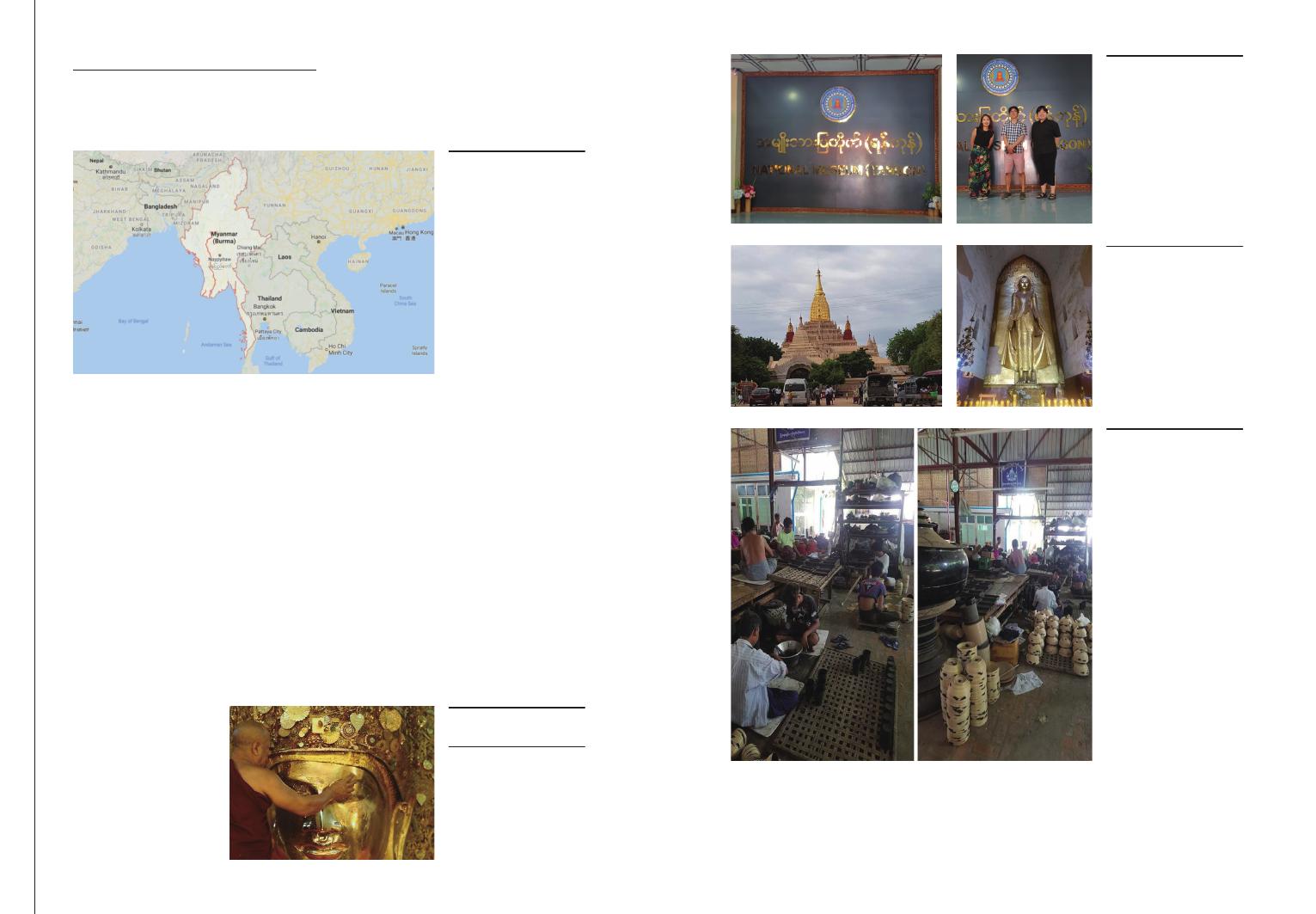
Mandalay(မနတလေး), Myanmar(မြ န်မာ) is selected for the 2019 UNESCO Asia-
Pacific Research on Traditional Materials Myanmar. It is located between
the Indochina Peninsula and the Indian Continent in Southeast Asia.
Myanmar is a leading Buddhist country with a strong Buddhist faith,
with the composition of its members accounting for 89.4 percent of the
population as well as historical sites and cultures. The Buddhist history of
Myanmar is more than 2,000 years old, with a high proportion of monks
among the population, and about 500,000 monks in Myanmar, and
about 10 percent of Myanmar’s total population as of 2019. There is a high
percentage of household income spent on religious life. Also, gold leaf
is a representative cultural offering to Buddha by worshipers. Myanmar
Gold leaf has been developed in the care of Myanmarese over a long
period of time along with Buddhist history. The Myat Par Yat in Mandalay,
Myanmar, is main area where gold leaf production is concentrated and
the technique is being transfered. Thus, the field research focused on
Mandalay, Myanmar,
and also conducted
touring the Pagodas
and Yangon National
Museum in Yangon and
lacquerware workshop
in Bagan in order to
understand their culture
and actual examples.
Pic 7
Geographical location of
Mandalay
(
ⓒ
google maps)
Pic 8
Applying gold leaf on the
Buddha statue❻
❻ “
A washout ceremony in The
Buddhist Statue of Mahamuni
Temple .”
EBS Clip Bank
(
https://clipbank.ebs.co.kr/
clip/view?clipId=VOD_201709
10_00125)
Pic 9, 10
Yangon National Museum
Pic 11, 12
Ananda Temple in Bagan
Pic 13
Lacquer ware workshop in
Bagan
12
13
Sa
ng
hy
un L
EE | J
ee
ye
on K
IM | H
ye
su P
AR
K | S
eh
ee S
O
NG
Tra
di
tional
G
old
Le
af in
M
yan
m
ar
2) Brief information of Myanmar
M ya n m a r, of f i c i a l l y th e
Republic of the Union of
Myanmar(ပြ ည်ထောင်စ ုသမ ္မတ
မြ န်မာနိ ုင်င ံတော်)
is a country in
Southeast Asia. Myanmar
is bordered by Bangladesh
and India to its northwest,
China to its northeast, Laos and Thailand to its east and southeast, and
the Andaman Sea and the Bay of Bengal to its south and southwest.
With a size of 676,578 square kilometres (261,228 square miles), Myanmar
is the largest of the Mainland Southeast Asian states by area. As of 2017,
the population is about 54 million. Its capital city is Naypyidaw, and its
largest city is Yangon(Rangoon). Myanmar has been a member of the
Association of Southeast Asian Nations(ASEAN) since 1997.
Early civilizations in Myanmar included the Tibeto-Burman-speaking Pyu
city-states in Upper Burma and the Mon kingdoms in Lower Burma. In
the 9th century, the Burma people entered the upper Irrawaddy valley
and, following the establishment of the Pagan Kingdom in the 1050s, the
Burmese language, culture and Theravada Buddhism slowly became
dominant in the country. The Pagan Kingdom fell due to the Mongol
invasions and several warring states emerged. In the 16th century,
reunified by the Taungoo dynasty, the country was for a brief period the
largest empire in the history of Mainland Southeast Asia. The early 19th
century Konbaung dynasty ruled over an area that included modern
Myanmar and briefly controlled Manipur and Assam as well. The British
East India Company seized control of the administration of Myanmar
after three Anglo-Burmese Wars in the 19th century and the country
became a British colony. Myanmar was granted independence in 1948,
as a democratic nation. Fol owing a coup d'état in 1962, it became a
military dictatorship under the Burma Socialist Programme Party.
For most of its independent years, the country has been engrossed in
rampant ethnic strife and its myriad ethnic groups have been involved
in one of the world's longest-running ongoing civil wars. During this
time, the United Nations and several other organizations have reported
consistent and systematic human rights violations in the country. In
2011, the military junta was officially dissolved following a 2010 general
election, and a nominally civilian government was installed. This,
along with the release of Aung San Suu Kyi and political prisoners, has
improved the country's human rights record and foreign relations, and
Pic 14
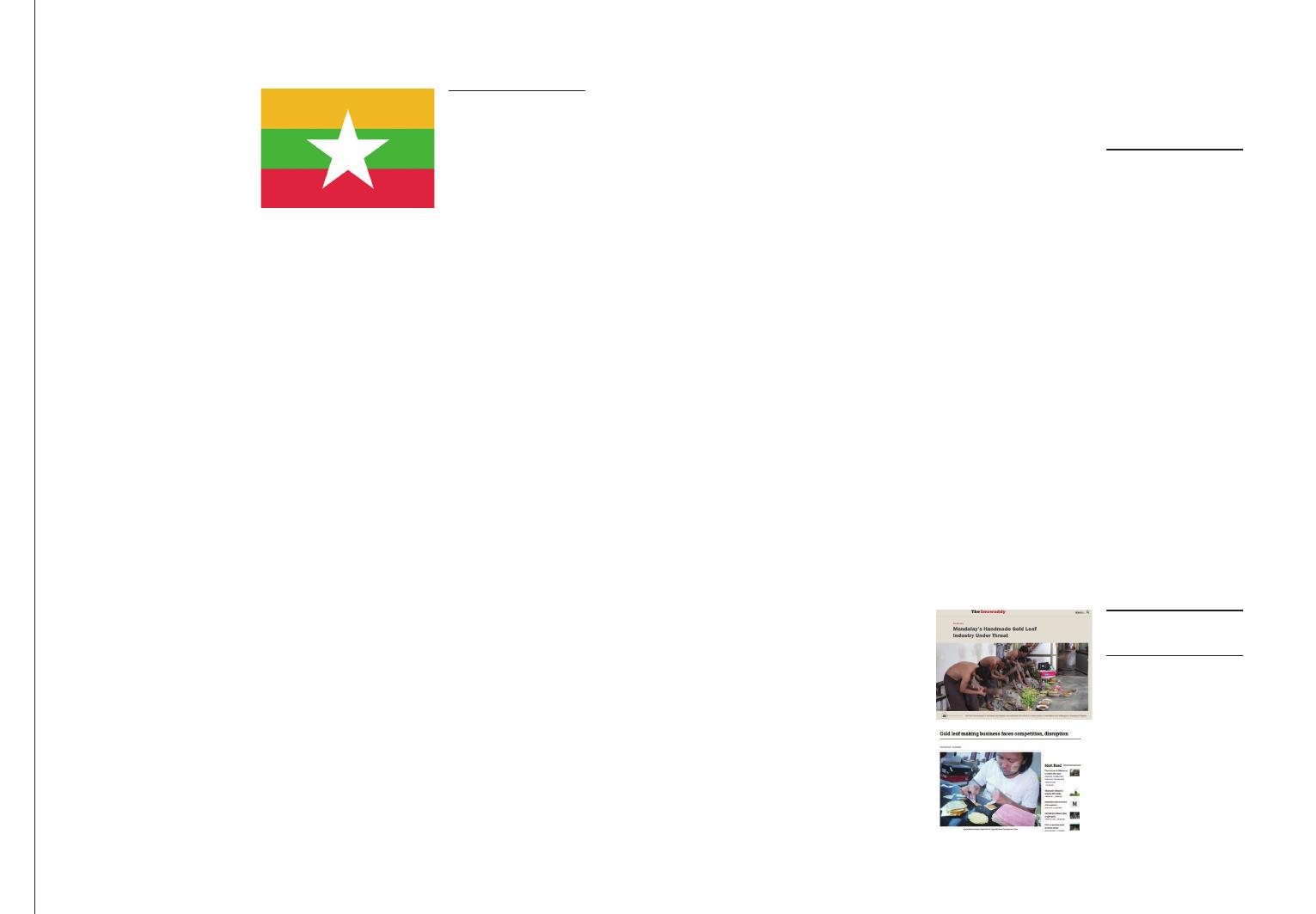
Myanmar national flag
has led to the easing of trade and other economic sanctions. There is,
however, continuing criticism of the government's treatment of ethnic
minorities, its response to the ethnic insurgency, and religious clashes.
In the landmark 2015 election, Aung San Suu Kyi's party won a majority in
both houses. However, the Burmese military remains a powerful force in
politics.❼ The current president(2019) is Win Myint.
Mandalay(ြ မန ္တလေး)is located in the center of Myanmar. In
Myanmar's economy, Mandalay Region is accounting for
15% of the national economy. Mandalay is the birthplace of
Myanmar's gold leaf industry, and handmade gold leaf is a
major industry in Mandalay.
❼ “
Myanmar” Wikipedia (https://
en.wikipedia.org/wiki/
Myanmar)
2. Contents of research
1) Pre-research
UNESCO Chair program aims to develop a network and mutual
understanding with recipients of the program with enhancing Asia-
Pacific Cultural Heritage preservation.
Based on these goals, it is deemed necessary to research for Korean
traditional gold leaf crafts in order to bring Myanmar gold leaf
technique into Korean gold leaf restoration. The next pages will touch
on ‘Geumbakjang’, intangible cultural heritage in Korea, and gold leaves
which are found in paintings and documents prior to field research.
(
1) Myanmar gold leaf and workshops
A preliminary study confirmed that Myanmar’s gold leaf is a very
important traditional industry, as it is used in the construction of Pagoda
a n d c ra f t s i n c o n n e c t i o n
with Buddhism, the national
religion. However, data on gold
leaf production was mostly
about manual gold-beating in
Myanmar, the place was limited
to the King Gallon workshop.
There were difficulties in finding
additional data, but with the
help of Myanmar’s National
Intangible Cultural Heritage
Center, it was able to get an
overview of the area of the
“
Myat Par Yat” and the state of Myanmar traditional gold leaf
industry.
Pic 15, 16
Articles on the state of
Myanmar traditional gold
leaf industry❽
❽ (
up) Mandalay’s Handmade
Gold Leaf Industry Under
Threat, The Irrawaddy, 2014
(
https://www.irrawaddy.
com/features/mandalays-
handmade-gold-leaf-
industry-threat.html)
(
down) Gold leaf making
business faces competition,
disruption, MYANMARTIMES,
2018 (https://www.mmtimes.
com/news/gold-leaf-
making-business-faces-
competition-disruption.html)
14
15
Sa
ng
hy
un L
EE | J
ee
ye
on K
IM | H
ye
su P
AR
K | S
eh
ee S
O
NG
Tra
di
tional
G
old
Le
af in
M
yan
m
ar
(2) Korean traditional gold leaf crafts
Gold was the most convenient, safe commodity, having the invariability
that did not change over time.❾ It has symbolized the
wealth and power of the rulers. Humans have made various
ornaments based on these natures of gold and expressed
the sense of life and art.
The Korean people also valued gold, and the methods and
scope of its use were very pioneering. It can be found through
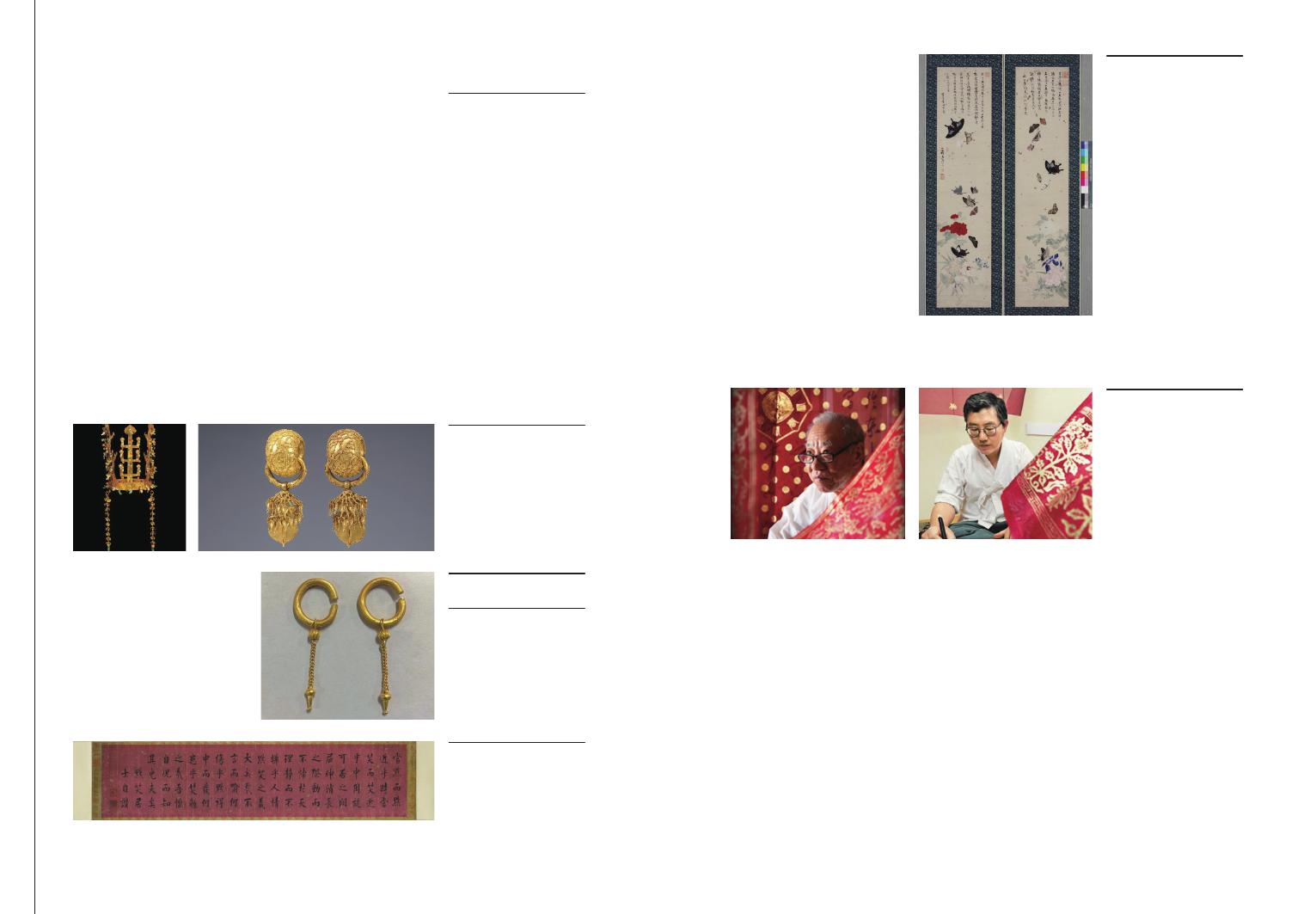
various works of art❿ such as National Treasure 87, Gold Crown
form Geumgwanchong Tomb(Gyeongju National Museum),
National Treasure 90, Gold Earrings(the National Museum of
Korea), Gold Earrings from Gongju.
An example of a paper cultural asset is 'Nanggeumji'. It is a paper
decorated with gold leaf, which was imported mostly from China in the
past. It was used in many art works such as Self-praise of Mukso Geosa
Written by Kim Jeong-hui(the National Museum of Korea), Butterflies and
Flowers draw by Nam Gye-u(the National Museum of Korea).
❾
❿
Wonyong Kim,The
Scythian gold from the
Hermitage,Chosunilbo,1991.
p.292.
Jungmi Kim. “A study of gold
applied in the fabric.” M.A.
degree, Graduate school
of Ehwa Womans University,
2001. p.1.
Pic 17
Pic 18
(
left) National Treasure
87, Gold Crown form
Geumgwanchong Tomb
(
Gyeongju National
Museum)
(
right) National Treasure
90, Gold Earrings
(
the National Museum of
Korea)
Pic 22
Pic 23
(
left) Late Deok-hwan Kim
(
03.14.1935-10.10.2019)
National intangible
cultural heritage No.119,
Geumbakjang
(
right) Ki-ho Kim,
National intangible
cultural heritage No.119,
Geumbakjang
Pic 19
Gold Earrings from Gongju,
South Korea⓫
Pic 20
Self-praise of Mukso Geosa
Written by Kim Jeong-hui
(
the National Museum of
Korea)
Pic 21
Nam Gye-u, Butterflies
and Flowers (the National
Museum of Korea)
⓫ “
the Essence of Baekje
Craftsmanship… Gongju
Sukchon-ri Ancient
Tombs-Gun gold Earrings”
Chungcheong Today, last
modified n.d.,accessed Dec
,2019, http://www.cctoday.
co.kr/news/articleView.
html?idxno=2038622
①
National intangible cultural heritage in Korea‘Geumbak
jang’(Gold Leaf Imprinting)
Today, Geumbakjang is the master or the technique of printing letters
or patterns on a fabric with thin gold leaf. The names, gold leaf and
Geumbakjang, are first identified in the records of the Goryeo Dynasty.
Until the Joseon Dynasty, Geumbakjang meant nothing more than a
master of making gold leaf and the gold leaf meant a material itself.
In modern times, however, the machine-made gold leaf became
common, in fact, the technique of handmade gold leaf has been cut off,
Geumbakjang actual y does not mean a master of manufacturer.
②
Traditional gold leaf manufacturing process on record
First, prepare pure gold or the combination of gold and silver by 8:2.
Place gold on an anvil and beat it for three days with a hammer to make
it thin.
Second, put pieces of gold(2x2cm, 1000 sheets) between each sheet of
black paper(15x15cm, 1,100 sheets), then wrap the package with a sheet of
16
17
Sa
ng
hy
un L
EE | J
ee
ye
on K
IM | H
ye
su P
AR
K | S
eh
ee S
O
NG
Tra
di
tional
G
old
Le
af in
M
yan
m
ar
paper, and then beat it. The first day, only beat the center of the paper,
but from the second day, have to beat all around for three days. Should
be careful not to let a hole.
Third, divide gold leaf into quarters with a bamboo knife.
Fourth, cut the very thin white paper into 1/4 the size of the black paper.
Fifth, make 10 sheets package with thin strips made of the white paper.
Currently, the pure gold gourd used by Geumbakjang uses machine-
made ones in Korea.
2) Field research
(
1) Interview
Based on pre-research, the interview was conducted with local experts
and workshop officials in myanmar. The questions are below:
<Questions>
· Where do you get the gold ?
· Is there a standard for gold leaf quality?
· Does the use of gold leaf vary depending on the quality of the gold leaf?
· What is the difference between handmade and machine-made gold leaf?
· Why maintain the handmade gold foil production debate?
· Where are the tools for manual work from?
· Is there a record of handmade gold leaf techniques?
· Is there government support to maintain traditional industries such as handmade
gold leaf?
· Are the trustees of the Shwedagon Pagoda related to government officials?
Through the interview with Thindar Htwe Win(professor, University
of Mandalay), Zin Mar(professor, Yadanabon University), it is told the
detailed stories about the controversy over the decision to use the
machine-made gold leaf by Shwedagon Pagoda in 2014, the crisis which
the traditional gold leaf industry is facing, and the difficulties in running a
workshop due to rising gold prices. Also, from Aung Tagon, the president
of the workshop, it was able to obtain information and base data on the
differences between handmade and machine-made gold leaf.
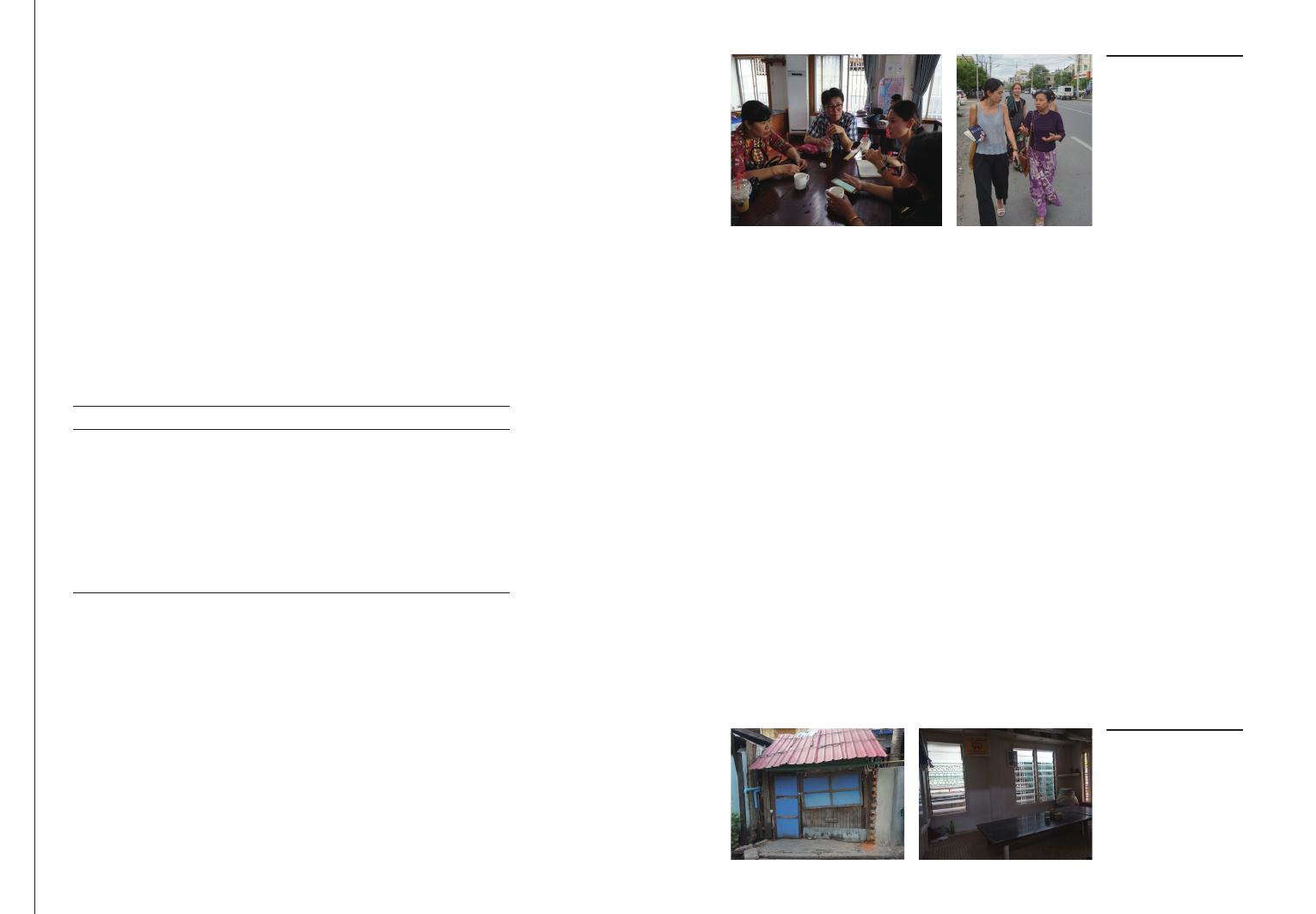
Pic 24, 25 Interview with professors
①
State of traditional gold leaf industry
There are some factors that threaten Myanmar's traditional gold leaf
industry: The reduction in the number of workers due to hard labor and
low wages, the unstable operation and maintenance of workshops with
a rise of gold price and the influx of machine-made gold leaf.
Among other things, the influx of machine-made gold leaf was decisive
to the traditional industry. Since 2014, the situation has become even
more difficult, as more and more people have imported and used
machine-made one from Thailand and China.
Myanmar's Pagoda has been decorated with handmade gold leaf
made of pure 100 percent gold, but after the import of the machine-
made gold leaf, the trustees of Shwedagon Pagoda decided to repair
it using the machine-made. Most of the entire gold leaf industry is used
for the construction and repair of Pagoda, which foretold a sharp drop
in demand for handmade gold leaf if it no longer uses it. In response,
people in Myanmar voiced concern that the use of the machine-made
may undermine the value of the pagoda in the future and cause a threat
to the gold leaf industry, and as a result, the trustees of Shwedagon
Pagoda withdrew its decision to use the machine-made gold leaf.
In addition to these problems of machine inflow, the soaring gold prices
(
during local survey in August 2019) caused the temporary shutdown of
many of the small workshops in Myat Par Yat.
Pic 26, 27 Temporary closed
workshops in Myat Par Yat
18
19
Sa
ng
hy
un L
EE | J
ee
ye
on K
IM | H
ye
su P
AR
K | S
eh
ee S
O
NG
Tra
di
tional
G
old
Le
af in
M
yan
m
ar
②
Handmade vs Machine-made gold leaf
<Table 4> shows the reason why the gold leaf craftsman insist that
handmade gold leaf should be used.
①
KING GALON
King Galon Gold Leaf Workshop is the largest one in Myat Par Yat, and
Mandalay's signature workshop. Located on the main street in the
center of Mandalay, it is most popular among foreign media and tourists
because it is more accessible than other workshops and can be easily
found through Internet.
It also has a showroom with materials and tools of handmade gold leaf
for free, helping to understand the overall process. In particular, it runs
an experience program for tourists and sel s gold leaf as a souvenir. It
operates a shop in the capital city of Yangon as well, focusing on the
tourism industry along with the gold leaf distribution.
With the democratic government in Myanmar in 2016, an exhibition
of cultural heritage was held in Yangon as part of efforts to develop
and maintain cultural heritage. King Galon was invited to the Cultural
Heritage Exhibition in recognition of his contributions to maintaining
tradition for 60 years, promoting Myanmar’s traditional gold leaf to the
public, and also visited by the culture minister himself.
Handmade gold leaf is made of pure 100 percent gold, but machine-
made gold leaf is made by mixing 18k gold with chemical materials,
which is inferior to the handmade. Also, the polishing, weight, and
duration of the gold leaf vary depending on the content of the gold.
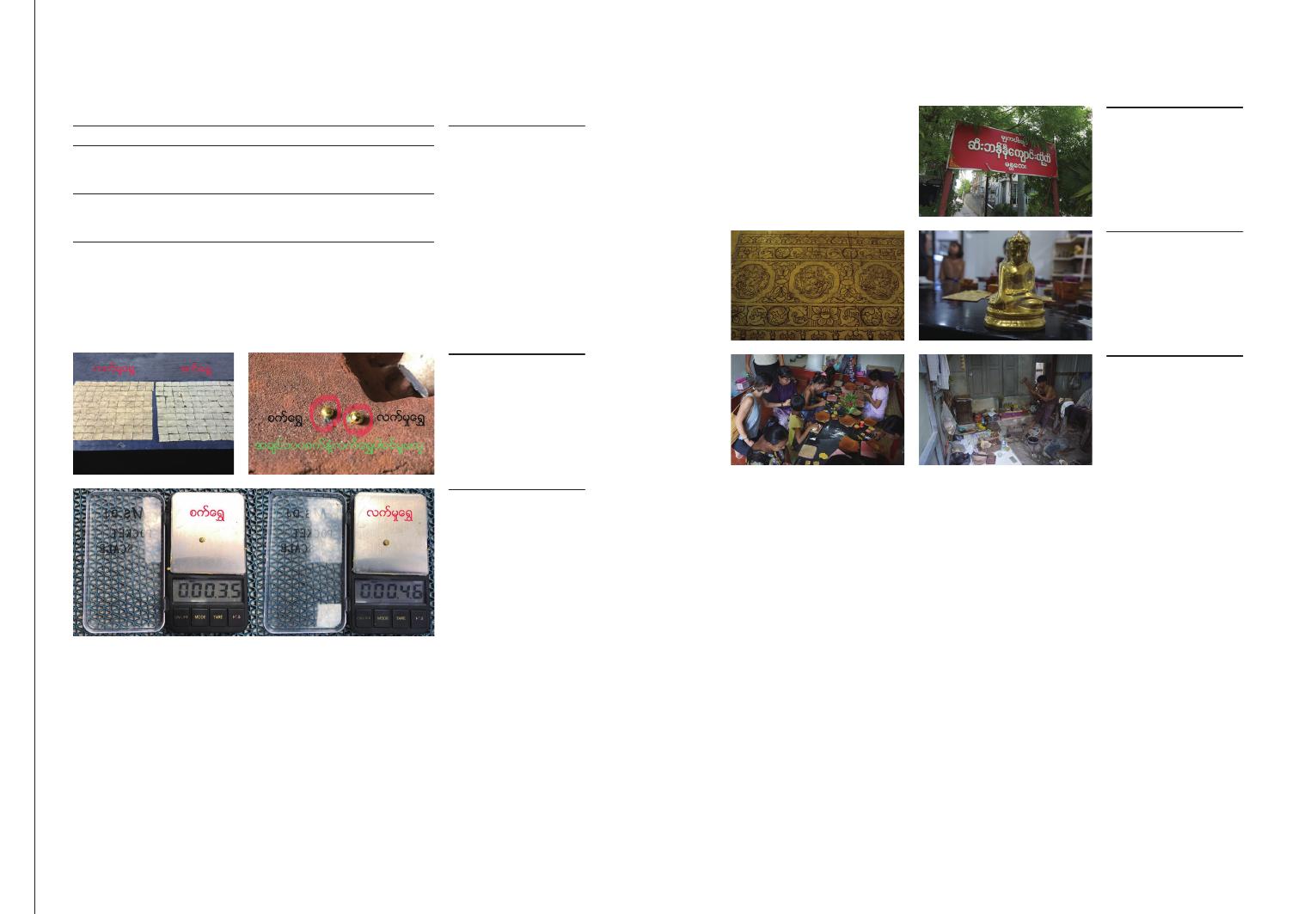
In the pictures above, the difference between the handmade and the
machine-made gold leaf is obvious: visual difference in luster, 1.1 mg
difference in weight and uncertain content of pure gold used in the
machine-made. Also, the machine-made attached to Pagoda with
lacquer was found to fall off the surface 3 years later.
(
2) MYAT PAR YAT
"Myat Par Yat" is the name of the area where the gilt workshops are
clustered in Mandalay. Mandalay is the birthplace of Myanmar's gold
leaf industry. Gold leaf made at the Myat Par Yat is sold throughout
Myanmar, and is used in Pagoda and lacquer ware, medicine and
Handmade
Machine-made
Pros
· Pure 100% of gold
· Persistent
· Lustrous
· less price
(39,000Kyat/100sheets)
Cons
· pricey
(43,000Kyat/100sheets)
· Mixed with chemical materials
· Less persistent
· Less lustrous
Table 4
Handmade vs Machine-
made gold leaf
Pic 28
Pic 29
(
left) the difference
of luster between
handmade(left)
& machine-made gold
leaf(right) (ⒸAung Tagon)
(
right) the difference of
luster between machine-
made(left)
& handmade gold
leaf(right) (ⒸAung Tagon)
Pic 32
Pic 33
(
left) Wall decoration in
Mahamuni
(
right) Gold-plated statue
Pic 34, 35 Small workshops in Myat
Par Yat
Pic 30
the weight difference
between handmade gold
leaf(left)
& machine-made gold
leaf(Right) - after make
gold leaf to pil . (ⒸAung
Tagon)
Pic 31
Myat Par Yat' sign board
cosmetics. Currently, there are about 134 workshops on a large and smal
scale.
20
21
Sa
ng
hy
un L
EE | J
ee
ye
on K
IM | H
ye
su P
AR
K | S
eh
ee S
O
NG
Tra
di
tional
G
old
Le
af in
M
yan
m
ar
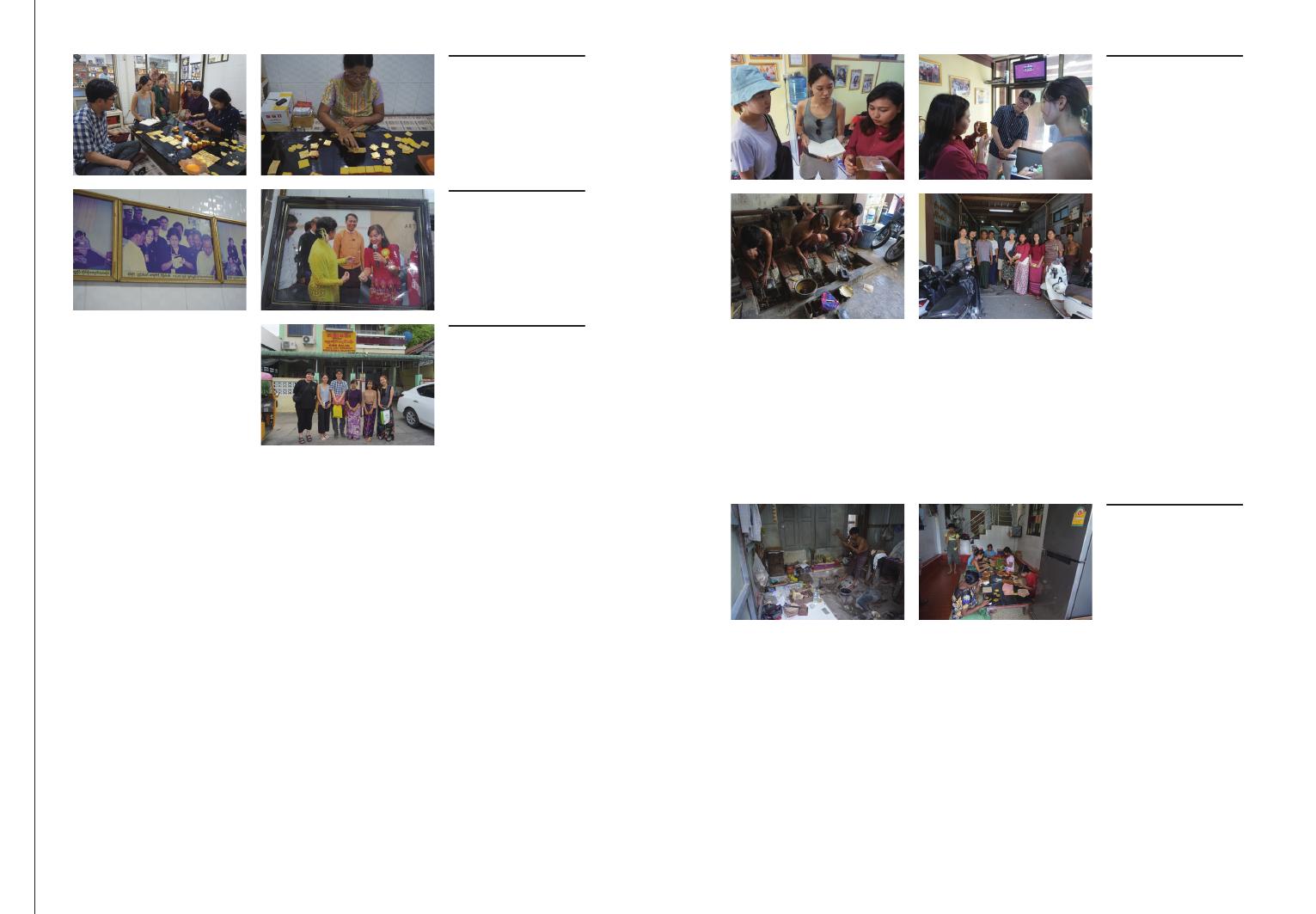
Pic 36, 37 Visit and interview in King
Galon
Pic 41, 42,
43, 44
Visit and interview in Aung
Tagon
Pic 45, 46 Small workshops
Pic 38, 39 Attend an official event
Pic 40
Visit to King Galon
②
Gold Leaf Aung Tagon
Gold Leaf Aung Tagon also belongs to a large-scale workshop where
the work of beating gold and packing is done together. Unlike the King
Galon, however, it is putting more effort into preserving and conserving
traditional handmade gold leaf rather than engaging in activities to
attract foreign tourists.
The owner also manages construction projects to put gold leaf on
Pagodas and Buddha statues, so he knows the importance of the
handmade gold leaf. Since 2014, it has participated in protests against
the use of the machine-made gold leaf in Pagoda and has been steadily
engaged in activities to preserve tradition.
He is not only the owner or seller of traditional workshop but also is the
one who requested numerical value to a research institute to build up a
base data the superiority and the differentiation of handmade gold leaf.
He is also at the forefront of the activities of preserving traditional gold
leaf that are threatened by actively sharing articles, materials, or work
on handmade gold leaf with SNS services.
③
Other workshop
In fact, there are not many large scale workshops such as King Galon
and Aung Tagon, it is easier to find small workshops. Usually the
workplace for beating gold and packing is separated. Several workshops
has only the small room for work. Most workshops are following their
cottage industry, they run workshops under two names, one is from their
parents and the other is their own, so that they can maintain the family
tradition and acquire more works from the market.
(
3) Manufacturing process
Depending on gender, their role is different for a religious reason: only
men can participate in gold-beating and women can take part in the
packing. According to the survey, male workers pray to the Buddha while
beating gold and women are banned from accessing to the beating
area. Exceptional y, Boys also participate in the packing work in case of
small workshops. Most workshops are run on a family basis.
①
How to produce the gold ribbon
The gold leaf is made from a small gold piece. To get this, the workshop
needs to buy a gold ribbon from the gold shop, for example, Aung Tagon
purchases it from Thar Htoo.(Shwe Naing Ngan: the gold shop)
22
23
Sa
ng
hy
un L
EE | J
ee
ye
on K
IM | H
ye
su P
AR
K | S
eh
ee S
O
NG
Tra
di
tional
G
old
Le
af in
M
yan
m
ar
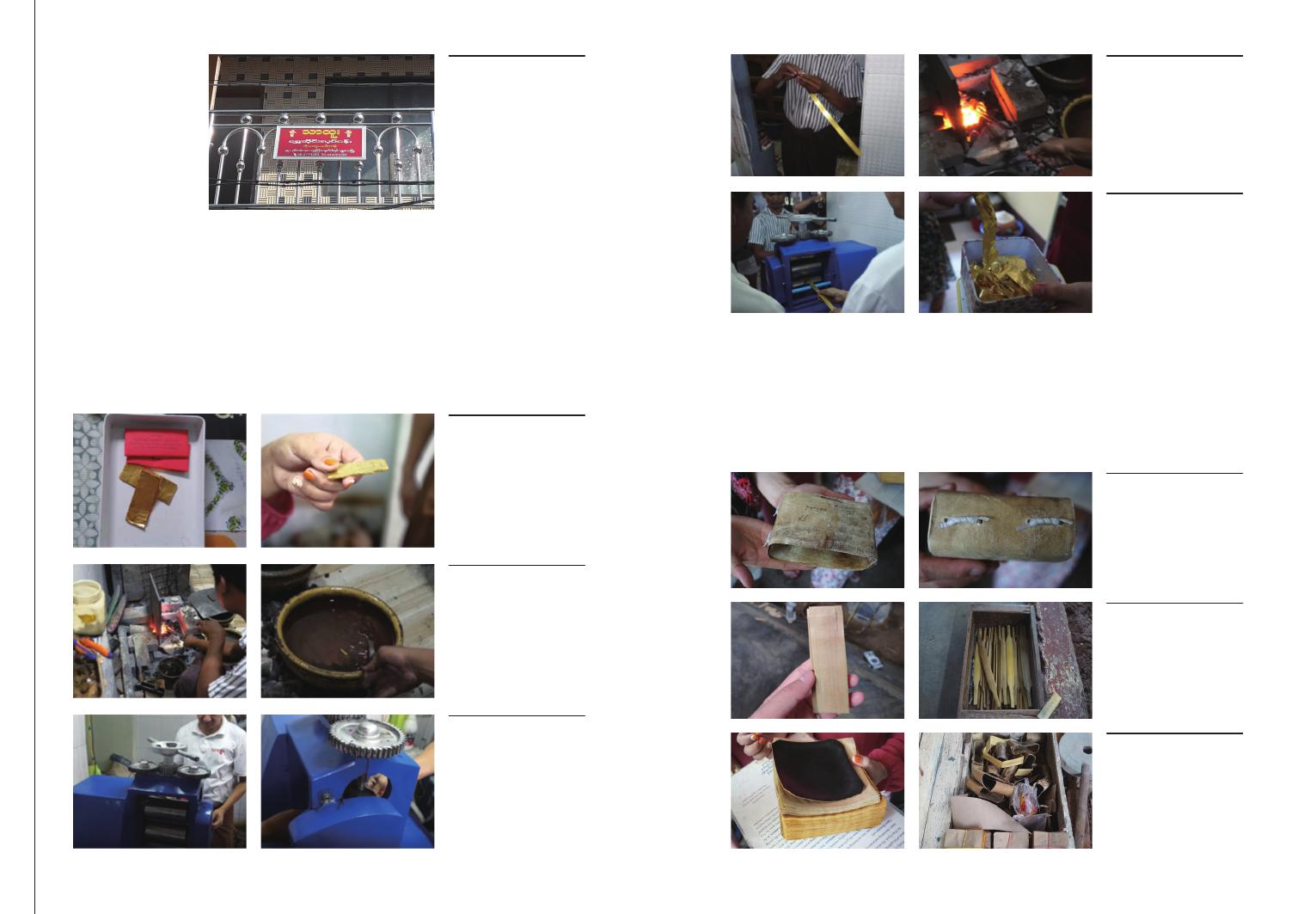
Pic 47
Thar Htoo, gold ribbon
shop
How to produce a gold ribbon
1. Beat in the hot gold stick to soften the gold.
2. Dip the gold stick in cold water
3. Put the gold stick into a rol ing machine to have a gold ribbon.
4. As the above process is repeated, the gold stick passes through
the rolling machine about 13 times. the thickness of the stick becomes
approx. 0.02mm, which was 2.5mm.
5. The gold ribbon(10.625g) is cut into 800 pieces(approx. 0.013g/1 piece)
in a gold leaf workshop.
②
The setup for the beating
The gold ribbon is cut into 800 pieces. First of al , put the pieces between
the sheets of bamboo papers. From this process, it is domain of
men(Shwe Kat). requires various of tools and skil s. It is important to be
fasten up the package to make a proper gold leaf.
The product “Gold stick”
Gold stick(Burmese: Warlone)
Heat the gold stick to beat
Dip it in water to cool it down
Rolling machine
Use the machine in pairs
Roll the stretched gold up
Repeat it from the heating
Use the machine in pairs
Gold ribbon
Pic 48, 49
Pic 54, 55
Pic 56, 57
Pic 50, 51
Pic 52, 53
The tools for the package
①
Leather cover
②
Palm tree leaf
Leather cover (Left side)
③
Bamboo stick
Pic 58, 59
Pic 60, 61
④
The package contents
⑤
Toolbox
Pic 62, 63
24
25
Sa
ng
hy
un L
EE | J
ee
ye
on K
IM | H
ye
su P
AR
K | S
eh
ee S
O
NG
Tra
di
tional
G
old
Le
af in
M
yan
m
ar
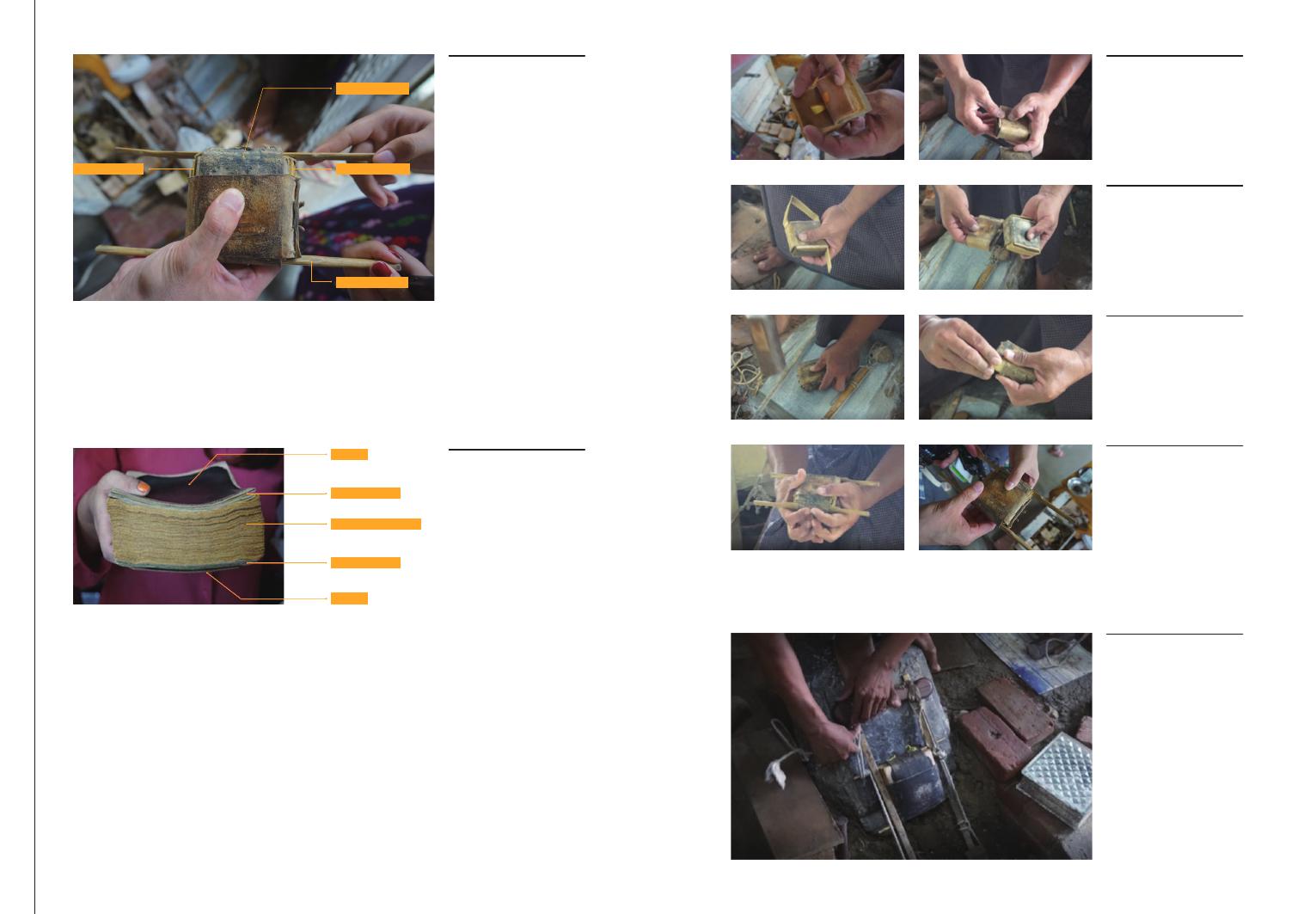
①
Leather cover
③
Bamboo stick
④
The package
②
Palm tree leaf
Pic 64
Pic 65
Order of package
Pic 74
Fix the package to wooden
apparatus on marble.
The setup for the beating consists of Leathers, straw papers and
bamboo papers.
When the gold pieces get bigger through the beating, change the
package to the big size of leather and papers and repeat the beating.
The contents of package is same with previous one.
After the fixing, proceed the next process with wooden apparatus on
marble.
Leather
40 Straw paper
1000 Bamboo paper
40 Straw paper
Leather
Fixing the gold pieces
1. A small piece of gold(1cm x 2cm) is made into a bundle of 1,200 sheets of
bamboo paper
2. Put 40 sheets of straw paper on the top and the bottom of the package
to prevent damage to the gold pieces during the beating, then cover it
with leather(deerskin or cowhide) and secure it firmly with palm tree leaf
and bamboo sticks.
3. put the leather covers as crosswise.
4. To firmly fix the package, pack the palm tree leaves into the inside of the
cover. and put the bamboo sticks in paral el. it is important to be fasten
up the package.
The package with first gold pieces
Put the leather cover
Fix the package with palm tree leaves
Put the leather covers as crosswise
Hit the package everywhere with
hammer to make it flat
Add the Palm tree leaves on the side
Pic 66, 67
Pic 68, 69
Pic 70, 71
Put the bamboo sticks in paral el
Finished fixing
Pic 72, 73
26
27
Sa
ng
hy
un L
EE | J
ee
ye
on K
IM | H
ye
su P
AR
K | S
eh
ee S
O
NG
Tra
di
tional
G
old
Le
af in
M
yan
m
ar
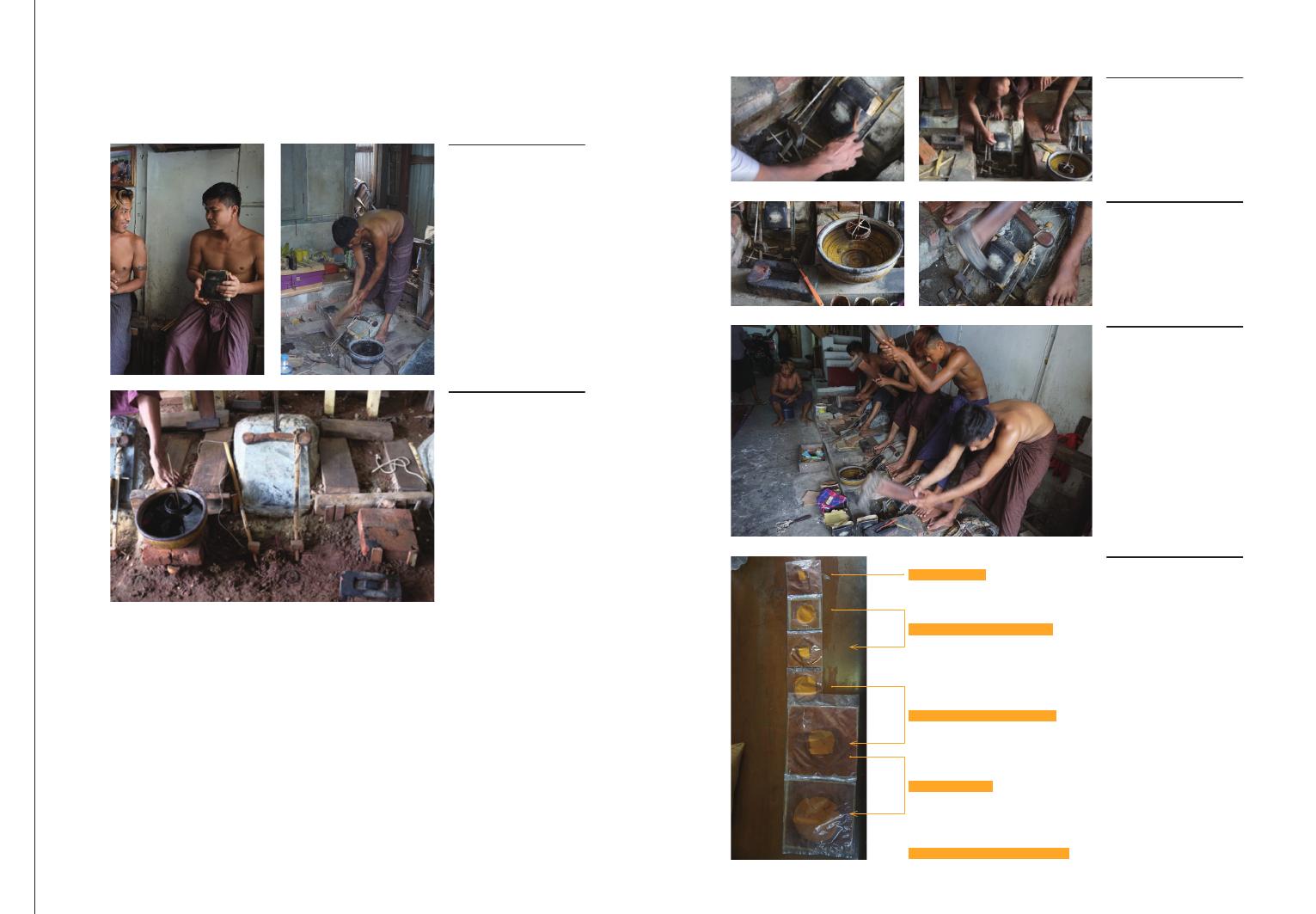
③
Beating the gold leaf
Man who makes the package and beats it is cal ed Shwe Kat. They
work with 7 pounds hammer for beating in a hot and humid climate of
Myanmar so they put only the bottoms at the workplace.
Pic 75, 76 Shwe kat
Pic 78, 79
Pic 80, 81
Pic 77
Workplace for the beating
Pic 82
Working Shwe kats (Aung
tagon)
Pic 83
Beating process
1. Beat the package of gold pieces for 3 minutes and turn it. Hit it from top
to bottom and repeat so that all sides can be beaten. (about 1 hour)
-Apply water little by little with a toothbrush during the beating to soften
the leather.
-The coconut has small hole at the bottom and sinks into the water slowly
in 3 minutes.
2. Hit everywhere to flatten the swol en paper and remove the leather.
3. Cut the large gold pieces into 1/4 and make them back for the package
again.
4. Beat it in the same way with <1> for 1 hour.
5. After beating, transfer it to a larger bamboo paper and make a package
and repeat <4> the beat it again 4 more times. (about 5 hours required)
Total 5 steps of beating for 7 hours
Apply water on leather cover
A toothbrush and Coconut timer
Mark heating point with chalk(optional)
Beating the package
A piece of ribbon
After beating, cut the leaf into 1/4
Transger to larger bamboo paper
Beat 4 more times
⇨
Total 5 steps of beating for 7 hours
28
29
Sa
ng
hy
un L
EE | J
ee
ye
on K
IM | H
ye
su P
AR
K | S
eh
ee S
O
NG
Tra
di
tional
G
old
Le
af in
M
yan
m
ar
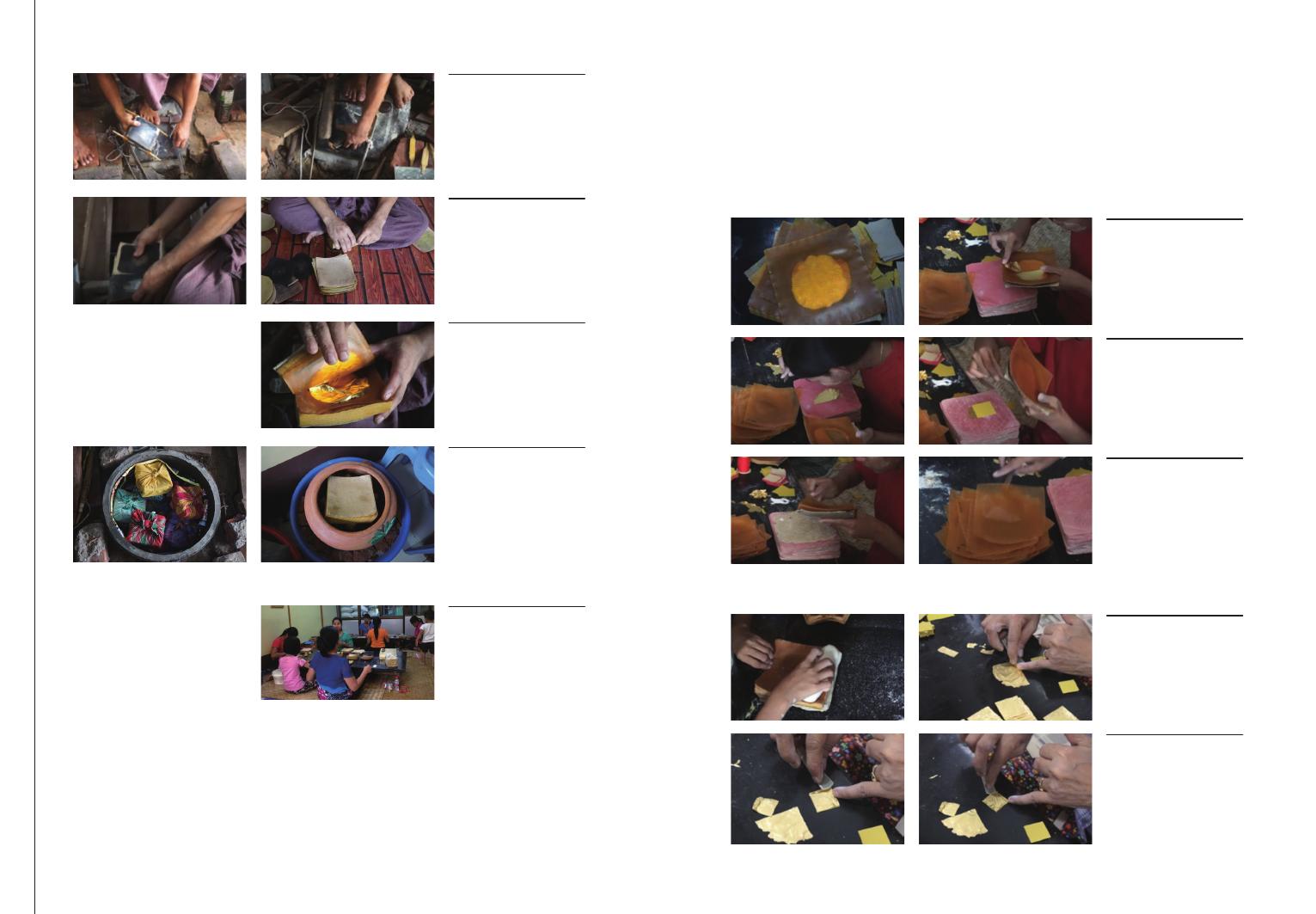
Untie the package
Untie the package
Separate the contents
Beat the everywhere with wood
Organize the bamboo papers
Pic 88
Gold leaf after the beating
Pic 89, 90 Traditional refrigeration
facilities and bamboo
papers
Pic 91
Shwe pyin
Pic 84, 85
Pic 86, 87
* The bamboo paper used
in the beating is stored in
traditional refrigeration
facilities to prevent the heat
from escaping and drying
rapidly.
Shwe pyin use the buffalo stick and lime power to handle the gold leaf.
1. Move the half size of gold leaf from the package to recycled paper
using buffalo stick.
2. Blow wind on the moved gold leaf to make smooth it.
3. Put the gold leaf on the straw paper for the package.
④
the packing
T h e p a c k a g e , w h i c h
has finished beating , is
transferred bamboo paper,
and women transfer the
d e l i ca te g o l d l e a f o nto
pieces of the straw paper,
producing ready-to-use packages for. women who pack the gold leaf
are cal ed Shwe pyin.
packing ①
Put up recycled paper
Used bamboo paper for re-use
Blow wind to put gold leaf on recycled paper
Put the straw paper for package
Gold leaf after beating
Separate gold leaf from bamboo paper
Pic 92, 93
Pic 94, 95
Pic 96, 97
Packing ②
Apply lime powder on bamboo papers
Fit the gold leaf with a buffalo stick
Pic 98, 99
In advance, put the big size of gold leaf and bring it to skil ed Shwe pyin.
4. Skil ed Shwe pyin covers the empty space of straw paper with spare
parts of gold leaf.
5. Tie the set of gold leaves with sheet of workshop’s logo and red threads.
Young girls who help the family’s work(even boys) take part with simple
work which is putting on lime powders to the bamboo papers to prevent
the gold leaf from sticking to the paper.
Move gold leaf with the stick.
Fill the holes
Pic 100, 101
30
31
Sa
ng
hy
un L
EE | J
ee
ye
on K
IM | H
ye
su P
AR
K | S
eh
ee S
O
NG
Tra
di
tional
G
old
Le
af in
M
yan
m
ar
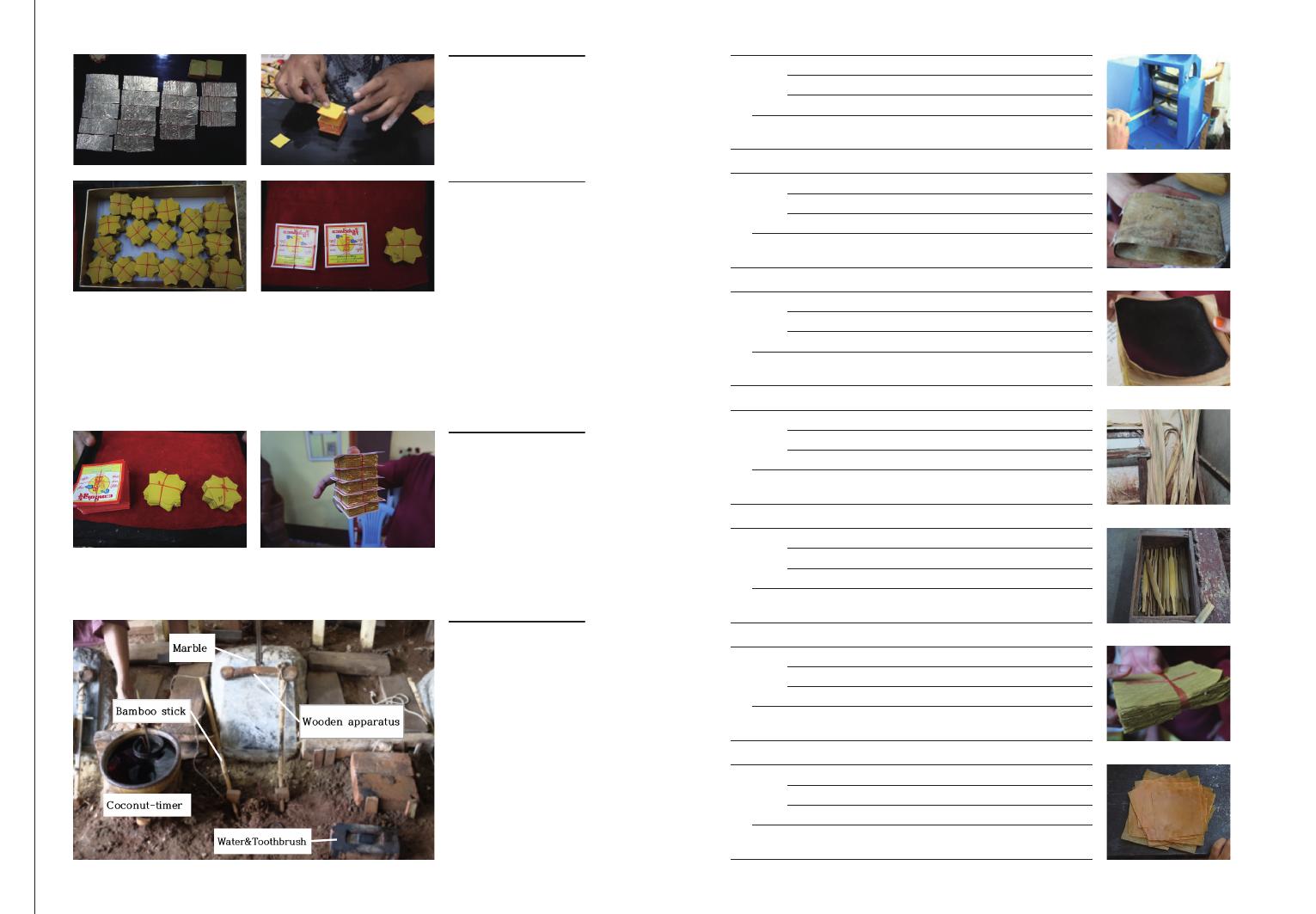
Gold leaves on straw papers
Pile the gold leaf
Pic 102, 103
The gold leaves with red thread
The product for selling
Pic 104, 105
The package
Most of workshops sell gold leaf in two ways. One is 5 sheets of gold leaf
(
5 pyar kwal) for the prayers in Pagodas and the other is a package of
100 sheets of gold leaf(yarsign) for repairing the Pagodas and gilding the
Buddha statues.
ငါးပြ ားခြ (
5 pyar kwal)
2"x2", 5 sheets of gold leaf
ရာဆိ ုင်း
(yarsign)
2"x2", 100 sheets of gold leaf
Pic 106, 107
(
4) Tools
Pic 108
Tools for beating
1
Name Korean 롤링 기계
Burmese
English Rolling machine
Feature
It stretches up the gold as 0.02mm thickness.
2
Name Korean 가죽 커버
Burmese
English Leather cover
Feature
It is made of deerskin or cowhide.
3
Name Korean 가죽
Burmese
English Leather
Feature
Cowhide, it protects gold leaves beneath.
4 Name Korean 야자수나무 잎
Burmese
English Palm tree leaf
Feature
It is used for fastenig up the package.
5
Name Korean 대나무 스틱
Burmese သစ်သးတုတ်် (Thitthar chaung / wachan pyar)
English Bamboo Stick
Feature
It fixes the package itself and is tied with wood
appratus during beating.
6
Name Korean 볏 종이
Burmese
English Straw paper
Feature
Each of 40 straw papers goes on the top and the
bottom of the gold leaves during beating for protection.
7
Name Korean 대나무 종이(죽지)
Burmese
English Bamboo paper
Feature
It keeps the gold leaves in the whole manufacturing
process and is produced in Sagaing, Myanmar.
Pi
c 1
09
Pi
c 11
0
Pi
c 111
Pi
c 1
12
Pi
c 1
13
Pi
c 1
14
Pi
c 1
15
32
33
Sa
ng
hy
un L
EE | J
ee
ye
on K
IM | H
ye
su P
AR
K | S
eh
ee S
O
NG
Tra
di
tional
G
old
Le
af in
M
yan
m
ar
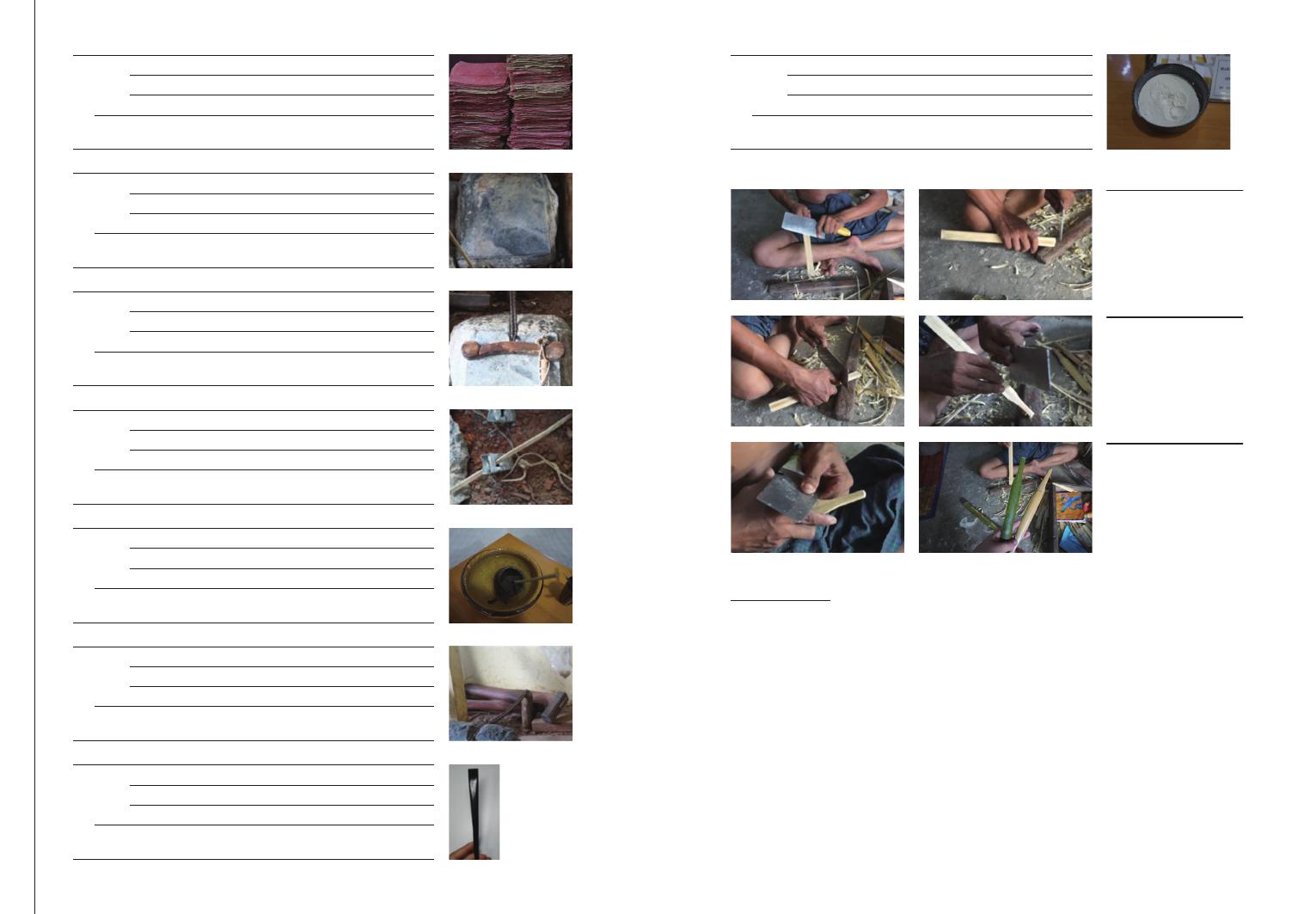
8
Name Korean 재생지
Burmese
English paper
Feature
Mixture of bamboo and other pulps, it is used for
packing.
9
Name Korean 대리석 받침대
Burmese စကျင်ကျောက် (Sajinkyut)
English Marble beating stand
Feature
The gold leaf is beaten on this marble stand, it is
trimmed by Shew kat.
10 Name Korean 나무 지지대
Burmese သစ်သား (Thitthar)
English Wood apparatus
Feature
It is instal ed on the marble stand with a chain
above to fix the package.
11 Name Korean 나무(대나무) 막대
Burmese သစ်သးတုတ် (Thitthar chaung / wachan pyar)
English Wood(Bamboo) stick
Feature
It is instal ed on the ground with a piece of metal to
fix the package and other tools for beating.
12 Name Korean 코코넛 그릇(3분 타이머)
Burmese
English 3mins coconut timer
Feature
It has a hole in the bottom and takes 3 minutes to
sink into the water.
13 Name Korean 망치
Burmese
English Hammer
Feature
7 pounds (3.2kg)
14 Name Korean 버팔로 뿔(헤라)
Burmese
English Buffalo stick(folder)
Feature
Shwe pyin’s tool, using for packing
Pi
c 1
16
Pi
c 117
Pi
c 11
8
Pi
c 11
9
Pi
c 1
20
Pi
c 12
1
Pi
c 12
2
15 Name Korean 석회 가루
Burmese
English Lime powder
Feature
It helps that the gold leaf does not stick to fingers
or bamboo papers
Pi
c 1
23
Making process for Bamboo stick
Finishing
Bamboo sticks
Marking for shaping
Shaping
Adjusting thickness
Adjusting length
Pic 124, 125
Pic 126, 127
Pic 128, 129
1. Result_ the necessity of preseving Myanmar traditional
gold leaf
In a rapidly changing society, maintaining traditional industries is
obviously difficult. Many traditional cultures around the world, including
traditional gold leaf manufacturing techniques, are easily cut off and
replaced by new technologies under the influence of modernization and
globalization. Myanmar's handmade gold leaf is also facing the same
crisis. The influx of machine gold is an example of the future changes in
Myanmar’s traditional industry. The recent economic growth in Myanmar
is also expected to continue and accelerate the crisis in the traditional
industry.
Ⅲ
Conclusion
34
35
Sa
ng
hy
un L
EE | J
ee
ye
on K
IM | H
ye
su P
AR
K | S
eh
ee S
O
NG
Tra
di
tional
G
old
Le
af in
M
yan
m
ar
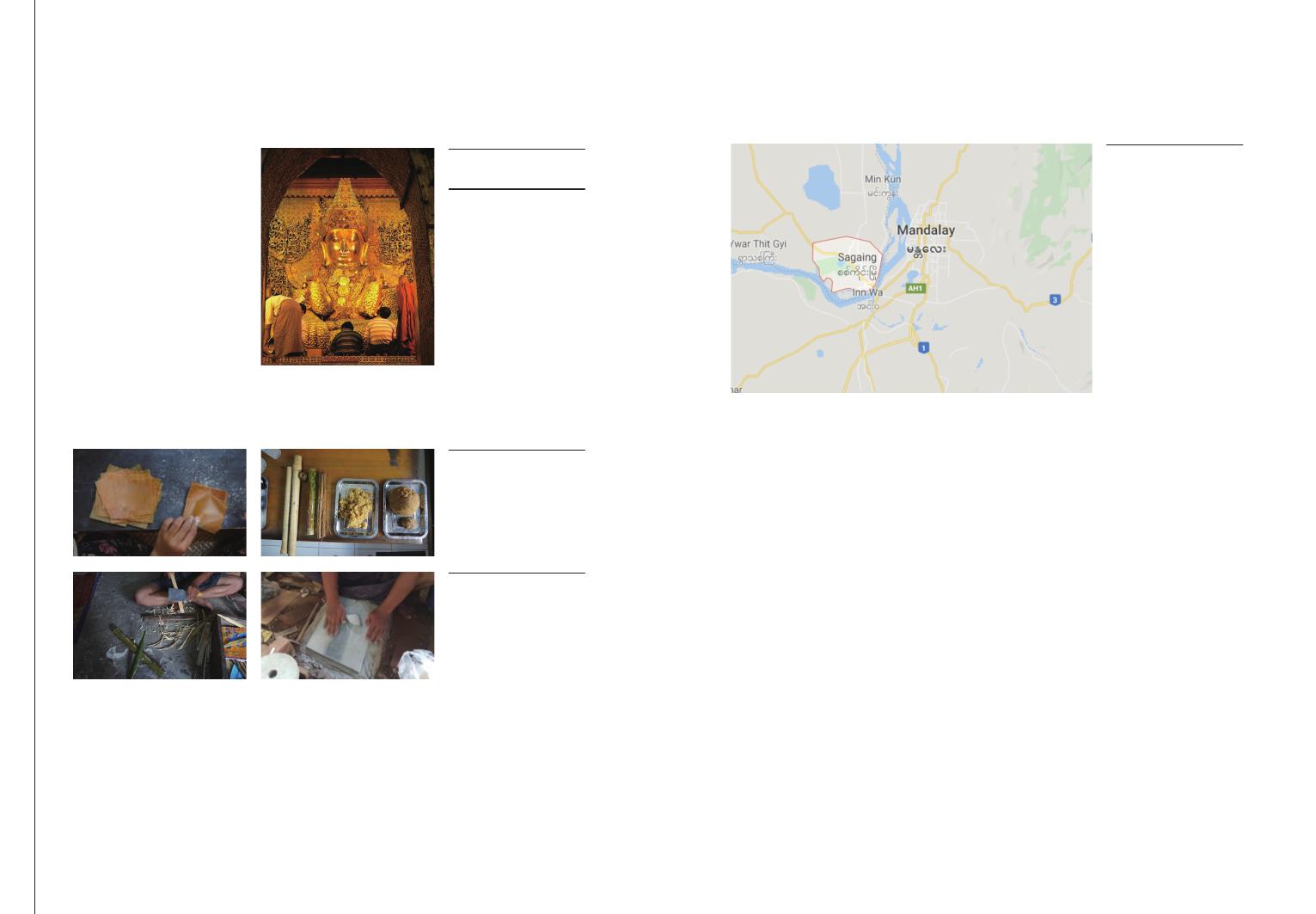
The lack of government support for the preservation of Myanmar’s
intangible cultural heritage is a problem, while following the traditional
methods of Myanmar’s gold leafing requires a lot of manpower, time and
money.
Myanmar’s traditional gold
leaf is still closely related to
the lives of Myanmarese, and
the people are more aware
of the value of traditional
gold leaf than anyone else.
But without continued efforts,
there is the possibility that it
could be forgotten. Therefore,
it is necessary to carry out
the research and detailed
record of handmade gold
leaf technique as Myanmar’s important intangible cultural heritage.
2. Future plan
Research on tools for gold leaf making
⓬
Mahamuni Buddha Temple
(
https://www.wikiwand.com/
en/Mahamuni_Buddha_
Temple)
Pic 130
Applying the gold leaves
in Mahamuni Pagoda⓬
Pic 135
Sagaing, Myanmar
Making bamboo stick
Trimming the marble
Bamboo paper
Bamboo powder and porridge
Pic 131, 132
Pic 133, 134
Tools, such as Bamboo paper, Straw paper, Bamboo stick etc., used for
gold leaf making, these are also handmade and traditional. In order to
understand the gold leaf making process, it is necessary to leave the
record of tools.
Especially, as numerous bamboo papers are used in the making
process, bamboo paper will be a subject of research for the next step.
It is produced and distributed from Sagaing, Mynamar. Although the
bamboo paper is known as Chinese traditional paper, it is also the main
source of many paper relics found in Korea today. Therefore, it is deemed
necessary to study the process and the features of the bamboo paper
made in Myanmar.
3. Conclusion and Application
Demand for gold leaf to repair many pagodas in Myanmar will be
continued. While some say the machine-made gold leaf cannot replace
the handmade gold leaf, it is highly likely that the machine-made
gold leaf will gain the upper hand due to Myanmar's market-opening
and economic growth. This is in light of the fact that the technique for
traditional gold leaf has been virtually cut off in Korea and the machine-
made gold leaf is used for traditional crafts.
In Myanmar, however, gold leaf is not just a decorative material. Pagoda,
used most of gold leaves, is authorized by its trustee to decide on how
to preserve Pagoda. And the residents around Pagoda are obliged to
donate money to buy gold leaf each year. That means, the gold leaf in
Myanmar is not only for decoration, bus it also reflects the nation's care
for the tradition and the culture.
As a result, the influx of machine gold is slowing down, but without efforts
to preserve the craftsmanship, Myanmar’s gold leaf will eventual y
disappear into the back of history. Therefore, the original technique
of handmade gold leaf is intangible cultural heritage as a valuable in
Myanmar and it needs records and preservation.
Lastly, by archiving on handmade gold leaf techniques based on a
survey conducted in Mandalay, the research data will be used for the
36
37
Sa
ng
hy
un L
EE | J
ee
ye
on K
IM | H
ye
su P
AR
K | S
eh
ee S
O
NG
Tra
di
tional
G
old
Le
af in
M
yan
m
ar

restoration of the original technique for gold leaf making in Korea and be
organized into basic data to preserve and restore the craft techniques
for traditional painting and textile.
Pic 136
Pic 137
Shedagon Pagoda(left)
Mahamuni Pagoda(right)
38
Sa
ng
hy
un L
EE | J
ee
ye
on K
IM | H
ye
su P
AR
K | S
eh
ee S
O
NG
Tra
di
tional
G
old
Le
af in
M
yan
m
ar

4. References
♦
Book
♦
Acedemic Thesis
♦
Report
♦
Online Article
♦
Webpage
1. Yeonok Sim. GeumBak Jang. n.p.: MINSOKWON, 2009.
2. Committee on the compilation of the Metallic Terminology
Dictionary. the Metallic Terminology Dictionary. n.p.:
Sungandang, 1998.
3. Yeonseon Park, (A) dictionary of Color, YeLim,2007
4. Hoyeol Song, (A) dicionary of world names of places, Sungji
Moonhwa,2006
5. Wonyong Kim,The Scythian gold from the Hermitage, Chosunilbo,
1991
1. Gwangsun Paik, A Study on Geumbak and Geumbakjang's
Manufacturing Techniques in the Joseon Dynasty, 2015
2. Jungmi Kim. "A study of gold applied in the fabric." M.A. degree,
Graduate school of Ehwa Womans University, 2001.
3. Ina Kim. "Myanmar Lacquerers: Their Historical Tradition and
Sociocultural Meanings." The Southeast Asian Review 20
no.1 (2010): 181-210.
1. Heejin Kim. "金箔匠(GeumBak Jang)." Intangible Cultural Properties
Survey Report96 (1972)
2. National Research Institue of Cultural Heritage. Revializing
Korean Cultural Heritage around the World, Selected
Reprots on Overseas Korean Col ection Conservation
Projects. n.p.: National Research Institue of Cultural
Heritage
1. "Gold leaf peeled off from Gilt-bronze Buddha of Goryeo, broken
glass of Silla… Regeneration in Cultural Properties
Surgery Room." The Dong-A Ilbo. last modified n.d.,
accessed Dec ,2019, http://www.donga.com/news/
article/all/20190612/95949432/1.
2. “A family of Gold leaf for 5 generation…Took care of the first lady’s
Hanbok”The Chosunilbo. last modified n.d., accessed
Dec ,2019, http://news.chosun.com/site/data/html_
dir/2017/09/29/2017092900216.html
3. “Go to Myanmar, a country of golden fire pagodas” bulgyo , last
modified n.d., accessed Dec ,2019, http://www.ibulgyo.
com/news/articleView.html?idxno=95741
4. “History and Status of Buddhism in Myanmar”,The Buddhist
Review,last modified n.d.,accessed Dec ,2019, http://www.
budreview.com/news/articleView.html?idxno=1774
5. “the Essence of Baekje Craftsmanship… Gongju Sukchon-ri
Ancient Tombs-Gun gold Earrings” Chungcheong
Today, last modified n.d.,accessed Dec ,2019, http://www.
cctoday.co.kr/news/articleView.html?idxno=2038622
6. “Gold leaf making business faces competition, disruption.”
MYANMARTIMES,last modified n.d.,accessed Dec ,2019,
https://www.mmtimes.com/news/gold-leaf-making-
business-faces-competition-disruption.html
7. “Mandalay’s Handmade Gold Leaf Industry Under Threat”The
Irrawaddy, last modified n.d.,accessed Dec ,2019, https://
www.irrawaddy.com/features/mandalays-handmade-
gold-leaf-industry-threat.html
1. "Col ection Database." National Museum of Korea. last modified
n.d., accessed Dec ,2019, http://www.museum.go.kr/site/
eng/relic/recommend/list.
2. "EXHIBITIONS& COLLECTIONS." National Palace Museum of Korea.
last modified n.d., accessed Dec ,2019, https://www.
gogung.go.kr/appointList.do?pLng=en.
3. "Textbook Information Integration Services." National Research
Institue of Cultural Heritage. last modified n.d., accessed
Dec ,2019, http://portal.nrich.go.kr/kor/originalUsrView.
do?menuIdx=1046&info_idx=2148&bunya_
cd=409&report_cd=387.
4. "Republic of the Union of Myanmar." doopedia. last modified n.d.,
accessed Dec, 2019, http://www.doopedia.co.kr/
doopedia/master/master.do?_method=view&MAS_
IDX=101013000737868.
5. "The Republic of the Union of Myanmar." MInistry of Foreign Affairs.
last modified n.d., accessed Dec ,2019, http://www.mofa.
go.kr/www/nation/m_3458/view.do?seq=16.
6. "Gold leaf artisan Kim Deok-hwan." Korea Cultural Heritage
Foundation. last modified n.d., accessed
Dec ,2019, https://www.chf.or.kr/c2/sub1.
jsp?brdType=R&bbIdx=100277.
7. Cheongnyongsa shin jung do, encyclopedia of korean culture.
last modified n.d., accessed Dec ,2019, http://encykorea.
aks.ac.kr/Contents/Item/E0075530.
8. "A washout ceremony in The Buddhist Statue of Mahamuni
Temple ." EBS Clip Bank. last modified n.d.,
accessed Dec ,2019, https://clipbank.ebs.co.kr/clip/
view?clipId=VOD_20170910_00125.
9. "Intangible Cultural Heritage: Sustainability for Traditional Gold
Leaf Industry of Myanmar." The Republic of The Union
of Myanmar Ministry of Information. last modified
n.d., accessed Dec ,2019,https://www.moi.gov.mm/
moi:eng/?q=content/intangible-cultural-heritage-
sustainability-traditional-gold-leaf-industry-myanmar.
41
40
Sa
ng
hy
un L
EE | J
ee
ye
on K
IM | H
ye
su P
AR
K | S
eh
ee S
O
NG
Tra
di
tional
G
old
Le
af in
M
yan
m
ar
Survey of Weaving
Technique on
the Vietnam Border Region
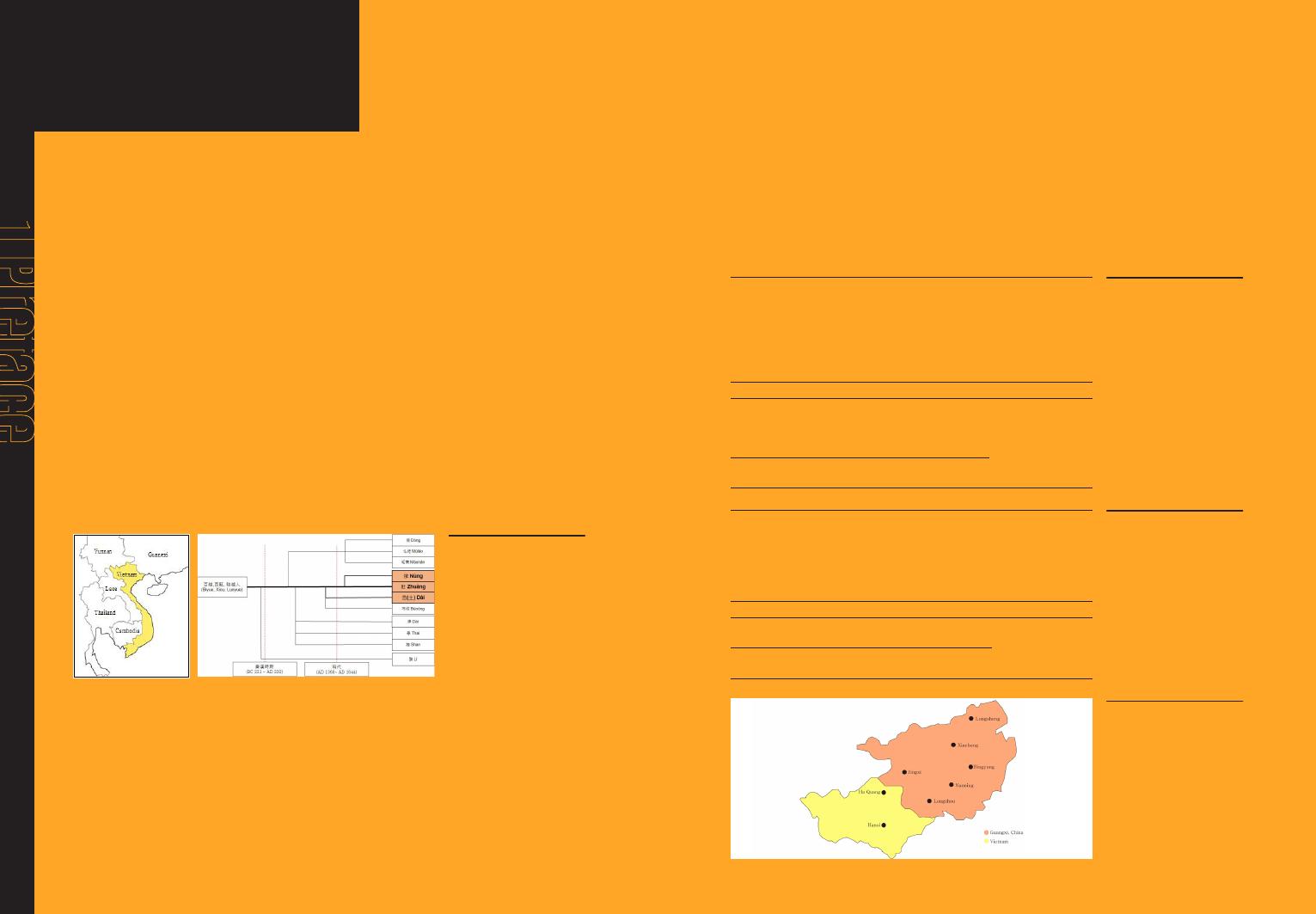
Vietnam shares a borders with China, Laos, Cambodia.<Pic. 1>. Because
these countries are composited by several minorities, they has a various
cultures for each minorities. Especial y in Vietnam, there is a 54 minorities.
Among them the Tay[傣] peoples has composed 3.8% of whole population
on Vietnam, and they are most popular peoples among a minorities.
Because Vietnamese geographical feature is long, the cultures of a North,
Middle and South has a different features. And the almost Tay is living on
the Northern Vietnam.
Vietnamese Tay and Nuong[侬] peoples has been known a branch of
Zhuang[壯] peoples which is based on the Baiyue[百越], Xiou[西甌], Luoyue[駱
越
]<Pic 2>. And because Tay, Nuong, Zhuang peoples is belong to Zhuang-
Tay Languages, they are using a similar languages. Chinese Zhuang
peoples is most popular minorities on China, and almost of them are
living in the Guangxi province where share a border with Northern
Vietnam.
KNUCH, Dept. of Traditional Arts and Crafts,
Graduate School
Prof. Yeon Ok Sim
Senior Researcher. Sun Yong Lee
Researcher. Geun Il Park
Researcher. Ji Hee Roh
Pic 1
Pic 2
(
left) Neighborhood of
Vietnam
(
right) Branches of Zhuang
Pic 3
Survey Regions of Vietnam,
China
Vietam Tay has weaved a Tho Cam, and Chinese Zhuang has weaved a
Zhuangjin[壯錦]. These two textile is weaved by using vivid coloured yarns,
and the patterns which is presented on them are based on geometric
and flower patterns. Especially the Zhuangjin of Chinese zhuang peoples
is one of the 4 best silks of China with Nanjing-Yunjin(南京雲錦), Chengdou-
Shujin(成都蜀錦), Suzhou-Songjin(蘇州宋錦). Among the 4 best silks, the
Zhuangjin is the only textile which is made by minorities. Because of this
reason, Zhuangjin is very valuable on the textile histories.
1. Index and Schedules of Survey
Even a names and countries of Zhuang and Tay peoples has changed,
they has same origin. Because of these reasons, survey has aimed these
two peoples. The survey regions are Cao bang where Tay people is living
and Guangxi where is sharing border with Vietnam. This Survey is for the
weaving techniques of Tho Cam and Zhuangjin of Vietnam and China.
The survey was progressed on two times, August and November, for each
countries<Table 1-2>. It is the particular regions of survey that 6 cities of
Guangxi of China, 2 cities of Hanoi and Cao bang of Vietnam. This survey
is focused on the weaving techniques and looms, kind of textiles.
▪
Object : Chinese Zhuangjin of Zhuang Peoples
▪
Date : 2019. 08. 19(Mon) ~ 2019. 08. 28(Wed)
Guangxi province, China(中國 廣西省)
▪
Method : Interview, Practice, Taking a Photo. etc
▪
Subject : Major of Traditional Textile, KNUCH
Sim Yeon Ok(Professor)
Lee Sun Yong, Park Geun Il, Roh Ji Hee(Researcher)
Contents
Objects
1 Loom Types
• Zhulongji of Nanning,
Xincheng, Binyang
• Loom of Jingxi
• Loom of Longzhou
• Several Workshops
and Museum
2 Zhuangjin Weaving
Technique
• Materials and Tools
• Weaving Technique
Table 1
Index of Survey - 1st Servey
Table 2
Index of Survey - 2nd
Servey
▪
Object : Vietnamese Tho Cam of Tay Peoples
▪
Date : 2019. 11. 20(Wed) ~ 2019. 11. 26(Tue)
▪
Method : Interview, Practice, Taking a Photo. etc
▪
Subject : Major of Traditional Textile, KNUCH
Sim Yeon Ok(Professor)
Lee Sun Yong, Park Geun Il, Roh Ji Hee(Researcher)
Contents
Objects
1 Vietnamese
Minorities
• Vietnam Ethnic Museum
• Several Workshops
and Museum
2 Tho Cam Weaving
Techniques
• Luong noi vil ages, Ha quang,
Cao bang, Vietnam
43
42
1. Tho Cam of Vietnamese Tay
Tay, Nunog, Zhuang is a branch which is originated from Baiyue, Xiou,
Luoyue. Practically, the traditional costume of Tay, Nuong, Zhuang is
very similar, and even they are located on differnet countries, they are
very close. Recently, the region where is weaving a Tho Cam by using
traditional way is Luong Noi village, Ha Quang, Cao Bang, Northern
Vietnam. This vil age is very close with Chinese border.
The favorite pattern of Tay people is a flower. Occasionally, animal
pattern was weaved but there is no many crafter who can weave the
animal pattern these days. The way which is composing pattern of Tho
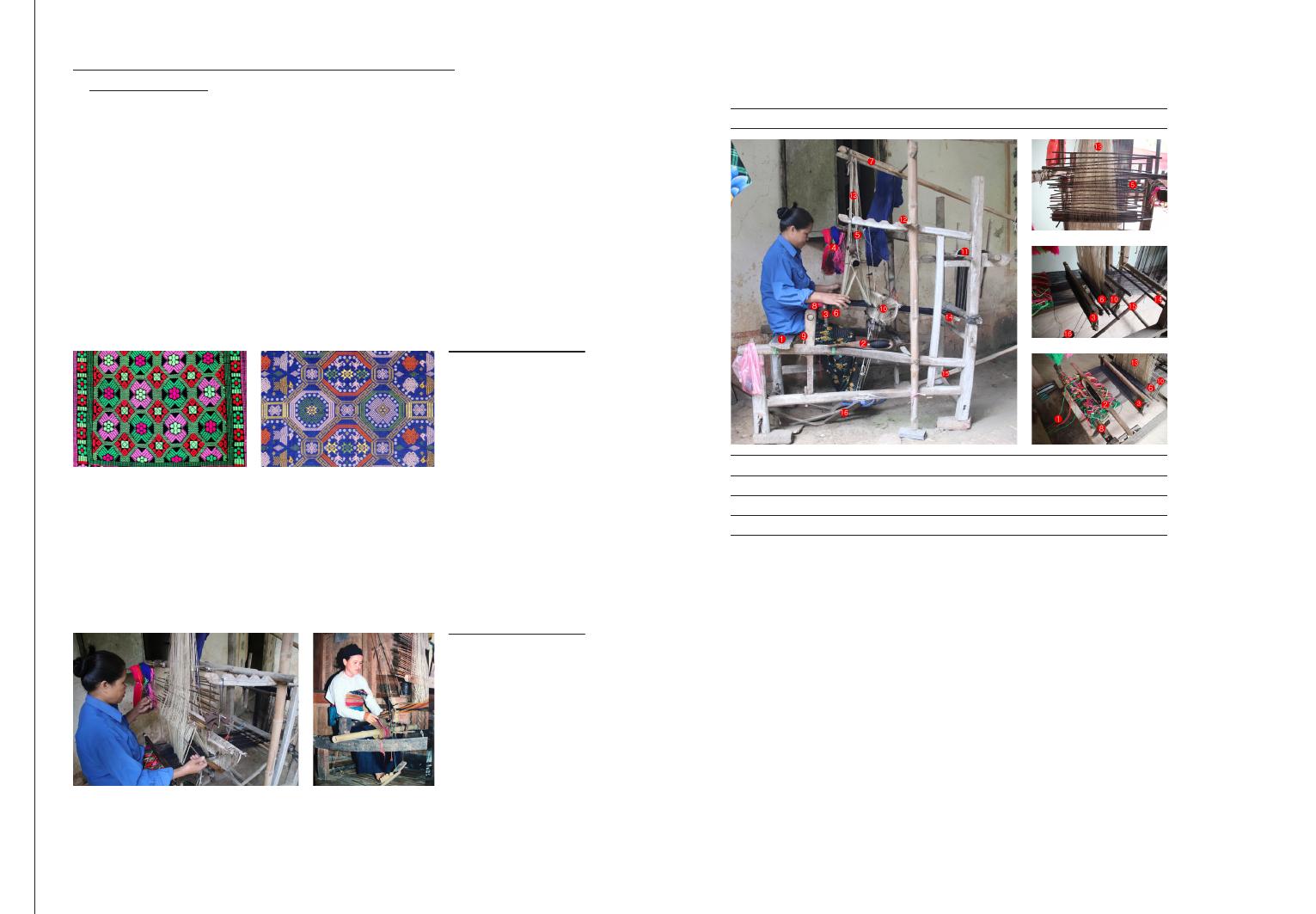
Cam<Pic 4> and Zhaungjin<Pic 5> is very similar.
This Vietnamese traditional Tho Cam weaving is passing down only in
Luong Noi village, Ha Quang, Cao Bang, Northern Vietnam. Ha Qunag Tho
Cam Loom is a one-person pattern loom<Pic 6>. The structure of loom is
similar with Nuong<Pic 7>. These two types of looms is saving a patterns
on the heald yarns by using a bamboo. The heald yarn is used to weave
patterns. If the pattern is getting more complex, the number of bamboo
is increasing.
Ⅱ
The Survey and Features of Traditional Textiles on
Vietnamese Tay
Pic 4
Pic 5
(
left)Vietnamese Tho Cam
(
right)Chinese Zhuangjin
Pic 6
Pic 7
(
left)Loom of Tay
(
right)Loom of Nuong
2. How to Weave of Tho Cam Loom
1) Names
Name
Tho Cam Loom of Luong Noi
Location
Luong Noi, Ha Qunag
1 ghế
2 con thoi
3 vùng
4 sợi len
5 hoa vặn
6 pan
7 cáp rạp
8 rằm vặn
9 khắt
10 khau tắm
11 cóc nạc
12 ngọc ngạch
13 khau sung
14 ghặt ghèo
15 đôi gua
16 đôi guốc
2) Structure and Principle
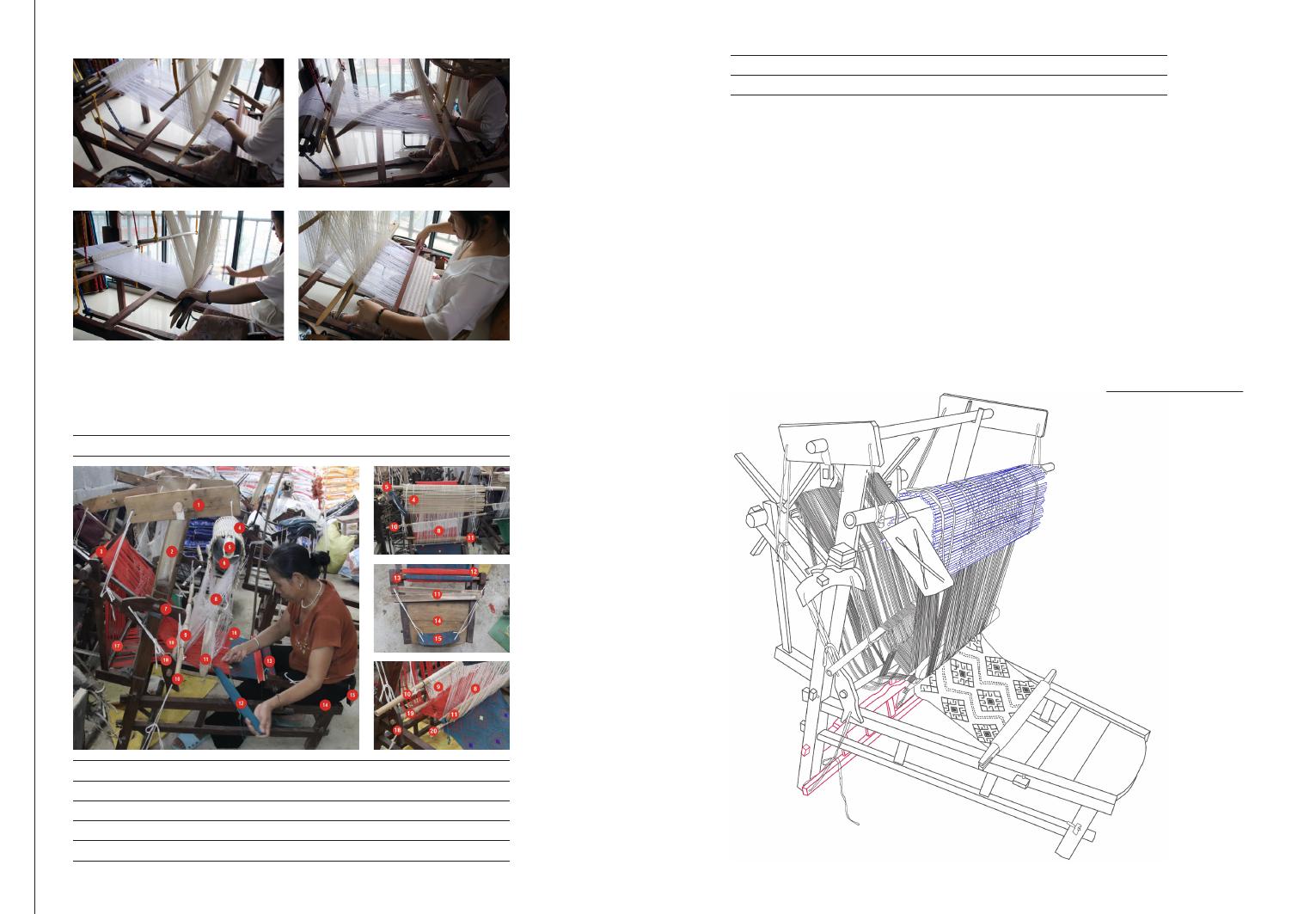
Actual y, Tho Cam means a Vietnamese textile crafts, but the textile
which is weaved in Luong Noi vil age is also cal ed Tho Cam. On the loom
which is weaving a Tho Cam is instal ed 2 khau tắm(healdes of structure)
and 1 Hwabon which is structure to weave pattern<Pic 8>. This Hwabon
is constructed with khau sung and hoa vặn(the bamboo stick), and the
form of Hwabon is that hoa vặn is mounted on khau sung in accordance
with pattern. A cylinder shaped bamboo which is installed between a
khau sung makes a hoa vặn in order. And it can make a pattern repeat
by moving a hoa vặn from back to front or from front to back.
2 treadles is instal ed to each khau tắm. A đôi gua, long bamboo made
treadle is instal ed between the treadles. This đôi gua is related in V
shaped cáp rạp which lift the khau sung. When crafter want to weave a
pattern, the crafter make a place to put a yarn by lifting a khau sung by
using the đôi gua.
44
45
Su
rv
ey o
f W
ea
vin
g T
ec
hn
iq
ue o
n t
he V
ie
tn
am B
ord
er R
eg
io
n
Ye
on O
k S
im | S
un Y
on
g L
ee | G
eu
n I
l P
ar
k | J
i H
ee R
oh
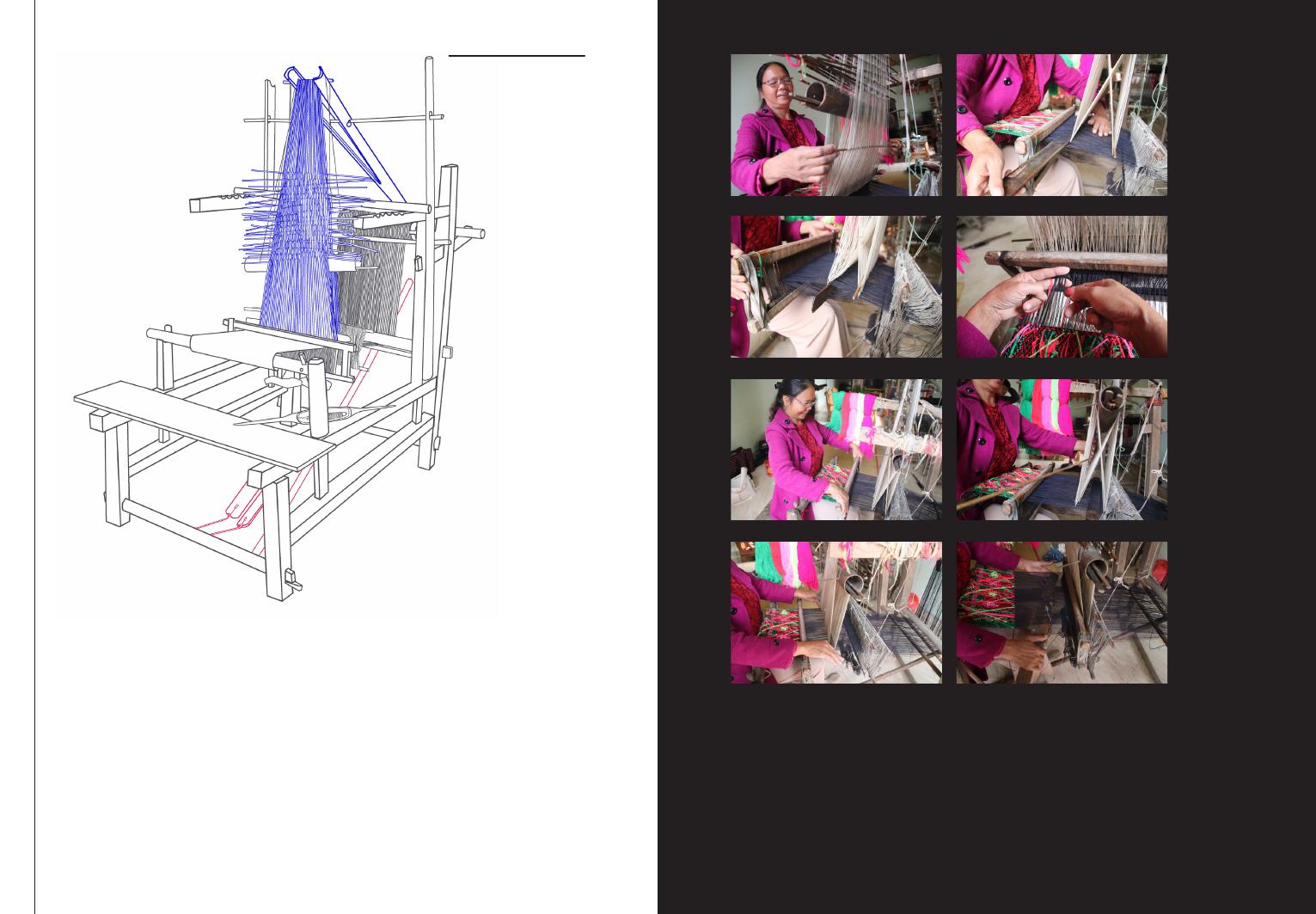
Pic 8
Tho Cam Loom
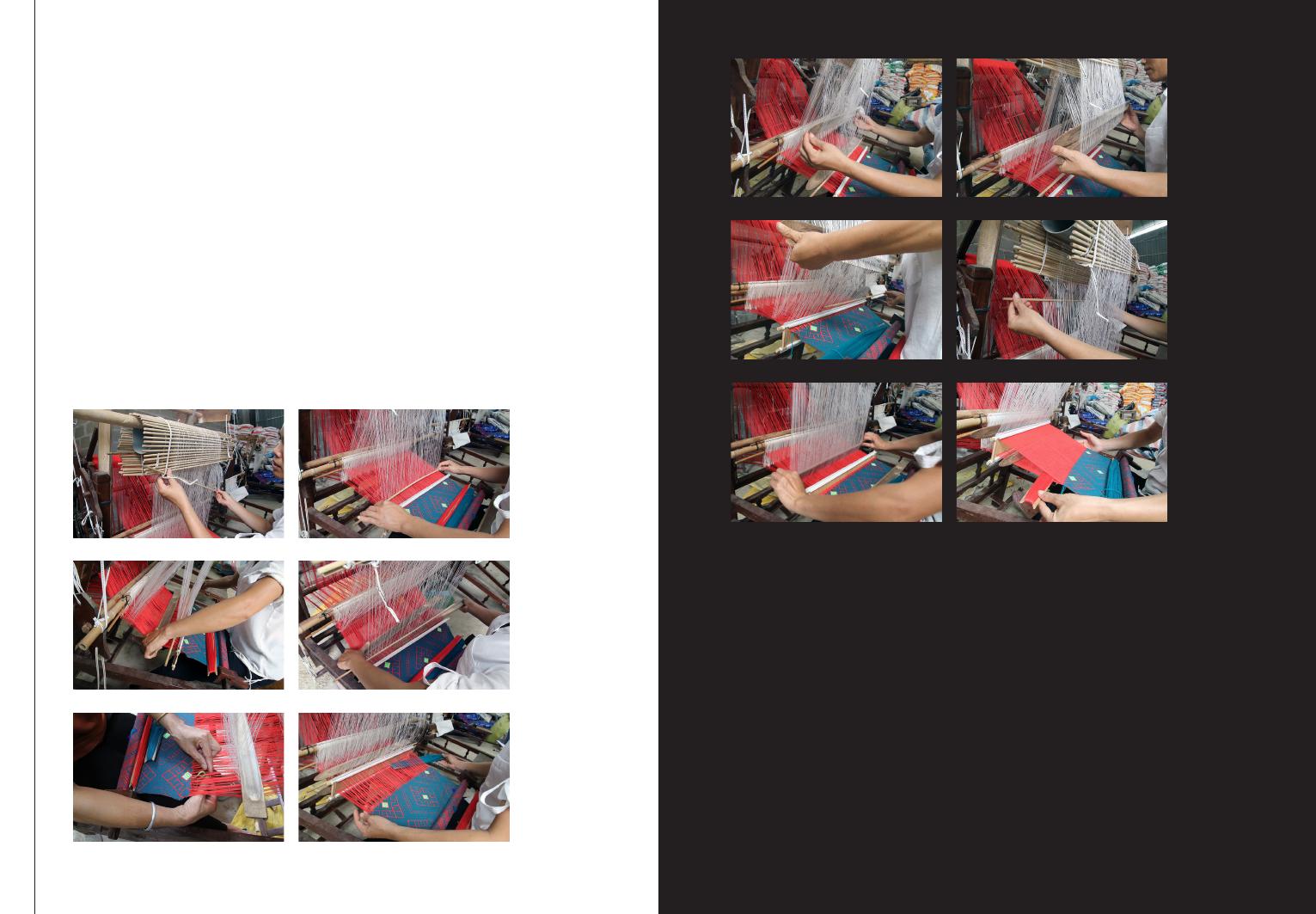
3) Weaving Procedure
1. To take a hoa vặn down and arrange a khau sung.
2. To lift a warp by treading a đôi gua and put a pan in.
3. To make space of warp wider by standing a pan
and put a yarn by using hand.
4. To put hoa vặn off and put it in front and arrange
a khau sung by using a pan.
5. To lift a warp according to structure
by treading a đôi guốc, put a structure weft yarn in.
Taking a hoa vặn down
Putting a pan in
Making space by standing a pan
Putting pattern weft yarn in
Heating a textile by using a vùng
Putting a hoa vặn in front
Arranging a khau sung by using a pan
Putting structure weft yarn
47
46
Su
rv
ey o
f W
ea
vin
g T
ec
hn
iq
ue o
n t
he V
ie
tn
am B
ord
er R
eg
io
n
Ye
on O
k S
im | S
un Y
on
g L
ee | G
eu
n I
l P
ar
k | J
i H
ee R
oh
1. Zhaungjin of Chinese Zhuang
The Zhuangjin of Guangxi province was a gift for the Emperor. Because it
is still remained of the Beijing’s palace museum, it show us the excel ent
weaving techniques. Zhuangjin was not only a gift for the Emperor, but
also it is used in normal life of normal peoples.
Zhuangjin has been very famous for their durability and elaboration,
unique and beautiful pattern. The technique of Zhuangjin weaving has
long history, and it is designated for intangible cultural national heritage
in China at 2006.
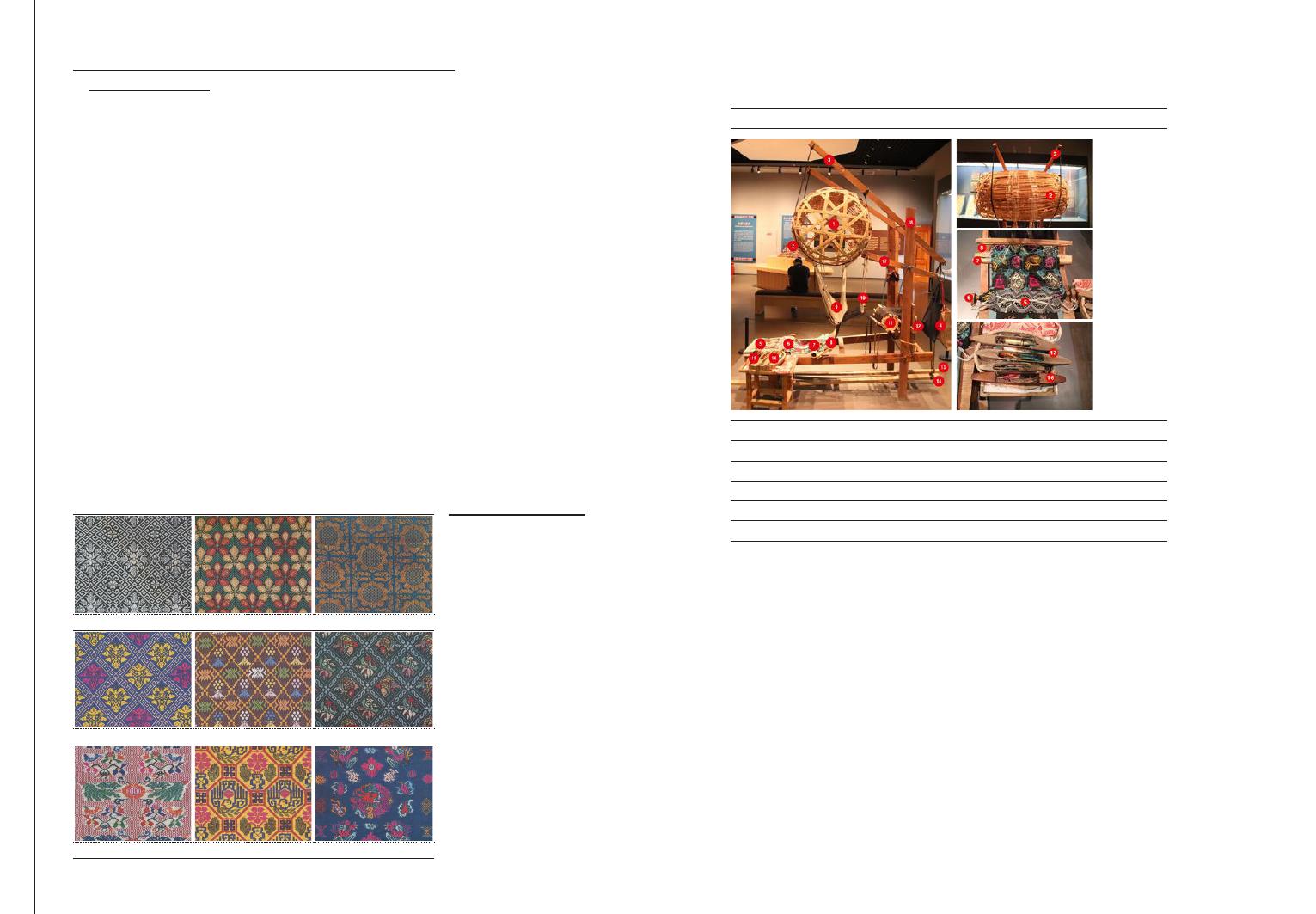
At present, there is 3 types of loom which is used to make Zhuangjin, and
this is differently used in each regions. In Nanning[南寧市], Xincheng[忻成
縣
], Binyang[宾阳縣], Zhulongji[竹籠機] which is most famous Zhuangjin loom
is used. But in Jingxi[靖西縣], Longzhou[龙州縣], they has different types of
looms for each regions. The material which has been mainly used is
ramie[麻], cotton[綿] for weft, and silk[絹] for weft, but recently, it is changed
to use a cotton for weft, silk for warp. The vivid and fancy coloured weft is
the feature of Zhuangjin. The pattern of Zhuangjin is basis on geometric
pattern and mixed with several patterns like plant or animals as main
pattern<Table 3>.
Ⅲ
The Survey and Features of Traditional Textiles on
Chinese Zhuang
Ear
Japanese apricot flower
Sunflower
Butterfly
Flower and Butterfly
Fish
Lion
Phoenix
Dragon
Table 3
The Patterns of Zhuangjin
2. How to Weave of Tho Cam Loom
1) Names
Name
Zhulongji
Location Guangxi Museum of Nationalities
1
Zhulong(竹籠)
2 Pianhuazhu(編花竹)
3 Huadiaoshou(花吊手)
4 Zhongchui(重錘)
5 Yaodai(腰帶)
6 Budouzhou(布頭軸)
7 Fenjingtong(分經筒)
8 Zhukou(竹筘)
9 Gaozengxian(高綜線)
10 Aizengxian(矮綜線)
11 Zhongtong(中筒)
12 Quanjingshajidou(卷經紗機頭)
13 Huacaijiao(花踩脚)
14 Shacaijiao(紗踩脚)
15 Rongsuo(絨梭)
16 Shasuo(紗梭)
17 Shadiaoshou(紗吊手) 18 Zengshaliang(綜線梁)
2) Structure and Principle
Zhulongji is typical Zhuangjin loom which weave pattern by installing
Zhulong(竹籠)<Pic 9>.
Hwabon is installed on Gaozengxian(高綜線) by
using a Pianhuazhu(編花竹). After Gaozengxian is hanged on Zhulong,
the
Hwabon is completed by inserting a Pianhuazhu to Gaozengxian
according to a textile pattern. A size of Zhulong is depending on a size
of textile pattern. If a 1 repeat pattern getting bigger, the number of
Pianhuazhu is also getting bigger and the size of Zhulong is getting wider.
In Zhulongji, there is 2 treadles, the one is connected with Shacaijiao(紗
踩脚)
which is instal ed with structure headles and the other one is
connected with Huacaijiao(花踩脚) which is installed with Zhulong.
Zhongchui(重錘) is hanged behind of this loom, It is connected with
Zhulong, and help to maintain a tension by their weight.
48
49
Su
rv
ey o
f W
ea
vin
g T
ec
hn
iq
ue o
n t
he V
ie
tn
am B
ord
er R
eg
io
n
Ye
on O
k S
im | S
un Y
on
g L
ee | G
eu
n I
l P
ar
k | J
i H
ee R
oh
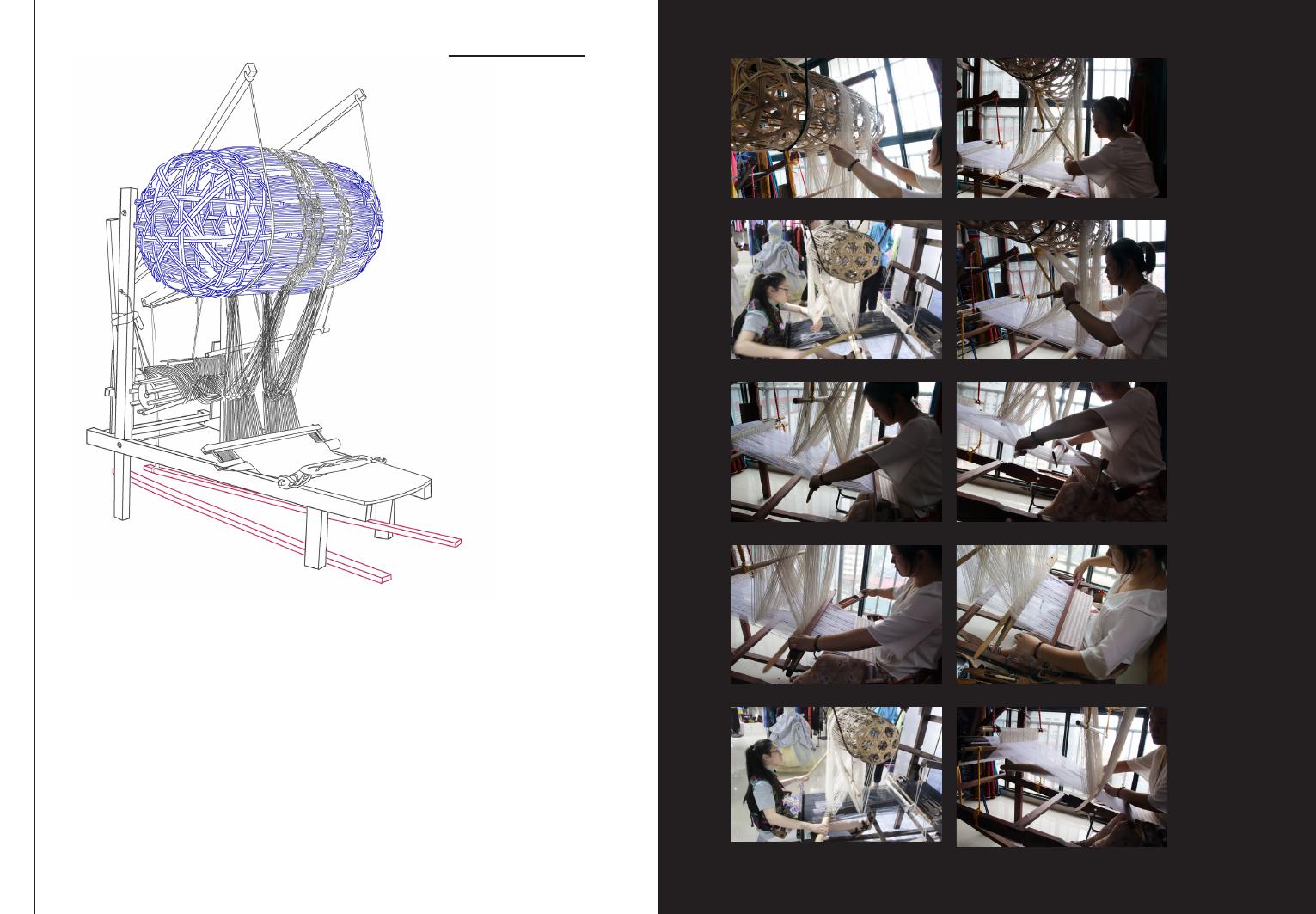
Pic 9
Zhulongji
3) Weaving Procedure
1. To take front Pianhuazhu down and arrange Gaozengxian
by using Pianhuazhu.
2. To put Bamboo stick in a space between Gaozengxian and
insert to behind Zhulong.
3. To tread Huacaijiao which is connected with Zhulong.
4. To push a Bamboo stick which is put and insert a Fenjingtong(分經筒)
in the space.
5. To let a Zhukou(竹筘) go back and insert a weft yarn.
6. To arrange a weft yarn by using Zhukou(竹筘).
7. To pull Bamboo stick out and put in space between Gaozengxian,
get rid of Fenjingtong.
8. To tread a treadle which is connected with Aizengxian(矮綜線)
and put weft yarn in.
Putting Pianhuazhu down
Arranging a Gaozengxian
Putting bamboo stick
Sending Pianhuazhu back
Make a space by using bamboo stick
Putting a Fenjingtong in the space
Putting a pattern-weft
Using Zhukou
Pulling bamboo stick out
Pulling Fenjingtong out
51
50
Su
rv
ey o
f W
ea
vin
g T
ec
hn
iq
ue o
n t
he V
ie
tn
am B
ord
er R
eg
io
n
Ye
on O
k S
im | S
un Y
on
g L
ee | G
eu
n I
l P
ar
k | J
i H
ee R
oh
Treading a Shacaijiao(紗踩脚)
Maintaining space by using Fenjingtong
Putting structure weft in
Using Zhukou
3. How to Weave of Longzhou Loom
1) Names
Name
Zhuangjin Loom of Longzhou
Location Zhuangjin Association of Longzhou
1
Tapa(擺杆)
2
Tangmai(機架)
3 Kouhuaki(卷經軸)
4 Erei(編花竹)
5 Koushui
6 Tangrou
7
Nouke(提綜擺杆)
8 Gongxian(高綜線)
9 Muxian(矮綜線)
10 Kouten(矮綜軸)
11 Pan(壓花尺)
12 Tuim(絲梭)
13 Syampan(布頭軸)
14 Tuinang(座板)
15 Tablang(腰帶)
16 Syengpenglu
17
Huengchuk(橫軸)
18
Hwalgan(活杆)
19
Apgyunggan(壓經杆)
20 Iyepom(竹筘)
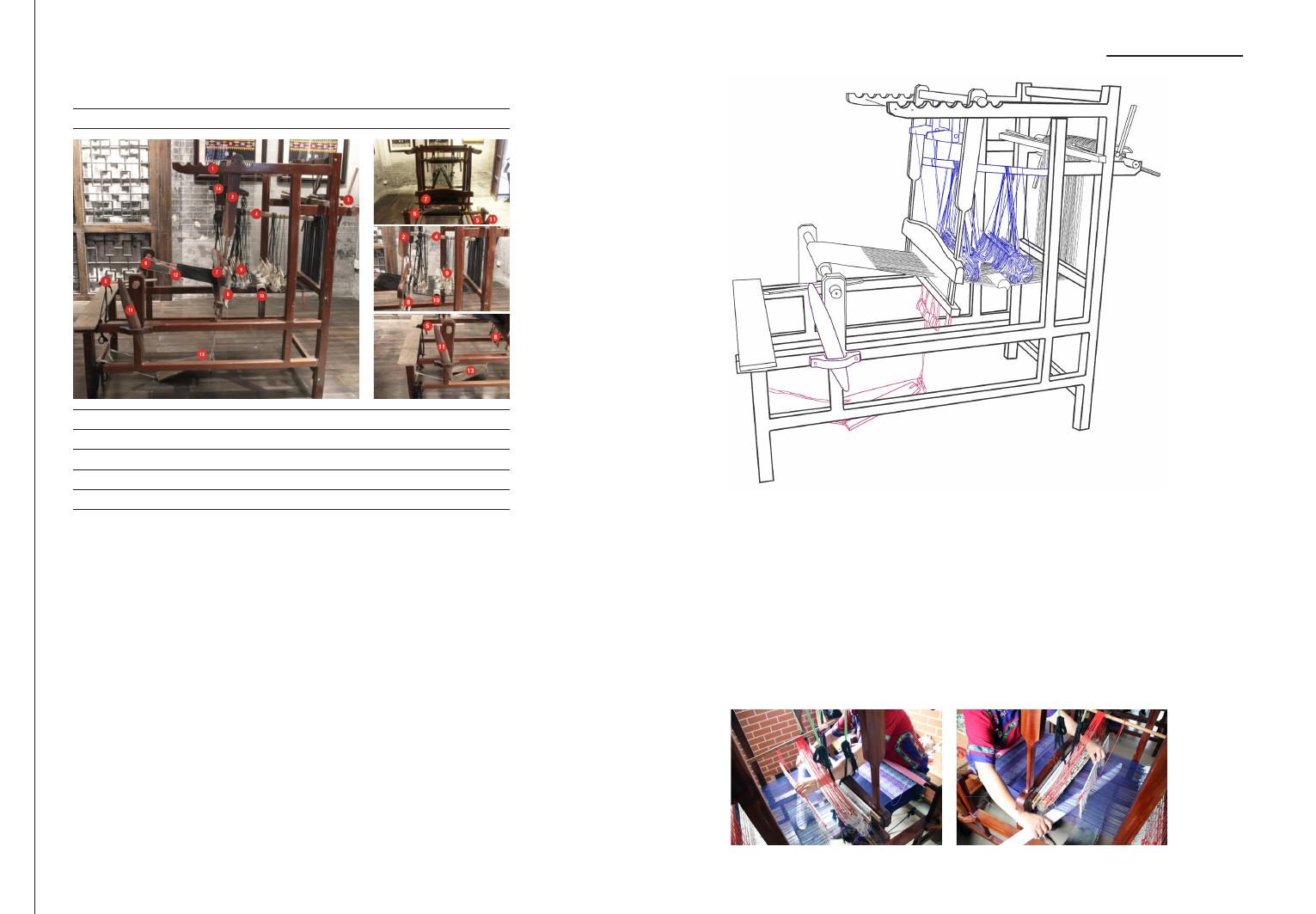
2) Structure and Principle
In Longzhou loom, instead of Zhulong, Tangrou which is cylinder shaped
Hwabon is instal ed to weave textile<Pic 10>. because Hwabon is repeated
on the basis of tangrou which is hanged on Koushui itt is called to
circulation type Hwabon[環式花本]. Seating on a seating board, Hwabon is
designed on Gongxian[高綜線] by using a Erei[編花竹] on the spot.
Nouke[提綜擺杆] which is hanged on Tangmai[機架] is related on
Hwalgan[活杆] and Muxian[矮綜線]. When crafter tread a treadle, Kouten[矮
綜軸
] which is connected with Hwalgan[活杆] is getting down put warp
down, and Muxian[矮綜線] which is connected with Nouke[提綜擺杆] is
lifted, it makes space between a warps. When crafter weave pattern, the
crafter makes space by using a 2 Pan which is made by split bamboo.
Pic 10
Longzhou Loom
52
53
Su
rv
ey o
f W
ea
vin
g T
ec
hn
iq
ue o
n t
he V
ie
tn
am B
ord
er R
eg
io
n
Ye
on O
k S
im | S
un Y
on
g L
ee | G
eu
n I
l P
ar
k | J
i H
ee R
oh
3) Weaving Procedure
1. To put Erei which is located on front side down.
2. To arrange Gongxian by using Erei.
3. To put a Pan behind Gongxian and push to arrange a warp.
4. To put another Pan to space where is made on the situation 3,
and maintain the space and the make space wider by using Iyepom[竹筘].
5. When crafter weave brocade structured pattern, lifting a warp
by using hands, putting a cut weft by using hands.
6. To put a pattern weft by using Tuim[絲梭] and hit it by using Iyepom.
7. To pull Pan which is front of Gongxian out and move it between
X-shaped Gongxian.
8. To pull 2 Pan to front of weaver and take Erei off.
9. To let pul ed Pan go back and insert this to lower side.
10. After putting a Pan of low of Pan, arranging Gongxian, take Pan off.
11. To tread a treadle and maintain a headle of Kouten[矮綜軸].
12. After maintaining a space by putting Pan in front of Iyepom,
to put structure weft yarn and hit by using Iyepom.
Putting Erei down
Arranging Gongxian
Making space by pushing weft
Putting another Pan in space
Putting pattern weft yarn in
Putting structure weft yarn in
Shifting Pan between X-shaped Gongxian
Lifting 2 Pan
Taking Erei out
Putting Erei behind in
Arranging Gongxian
After Make space wider by using Iyepom, Putting
structure weft yarn in
55
54
Su
rv
ey o
f W
ea
vin
g T
ec
hn
iq
ue o
n t
he V
ie
tn
am B
ord
er R
eg
io
n
Ye
on O
k S
im | S
un Y
on
g L
ee | G
eu
n I
l P
ar
k | J
i H
ee R
oh
4. How to Weave of Jingxi Loom
1) Names
Name Zhuangjin Loom of Jingxi
Location Exhibit Hall of Intangible Heritage of Jingxi
1
Tiaokou(機架)
2
Bopi(擺杆)
3 Kongnak(卷經軸)
4 Maipieu(棍子)
5 Maikau
6 Mairuntang(布頭軸)
7
Zhangkouzu(竹筘)
8 Koupai(平紋線)
9 Kouwa(花本線)
10 Anmuk(中桶)
11 Swaptaung(平紋梭)
12 Numsa(絨梭)
13 G
akdappan(脚踏板)
14
Yungyulgan(連結杆)
2) Structure and Principle
There is several headles to weave pattern. Because of this reason, Jingxi
loom has structural difference with another Zhuangjin Loom<Pic 11>.
There is 2 Gakdappans[脚踏板] of Jingxi loom and it is connected with
Koupai[平紋線], used to weave structure. Koupai[平紋線] is connected with
the front and back of Yungyulgan[連結杆]. This Gakdappan[脚踏板] is used
to make a space to weave structure. When weave pattern, crafter lifts a
Kouwa[花本線] which is located on the back of Koupai and put Anmuk[中桶]
inside to maintain space. In Jingxi, There is 3 types of weaving technique.
Pic 11
Jingxi Loom
3) Weaving Procedure
1. To maintain a space by using Anmuk after lifting a Kouwa.
2. In the situation 1, to make space by treading Gakdappan
and put structure weft yarn in.
3. To pull Anmuk which is put on the situation 1 and put
pattern weft yarn.
4. To let Kouwa go back again.
▶
Weaving Procedure of Jingxi Loom ①
Lifting Kouwa
Putting Anmuk in
56
57
Su
rv
ey o
f W
ea
vin
g T
ec
hn
iq
ue o
n t
he V
ie
tn
am B
ord
er R
eg
io
n
Ye
on O
k S
im | S
un Y
on
g L
ee | G
eu
n I
l P
ar
k | J
i H
ee R
oh
Treading
Gakdappan
Putting structure weft yarn in
Pulling Anmuk
Putting pattern weft yarn in
Hitting Zhangkouzu
Hitting Zhangkouzu(Side)
▶
Weaving Procedure of Jingxi Loom ②
▶
Weaving Procedure of Jingxi Loom ③
This is same procedure with Jingxi Loom ① but in this case, brocade
structure is used to weave textile.
Repeated pattern is instal ed in Kouwa. And the part of pattern which is
used partial y is weaved looking the pattern. At this time, weft yarn which
is twisted with several thread is used by hands
1. Fol owing Hwabon pattern, to make a pattern by using a stick
and make a space.
2. To maintain a space by using Anmuk.
3. To tread a treadle, weave a structure.
4. To weave brocade pattern.
5. To stand the stick and putting Anmuk in the space.
6. After putting a pattern weft yarn and putting structure weft yarn.
7. After putting different coloured pattern weft yarn,
putting with structure weft yarn again.
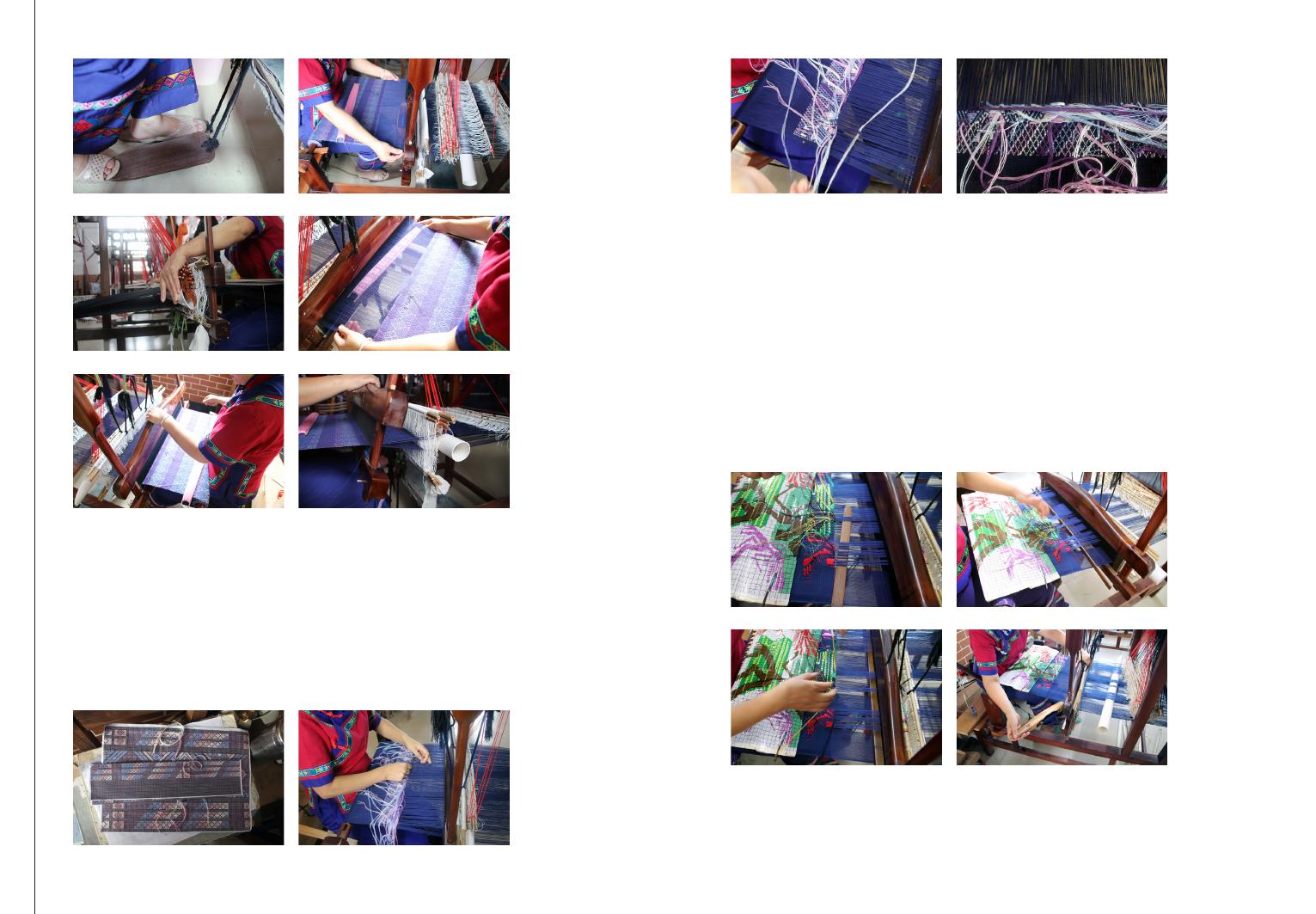
8. To repeat for 6~7 times to weave 1 line of pattern.
Hwabon pattern
Putting pattern weft yarn
Putting pattern weft yarn 2, 3
Making pattern by using stick
Making a space by standing stick
Putting pattern weft yarn in
Putting structure weft yarn in
58
59
Su
rv
ey o
f W
ea
vin
g T
ec
hn
iq
ue o
n t
he V
ie
tn
am B
ord
er R
eg
io
n
Ye
on O
k S
im | S
un Y
on
g L
ee | G
eu
n I
l P
ar
k | J
i H
ee R
oh
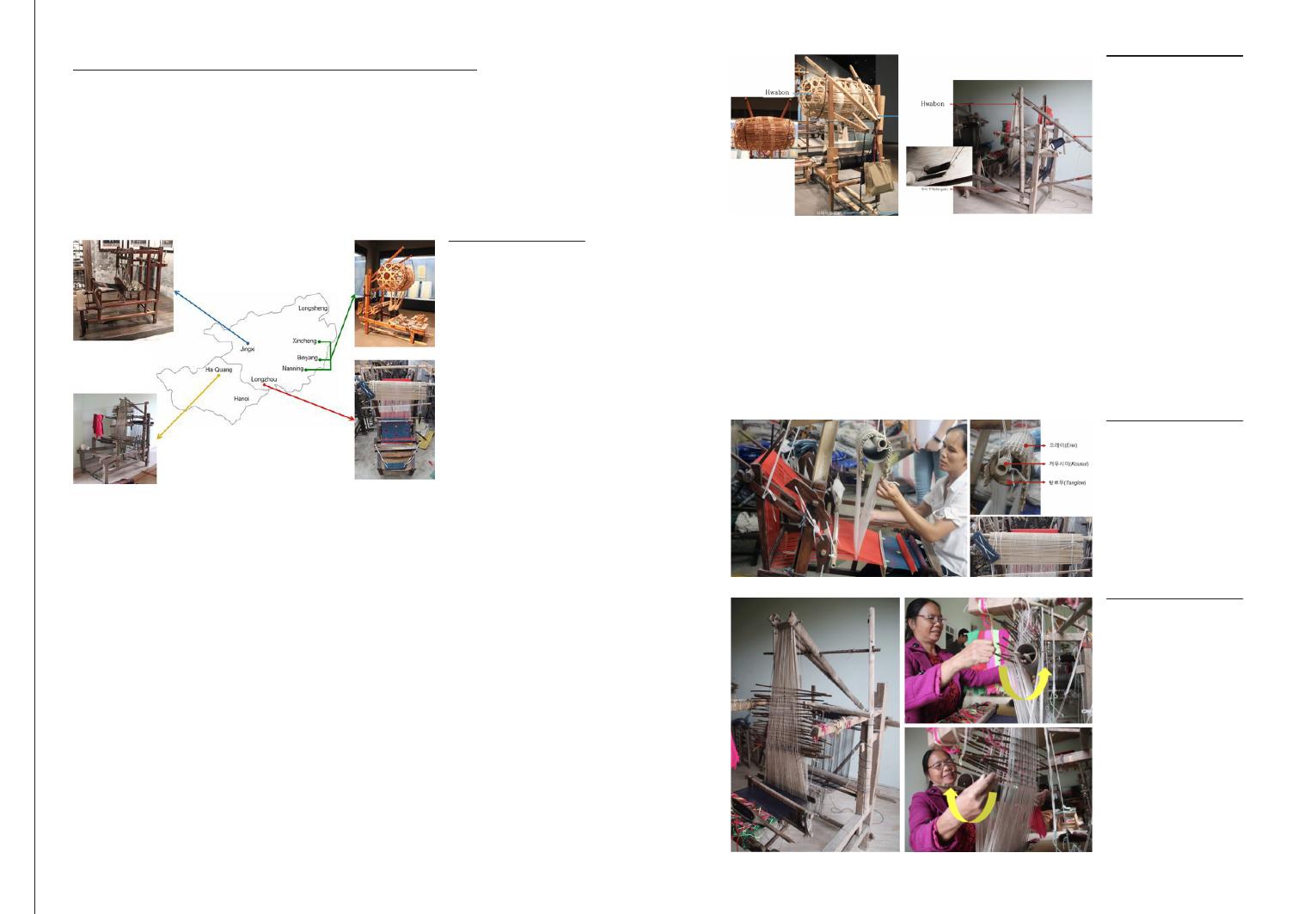
1. Similarity and Difference
In Guangxi, China, Zhuang peoples use 3 types of looms to weave
Zhuangjin. In Nanning and Xincheng, Binyang, Zhulongji is used, but in
Jingxi and Longzhou where is close with Zhulongji area, Zhulongji is not
used, but there was different types loom. On the other hand, In Vietnam,
traditional Tho Cam loom was used only in Luong Noi vil age which is Tay
people lives<Pic 12>.
There is a similarities that structure is unified with pattern weaving and
structure weaving with Tho Cam loom and Zhuangjin loom. But if we
focused on
Hwabon, among 4 types of Zhuangjin loom, Jingxi loom
is most different with Tho Cam loom. Except Jingxi loom, in 3 types of
Zhuangjin loom, we will focus on similarity and difference of structure of
Hwabon structure.
In Vietnamese Tho Cam loom, cáp rạp which is made bamboo to
V-shape maintains a tension of
Hwabon. It is same role with Huadiaoshou
of Zhulongji. But there is 2 peadles, Shacaijiao and Huacaijiao, Shacaijiao
is to weave structure and Hwacaijiao is connected with Zhulong to weave
pattern<Pic 13>. While Tho Cam loom has 2 peadles, đôi guốc, it is for
weaving structure. When weave pattern, the Tho Cam loom is operated
by treading đôi gua, long bamboo, which is connected with cáp rạp<Pic
14>. In other words,
Hwabon of Tho Cam loom and Zhulongji is maintained
by V-shaped cáp rạp and Huadiaoshou but the operating way is different
to weave pattern.
The most similar
Hwabon with Tho Cam loom is Longzhou loom. In case
of Longzhou loom, Tangrou which is hanged on Koushui(upper side)
is rotated to use
Hwabon continuously. It is some kind of automatic
structure, <Pic 15>. On the other hands,
Hwabon of Tho Cam loom of Tay
is fixed on the V-shped cáp rạp. Although the cylinder shaped bamboo
is installed below
Hwabon of Tho Cam loom but it is not rotated. When
crafter weave every front hoa vặn, let it hoa vặn go back again<Pic 16>. It is
some kind of manual structure. The
Hwabon shape of Tho Cam loom and
Longzhou loom is similar, but operating way is difference.
Ⅳ
Comparing with Tho Cam Loom and Zhuangjin Loom
Pic 12
Location where each loom
is used
Pic 13
Pic 14
(
left)Interlocking Structure
of Zhulongji
(
right)Interlocking
Structure of Tho Cam
loom
Pic 15
The
Hwabon and Pattern
Weaving of Longzhou
Loom
Pic 16
The
Hwabon and Pattern
Weaving of Tho Cam Loom
60
61
Su
rv
ey o
f W
ea
vin
g T
ec
hn
iq
ue o
n t
he V
ie
tn
am B
ord
er R
eg
io
n
Ye
on O
k S
im | S
un Y
on
g L
ee | G
eu
n I
l P
ar
k | J
i H
ee R
oh
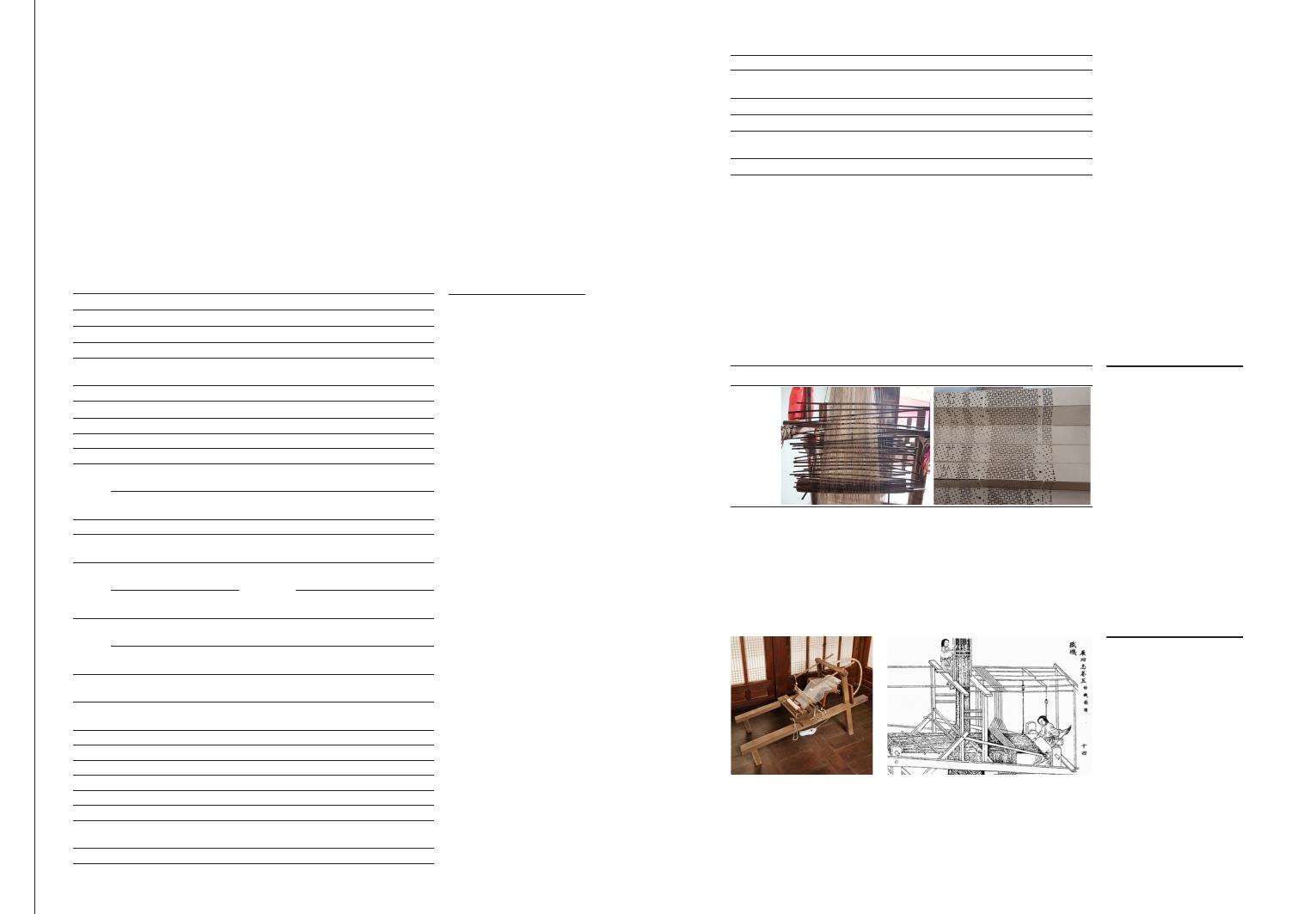
As a result, There is difference of operating way of
Hwabon between
Tho Cam loom and Longzhou loom but the structure and figure is most
similar than the other Zhuangjin loom. Actually, Luong Noi village where
is located in Haquang of Cao bang province is close to Chinese border.
And among the 6 regions which is objected to survey, Longzhou is most
closest region to Vietnamese border than other 5 regions. A names of
parts of Longzhou loom is too similar to make confusion that the their
pronunciation looks like vietnamese<Table 4>. For these reasons, There is
a possibility that the similar structure loom is passing down in Cao bang
and Longzhou. Although Vietnamese Tay and Chinese Zhuang have
different nationality now, but because they are basis on same ethnical
origin, they have homogeneity of traditional textile craft.
Korea
China
Vietnam
Hansan[Eng]
Zhulongji
JIngxi Loom Longzhou Loom Haquang Loom
·
Zhulong[竹籠]
·
Tangrou
·
·
Pianhuazhu[編花竹] ·
Erei
hoa vặn
·
Huadiaoshou
[花吊手]
·
·
cáp rạp
·
Zhongchui[重錘]
·
·
·
부테
[Belt]
Yaodai[腰帶]
·
Tablang
·
말코
[Loom Roller] Budouzhou[布頭軸] Mairuntang Shampan
rằm vặn
·
Fenjingtong[分經筒] ·
·
·
바디
[Reed]
Zhukou[竹筘]
Zhangkouzu ·
vùng
잉아
[Headle]
문조직
[Pattern]
Gaozengxian
[高綜線]
Kouwa
Gongxian
khau sung
지조직
[Ground]
Aizengxian
[矮綜線]
Koupai
Muxian
khau tắm
·
Zhongtong[中筒]
Anmuk
·
·
도투마리
[Warp beam]
Quanjingzhou
[卷經軸]
Kongnak
Kouhuaki
cóc nạc
발판
[Treadle]
문조직
[Pattern]
Huacaijiao[花踩脚]
Gakdappan
(
脚踏板)
·
đ
ôi gua
지조직
[Ground]
Shacaijiao[紗踩脚]
·
đ
ôi guốc
북
[Shuttle]
문조직
[Pattern]
Rongsuo[絨梭]
Numsa
Tuim
sợi len
지조직
[Ground]
Shasuo[紗梭]
Swaptaung ·
con thoi
·
Shadiaoshou
[紗吊手]
·
·
ngọc ngạch
·
Zengshaliang
[綜線梁]
·
·
·
최활
[Tenter]
Gongzi[弓子]
·
Iyepom
·
·
Jijia[機架]
Tiaokou
Tangmai
·
·
·
Pagan(擺杆) Tapa
·
앉을개
[Stall]
Zuoban[坐板]
·
Tuinang
ghế
·
Yahuachi[壓花尺]
·
Pan
pan
·
·
·
Koushui
·
·
·
·
Nouke
[提綜擺杆]
·
·
·
·
Huengchuk(橫軸)·
·
·
·
Hwalgan(活杆) ·
·
·
·
Apgyunggan
(
壓經杆)
·
·
·
Maipieu
·
·
·
·
Maikau
·
khắt
·
·
Yungyulgan
(
連結杆)
·
·
사침대
[lease rod]
·
·
·
ghặt ghèo
Table 4
Names of Tho Cam Loom
and Zhuangjin Loom
Table 5
Hwabon of Tho Cam Loom
and Jacquard Loom
2. Textile historical Meaning of Tho Cam Loom and
Zhuangjin Loom
Although there is a difference of structure with Tho Cam loom and
Zhuangjin loom, there is also common feature that Hwabon is installed.
Hwabon is some kind of database which is saved a textile pattern. Every
single bamboo stick of Tho Cam loom and Zhuangjin loom has same
role with a Pattern card of Jacquard loom which was used in modern
times<Table 5>.
Tho Cam Loom
Jacquard Loom
Hwabon
In case of Korea traditional loom, because it is not installed a Hwabon
like Tho Cam loom and Zhuangjin loom, it is possible to weave only
plane structure<Pic 17>. Actually, pattern weaving loom is painted on the
『
Imwongyungjeji(林園經濟志)』which is literature of Joseon dynasty<Pic 18>.
But it is different the loom which is remained now.
Vietnam Tho Cam loom of Tay and Chinese Zhuangjin loom of Zhaung
can weave plane structure likes Korea traditional loom, and pattern also
by installing
Hwabon. In the other words, This simple pattern loom is so
unified pattern weaving and structure weaving that crafter can weave
Pic 17
Pic 18
(
left)Loom(Hansan, Korea)
(
right)『
Imwongyungjeji(林
園經濟志)』
62
63
Su
rv
ey o
f W
ea
vin
g T
ec
hn
iq
ue o
n t
he V
ie
tn
am B
ord
er R
eg
io
n
Ye
on O
k S
im | S
un Y
on
g L
ee | G
eu
n I
l P
ar
k | J
i H
ee R
oh
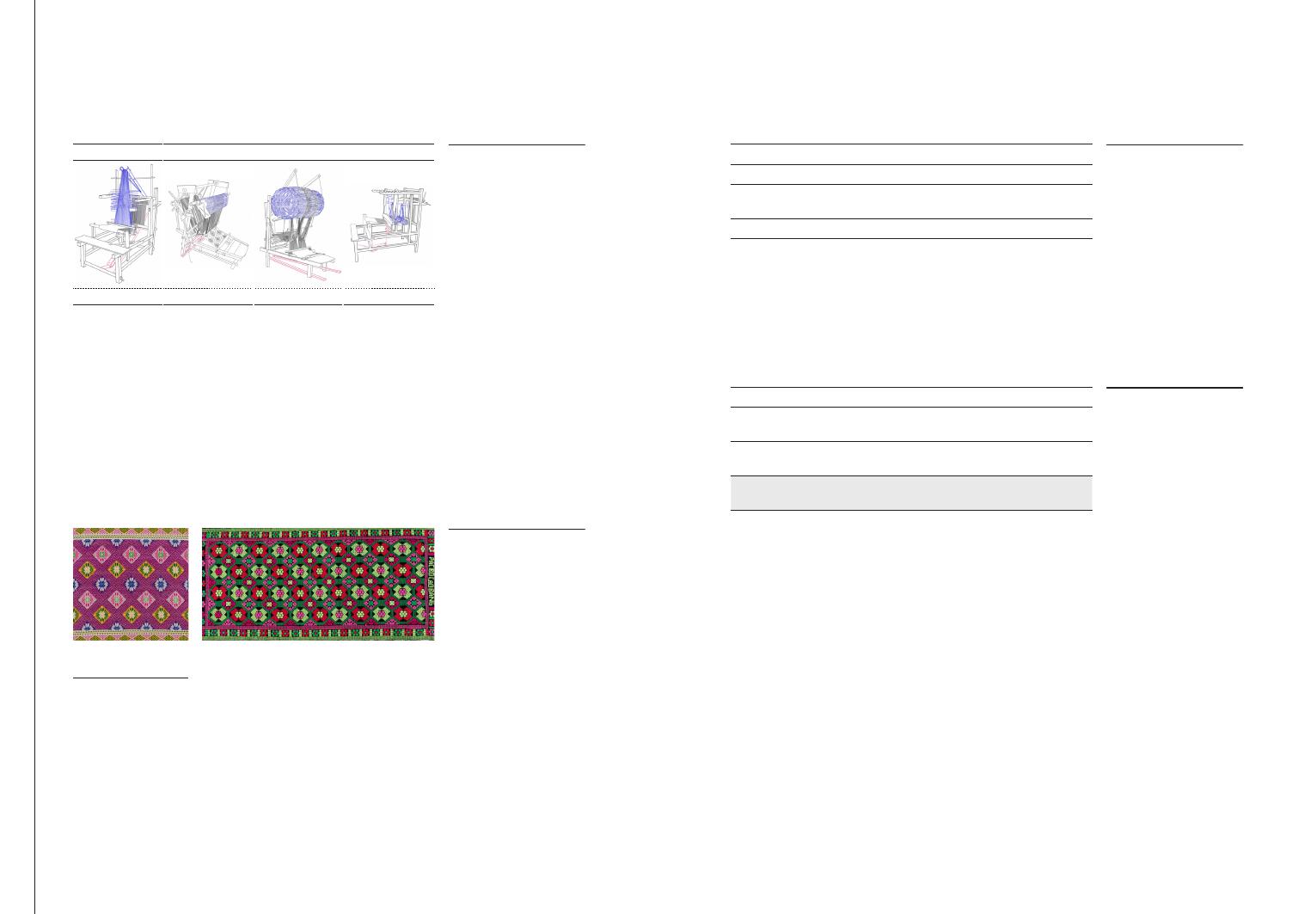
pattern by himself<Table 6>. These pattern weaving loom is cal ed one-
man patern weaving loom. Because crafter can weave both of structure
and pattern, it seems that the origin of a draw loom. The loom which is
printed on 『
Imwongyungjeji(林園經濟志)』 is classified with draw loom.
Table 6
Hwabon structure of Tho
Cam Loom and Zhuangjin
Loom
Table 7
List of Intangible Heritage
of Unesco
Table 8
List of Vietnam Intangible
Heritage
토껌직기
장금직기(롱저우)
장금직기(죽롱기)
장금직기(징시)
Vietnam Tho Cam
China Zhuangjin Loom
Because draw loom is composed with complex structure, loom is bigger
than other type loom. Even the pattern is very smal , it needs 2 persons to
operate. But because the structure of Tho Cam loom and Zhuangjin loom
is unified with pattern and ground, and by using brocade technique to
weave, it is simple to operate a loom.
Colourful weft is used to overcome a monotony of pattern<Pic 19~20>.
Although it is simpler that a way how to weave textile, and composition of
one-man pattern weaving loom of Tho Cam loom and Zhuangjin loom
than a draw loom, but it is very meaningful on a textile history.
Pic 19
Pic 20
(
left)Chinese Zhuangjin
(
right)Vietnamese Tho
Cam
This is common feature of Vietnamese Tho Cam and Chinese Zhuangjin
that they are weaved by traditional textile of minorities. These minorities
textile and culture is rapidly vanished today because of change of
use, uncleanness of market, decreasing of economic value. Especially
traditional textile is related with minorities unique culture. If it is vanished
away, the unique culture will be faded away.
In present, All of the world is trying to safeguard a traditional culture.
Among them, Unesco is the most global institution.
Ⅴ
Transmission
Among the textile culture of China and Vietnam, only 3 of them is
designated on the list, and all of this 3 heritage is Chinese one<Table 7>.
Although Zhunagjin of Zhuang people was one of the chinese 4 best silk, it
is not involved in Unesco intangible heritage list.
Nation
Year
Heritage
1
China
2009
Craftsmanship of Nanjing Yunjin brocade
2
China
2009
Traditional Li textile techniques: spinning,
dyeing, weaving and embroidering
3
China
2009
Sericulture and silk crafsamanship of China
To protect and preserve a traditional textile, the government of Vietnam
and China is trying to support. First, In Vietnam, they made a law in 2002
and started to manage a culture fol owing this law. In 12th list of 2016,
there is 160 heritage, among them, there is 12 crafts, and 3 textile. The
“
Traditional textile craft of the Tay ethnic people” is designated on the list
and safeguarded <Table 8>.
In China, the heritages which is designated is 8,327(National culture is
1,218, Local 7,109). Among them the there is 30 textile heritages. Zhuangjin is
designated as national cultural heritage and safeguarded<Table 9>.
Among the Chinese national intangible cultural heritage, there is 4
Chinese best silks like Nanjing-Yunjin, Suzhou-Songjin, Chengdou-Shujin.
And the minorities(Tu[土], Li[黎], Miao[苗], Bai[白], Zhuang[藏] etc.) culture is
majorities among the list.
In spite of these effort, Tho Cam and Zhuangjin is rapidly vanished away.
In Luong Noi vil age, Haquang, Vietnam, 85 whole families weaved before
1990 but only 10 around families are weaving now. These situation is also
progressed in Chinese Zhuangjin.
There is 3 reasons why Tho Cam and Zhuangjin weaving is rapidly
vanished. Firstly, demand of traditional textile is decreasing. In China and
Vietnam, these textile is weaved only for display or tourism product or
speciality<Pic 21-22>.
Nation
Year
Heritage
1
Dhinh Yen
Commune
2011
Mat weaving
2
Dong Giang
District
2012
Brocade textile craft of the Co Tu ethinic
People
3
Bac Kan
Province
2012
Traditional textile craft of the Tay ethnic
people
64
65
Su
rv
ey o
f W
ea
vin
g T
ec
hn
iq
ue o
n t
he V
ie
tn
am B
ord
er R
eg
io
n
Ye
on O
k S
im | S
un Y
on
g L
ee | G
eu
n I
l P
ar
k | J
i H
ee R
oh
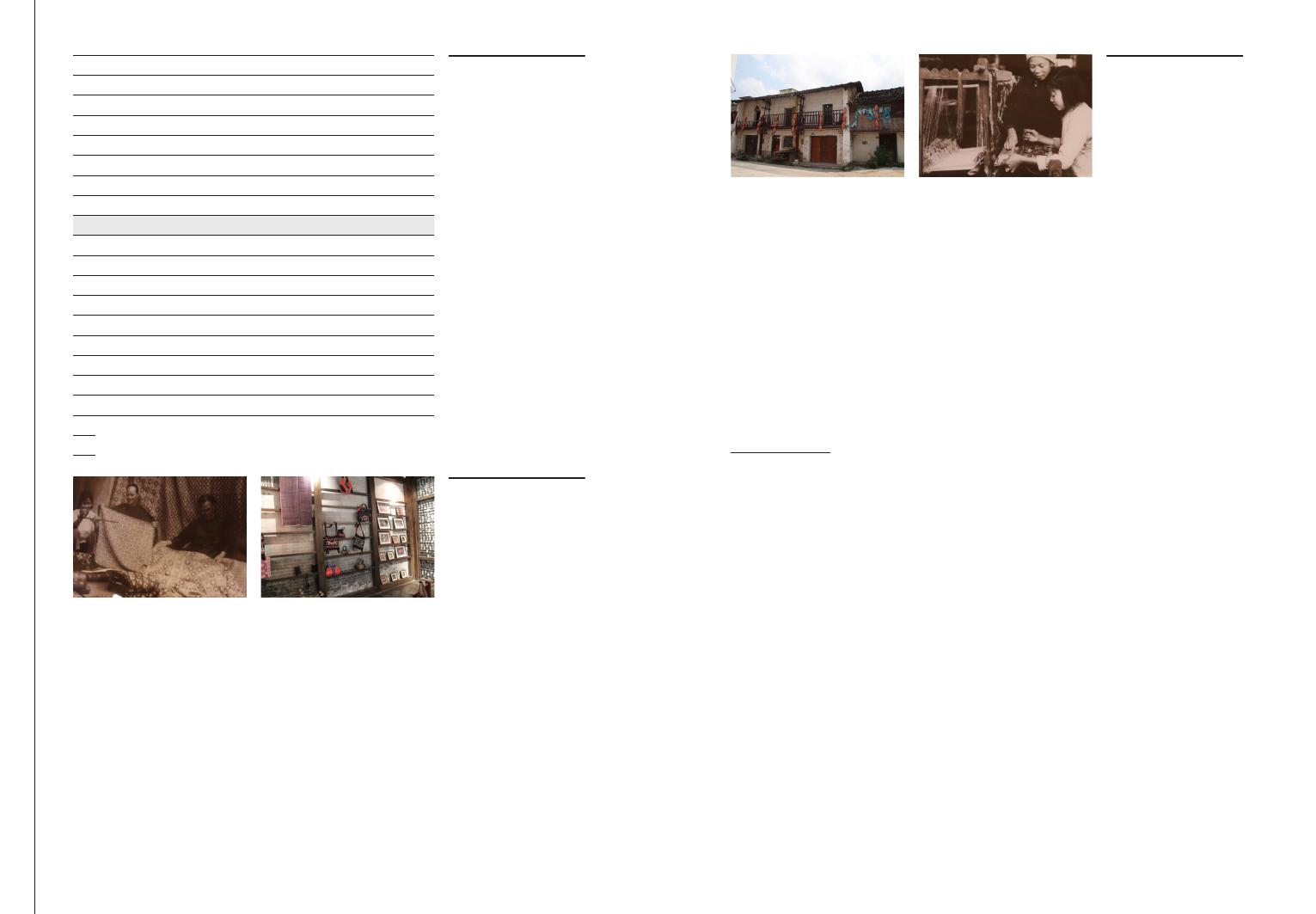
No Location
Year
Heritage
1
江苏省南京市
2006
南京云锦木机妆花手工织造技艺
2
江苏省苏州市
2006
宋锦织造技艺
3
江苏省苏州市
2006
苏州缂丝织造技艺
4
四川省成都市
2006
蜀锦织造技艺
5
上海市徐汇区
2006
乌泥泾手工棉纺织技艺
6
湖南省湘西土家族苗族自治州
2006
土家族织锦技艺
7
海南省五指山市
2006
黎族传统纺染织绣技艺
8
广西壮族自治区靖西县
2006
壮族织锦技艺
9
西藏自治区山南地区
2006
藏族邦典、卡垫织造技艺
10 青海省湟中县
2006
加牙藏族织毯技艺
11
新疆维吾尔自治区吐鲁番地区
2006
维吾尔族花毡、印花布织染技艺
12 江苏省南通市
2006
南通蓝印花布印染技艺
13 湖南省凤凰县
2008
蓝印花布印染技艺
14 贵州省丹寨县
2006
苗族蜡染技艺
15 贵州省安顺市
2008
蜡染技艺
16 四川省珙县
2011
蜡染技艺(苗族蜡染技艺)
17 贵州省黄平县
2011
蜡染技艺(黄平蜡染技艺)
18 云南省大理市
2006
白族扎染技艺
19 四川省自贡市
2008
扎染技艺(自贡扎染技艺)
Table 9
List of China Intangible
Heritage
Pic 21
Pic 22
(
left)Zhunagjin Sailing,
1972
(
right)Zhaungjin Exhibit
Hall of Jingxi
Pic 23
Pic 24
(
left)Zhuangjin Factory of
Xincheng
(
right)Zhunagjin Factory
of Jingxi, 1970
Secondly, the decreasing of demand causes severance of technique.
In the past, whole families of vil age weaved and used traditional y. But
the minimum families are just passing traditional way down in present.
Actual y, in Xincheng, only 3~5 families were weaving Zhuangjin, and
Zhuangjin factory is failed today<Pic 23>. In Jingxi, there was dozens of
persons who participate in Zhuangjin weaving but the number of crafter
was rapidly decreased today<Pic 24>.
Thirdly, the material is very important part of transmission. Traditionally,
silk had been used but cotton or wool or chemical yarn is used now.
And dyeing method has been changed from natural to chemical. And
bamboo which was used to make parts of loom was changed to plastic.
Traditional material has been vanished away.
Both countries of Vietnam and China is trying to safeguard a Tho Cam of
Tay and Zhuangjin of Zhuang by making a law. But it is not going well that
detail survey, information gathering and documentation of traditional
weaving technique. It is need that efforts for secure of materials and
tools, transmission of technique, management of crafter, academic
survey and research, It is urgent time to make scientific polish now.
Zhuang people is living in several countries with various names. Although
they are most popular minorities in both countries of Vietnam and
China in present, there isn’t an in-depth study. Especial y, the research of
relationship about these 3 peoples is a few.
Because Zhuang people which is spread in several countries has
same origin, they has clear similarities on several parts from costume
and textile to language and faith. Especially, textile is so essential part
of human life that it places from normal life to awareness. It is also
important evidence that similarities of the patterning and weaving
techniques and of Tho Cam weaved in Vietnam and Zhuangjin weaved
in China.
In this survey, it is focused on the weaving technique of Zhuang who lives
in Guangxi, China and Tay who lives in Cao bang, Vietnam. The loom of
Zhuang and Tay is a one-man pattern weaving loom which can weave
pattern and ground. The most characteristic part of one-man pattern
weaving is how to use a Hwabon. Unlike a different pattern weaving loom
that draw boy should help to lift a Hwabon, crafter who use one-man
pattern weaving loom uses Hwabon himself to weave pattern.
Ⅵ
Conclusion
66
67
Su
rv
ey o
f W
ea
vin
g T
ec
hn
iq
ue o
n t
he V
ie
tn
am B
ord
er R
eg
io
n
Ye
on O
k S
im | S
un Y
on
g L
ee | G
eu
n I
l P
ar
k | J
i H
ee R
oh

Among them, the most similar structure of loom with Tho Cam loom
is Longzhou loom. There is a cylinder shaped bamboo below Hwabon
which is role of standard point. On the other hand, the cylinder shped
bamboo is on the top. It is most significant difference that make a
structural difference.
Both of Zhuangjin and Tho Cam is designated as intangible heritage. But
it is vanishing away now. This survey has meaning that it is a information
gathering of traditional textile craft which is severing. The database
which is made by using this survey will be a base information to revive
this traditional weaving technique when it was vanished.
References
♦
Literature
♦
Books
♦
Thesis
『嶺外對答』
『粤西瑣記』
Korean
김영순
외, 2013, 『베트남 문화의 오디세이』, 북코리아.
담응이엠
반 외, 2013, 『베트남의 소수민족』, 민속원.
소황옥
외, 2008, 『중국소수 민족과 복식』, 경춘사.
정재남
, 2007, 『중국 소수민족 연구 - 소수민족으로 분석하는 중국』, 한국학술정보관.
China
陈维稷
, 2005, 『中國紡織科學技術史』, 科學出版社.
李元君
, 2012, 『美麗的錦繡壮族服飾』, 接力出版社.
Japan
前田
亮, 1992, 『手織機の硏究』, 京都書院
USA
Cheng Weiji, 1992, 『HISTORY OF TEXTILE TECHNOLOGY OF ANCIENT
CHINA』, Science Press New York, Ltd.
徐昕
, 2016, 「中國傳統工藝全集 絲綢織染」, 东华大学.
69
68
Su
rv
ey o
f W
ea
vin
g T
ec
hn
iq
ue o
n t
he V
ie
tn
am B
ord
er R
eg
io
n
Ye
on O
k S
im | S
un Y
on
g L
ee | G
eu
n I
l P
ar
k | J
i H
ee R
oh
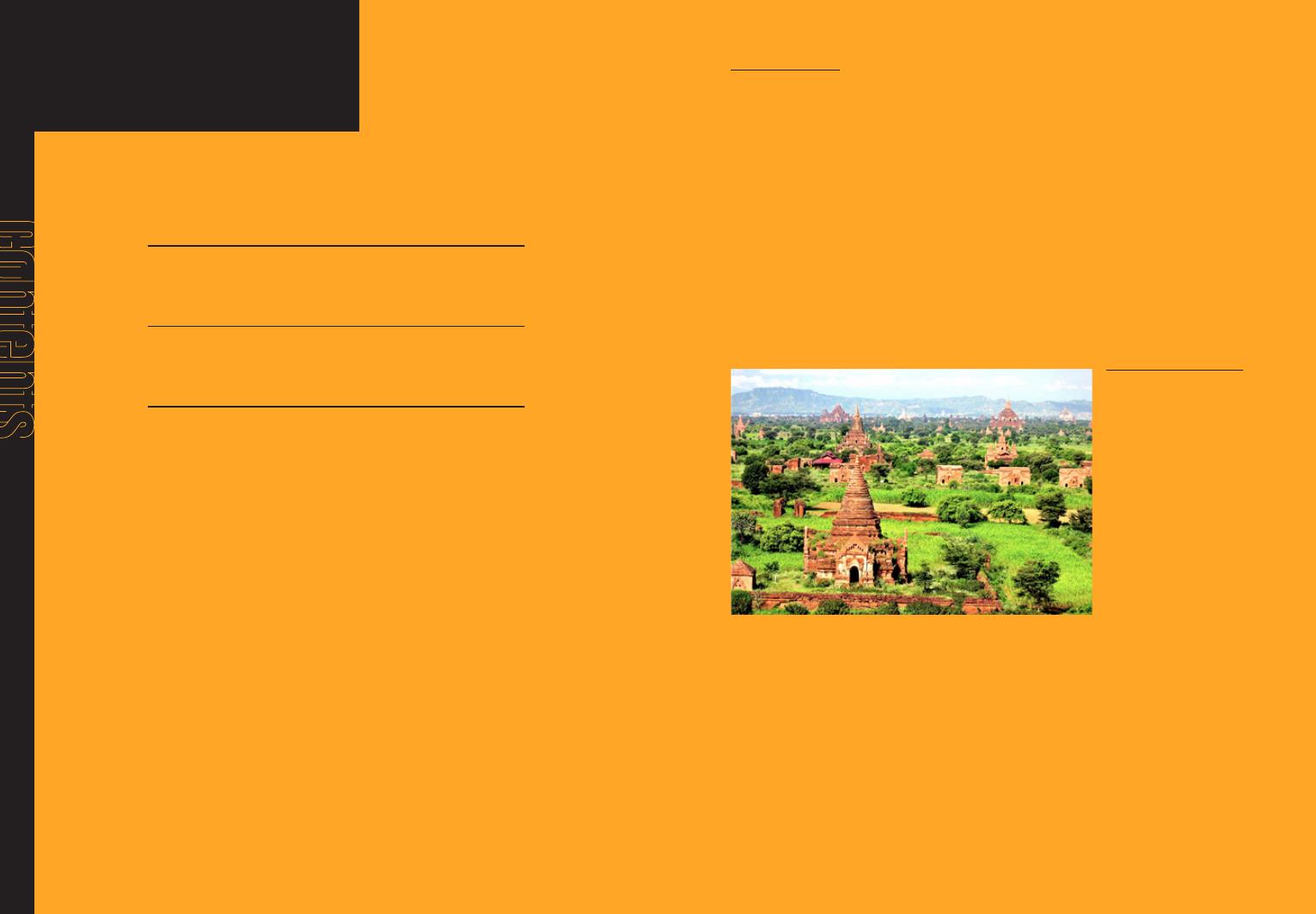
The Republic of the Union of Myanmar (henceforth Myanmar) is located
in the northwest of the Indochina Peninsula and borders India, China,
Bangladesh, Laos and Thailand. The size of the country is approximately
670,000 square kilometers, which is three times the size of the Korean
peninsula, and the population is about 54 mil ion. As for religion, Buddhism
accounts for 88% of the population, although Christianity (5%), Islam (4%)
and other religions are observed as well. The nation is composed of 130
ethnic groups including the Bamar (70%), Shan (9%) and Karen (7%), etc. The
major cities are Naypyidaw, the administrative capital city of Myanmar,
Yangon, the economic center of Myanmar, and Mandalay. Bagan, located
east of the Irrawaddy River, which is 150 kilometers southwest of Mandalay,
is an ancient city. The city was the capital of the Bagan dynasty, founded
by the Bamar between the 11th and 13th centuries(Korea International
Cooperation Agency,2014).
KNUCH, Dept. of Heritage Conservation
and Restoration, Graduate School of
Cultural Heritage
Prof. Yong Jae Chung
Researcher. Jia Yu
Researcher. Gyu Hyuk Cho
Researcher. Seong Eun Kim
Ⅰ
Introduction
Ⅱ
Myanmar traditional lacquer materials and techniques
1. Research on lacquer workshops
2. Research on lacquerware museum
Ⅲ
Scientific analysis of Myanmar traditional lacquer materials
1. Collection of Myanmar lacquer materials
2. Scientific analysis
Ⅳ
Conclusion
Ⅰ
Introduction
Fig. 1
Pagodas in Bagan.
A Survey and Scientific
analysis of natural
adhesives in Myanmar
70
71
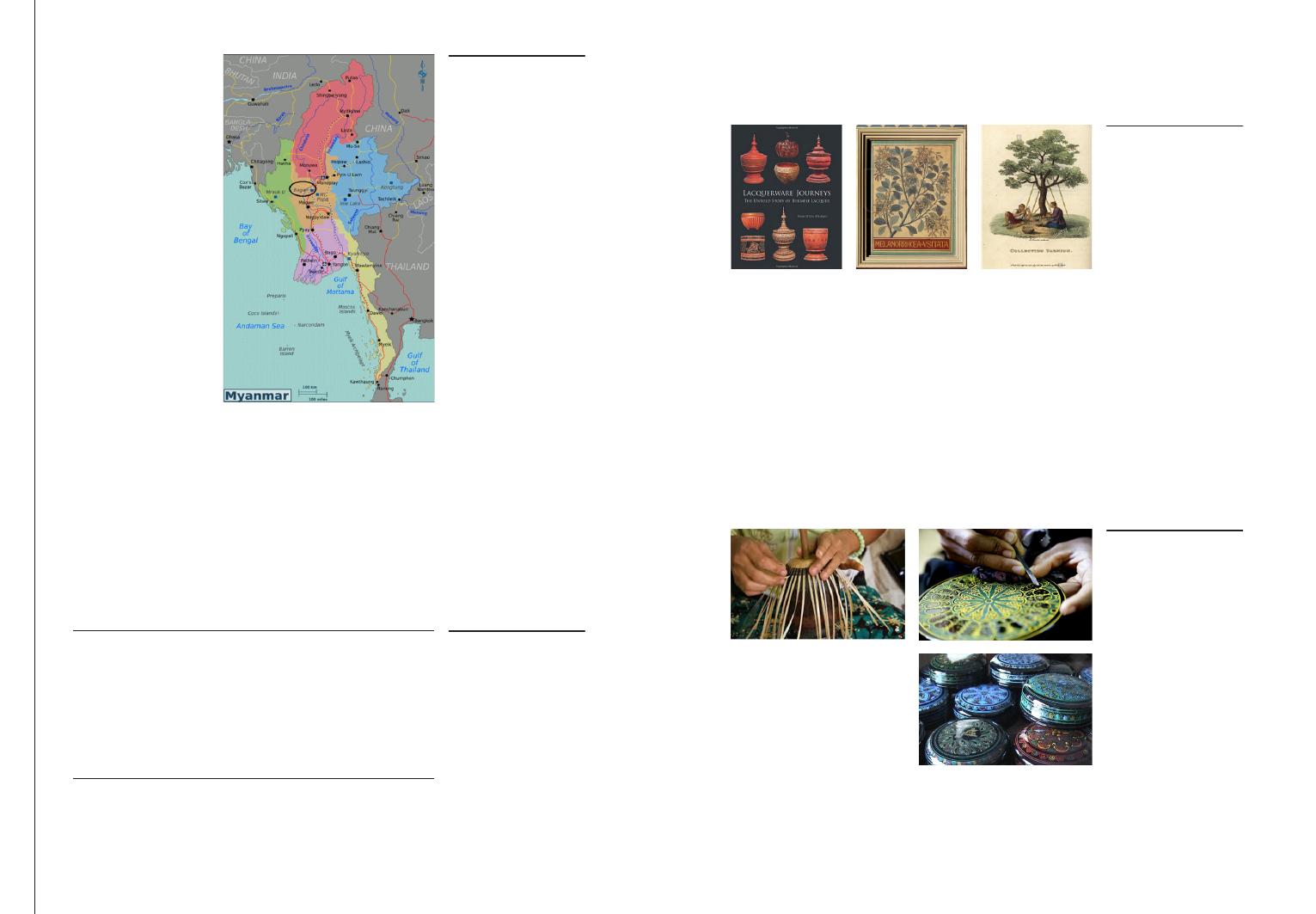
T h e r e a r e m o r e
than 5,000 Buddhist
remains, especially
pagodas, in Bagan.
As one of the richest
t re a s u r e h o u s e o f
Buddhist architecture
in the world, Bagan
is a famous tourist
destination for visitors
from all over the world.
The ancient cit y is
also very famous for
traditional lacquer
technique. Myanmar
wa s i s o l a te d f ro m
the outside world for
26 years from 1962
for various political
reasons. Subsequently,
leaving the country was very limited from 1988 to 2011. Because of the
painful history of the state being disconnected from the outside world, the
tradition of Myanmar has been preserved very well compared to other
neighboring countries.
Traditional arts and crafts of Myanmar are cal ed the 'Ten Flowers' and
have been recorded in palm leaf manuscripts and handed down to this
day. Lacquer sap has been used on almost all kinds of material, including
stone, leather, wood, bamboo, textiles, ivory, metals and paper, to enhance
durability and for waterproof and decorative effects.
1.
2.
3.
4.
5.
6.
7.
8.
9.
10.
Pan yun: Lacquer work
Pan chi: Drawing, painting
Pan bu: Sculpting
Pan tein: Goldsmithing & silversmithing
Pan bei: Blacksmithing
Pan tee: Metal casting
Pan taw: Stucco work
Pan t’maw: Stone/marble sculpting
Pan put: Turning wood in lathe
Pan yan: Bricklaying and masonry
Table 1
The Ten Flowers: Ten
major arts and crafts of
Myanmar
According to
Lacquerware Journeys, lacquer trees of various size are
produced all over Myanmar. The largest production area was Bagan,
the capital city of the Bagan Dynasty that flourished in the 11thcentury.
However, lacquerwares from the heyday of Bagan hardly remain to this
day since many wooden lacquerwares deteriorated and disappeared
with the passing times.
Fig. 3
Fig. 4
Fig. 5
(
left)
Lacquerware
Journeys.
(
center)The species of
lacquer tree in Myanmar.
(
right) Scene of col ecting
lacquer.
Due to the domestic and foreign political situations and relatively delayed
industrialization in Myanmar, the tradition of lacquering have been
preserved well and continues to this day in various techniques combined
with various modern methods. The lacquering technique of Myanmar is
characterized by the incised (yun/yunde) technique and various colors
(
red, green, yel ow). Characteristics of Myanmar lacquering also include
the fact that bamboo is mainly used as a base material and that, besides
the use of lacquer col ected from lacquer tree, materials such as sap,
resin and rubber col ected from other trees are used as well in various
ways. In particular, neem juice and neem glue obtained from neem
tree and acacia resin obtained from acacia tree are used in Myanmar
lacquerwares.
As Myanmar lacquering craft
reached its peak from the
late 18th century, production
a r e a o f l a c q u e r w a r e s
expanded beyond Bagan
to include other regions.
Bagan’s lacquer industry has
been handed down between family members for centuries, and there
are lacquer workshops in various sizes in Bagan. There are currently more
than 12 large lacquer workshops, producing lacquerwares not only for
the domestic market but also for export markets. In addition to producing
72
73
Fig. 2
Map of Myanmar and the
location of Bagan.
Fig. 6
Traditional lacquerware of
Myanmar.
Yo
ng J
ae C
hu
ng | J
ia Y
u | G
yu H
yu
k C
ho | S
eo
ng E
un K
im
A S
ur
ve
y a
nd S
cie
nti
fic a
na
lys
is o
f n
at
ura
l a
dh
es
ive
s i
n M
ya
nm
ar
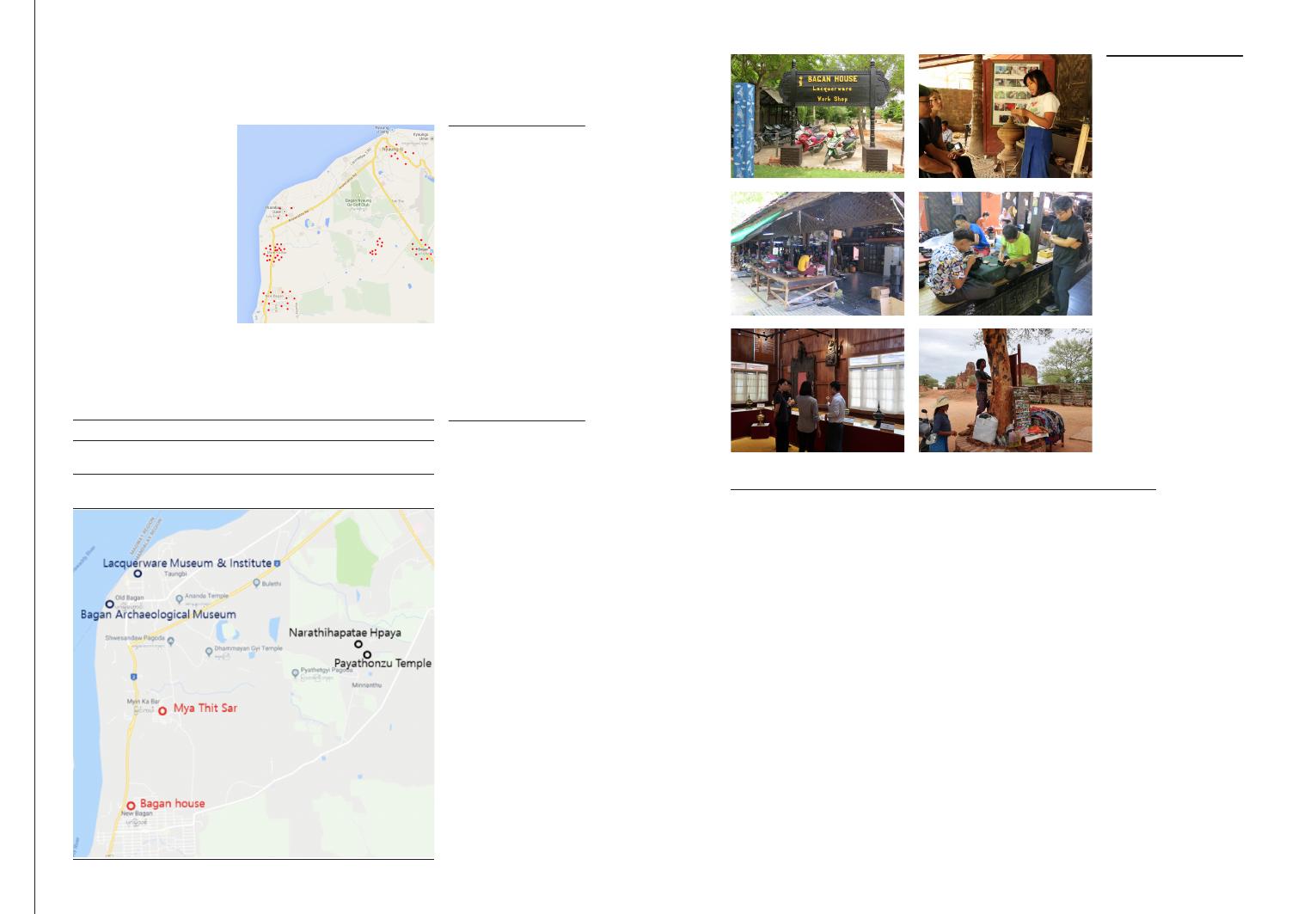
and selling lacquerwares, these workshops are also making an effort
to promote Myanmar lacquerware by holding and attending various
workshops and seminars.
The aim of this study was
to examine the tradition-
al lacquer materials and
techniques of Myanmar.
To this end, a field survey
was conducted at trad-
itional lacquer workshops
and lacquerware mu-
seum located in Bagan.
A variety of materials
and techniques were
documented based on expert interviews, and some materials were
directly collected from the field with the permission of staff in charge.
The collected materials were analyzed for components using pyrolysis-
gas chromatography-mass spectrometry.
Categories
Survey sites
Lacquerware
workshops
Bagan house, Mya Thit Sar, etc.
Lacquer
museum
Lacquerware Museum & Institute
Table 2
Survey sites in Bagan
1. Research on lacquer workshops
1) Process of preparing base material
Myanmar traditional lacquerwares are characteristically made to be
light with the use of inner bark of trees. Mainly used wood varieties are
bamboo, teak and other trees, and the inner layer of the bark instead of
the bark is used for softness and flexibility. Also, the wood is thoroughly
dried before use to prevent warping. There are three types of base
materials: wood for trays and furniture, bent bamboo, and bamboo and
horsehair used in small flexible cups.
In the past, materials were obtained from bamboo rafts that floated
down the Irrawaddy River, because the people thought that bamboo
that were kept wet while drifting down the river for a long time are more
durable. Bamboo col ected from the river are fumigated before use to
prevent biological damages from insects (Ma Thanegi, 2013).
The base materials are sometimes made without using adhesives, in
which case the bottom and the body are made at once as once piece
Ⅱ
Myanmar traditional lacquer materials and techniques
74
75
Fig. 7
Lacquerware workshop in
Bagan region(UNIDO, 2014).
Fig. 8
Conducting field survey.
Yo
ng J
ae C
hu
ng | J
ia Y
u | G
yu H
yu
k C
ho | S
eo
ng E
un K
im
A S
ur
ve
y a
nd S
cie
nti
fic a
na
lys
is o
f n
at
ura
l a
dh
es
ive
s i
n M
ya
nm
ar
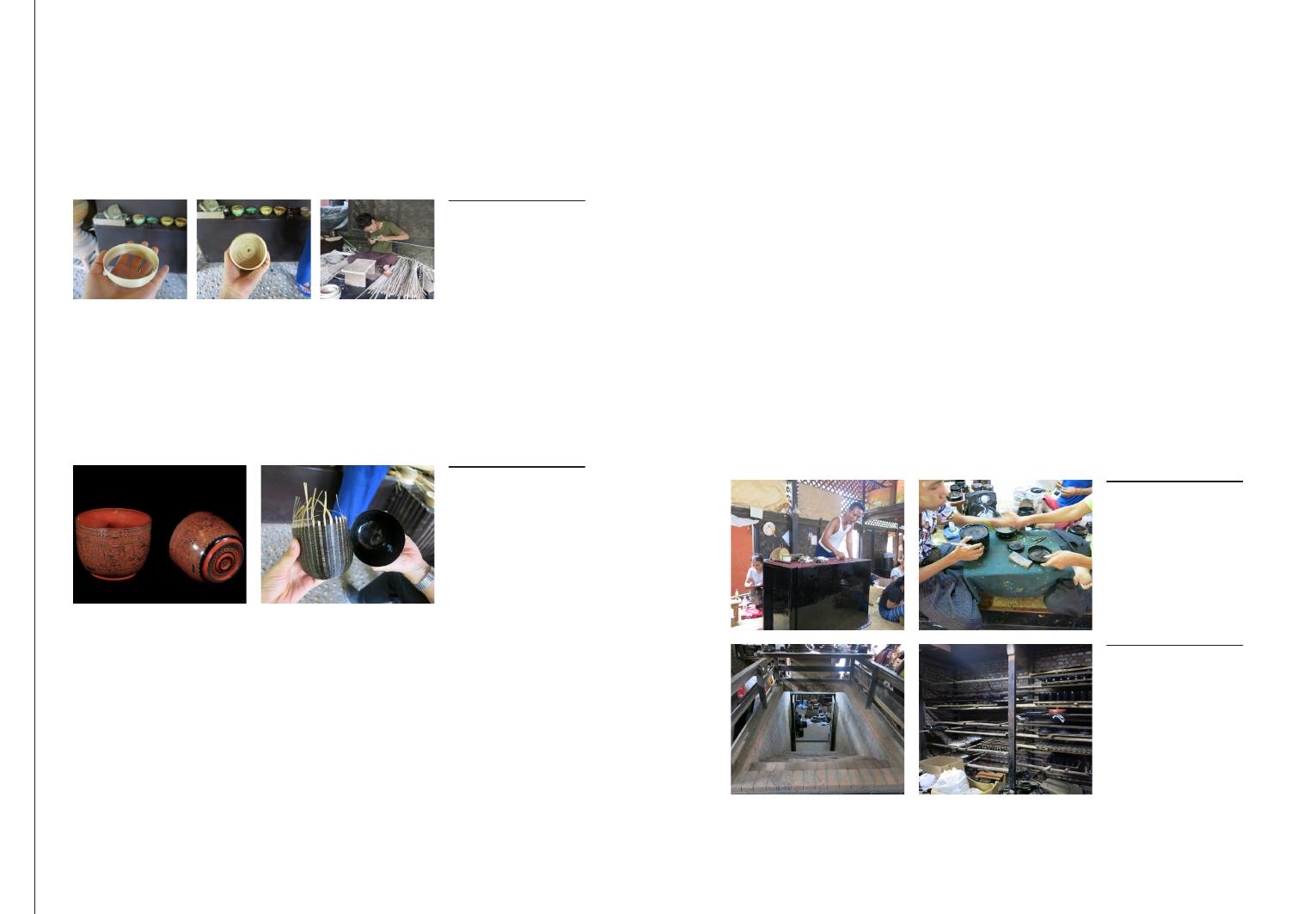
by stacking up wood strips. Otherwise, the bottom and the body are
made separately and later attached together. Wood strips are stacked
at an angle to create a rounded bottom, and the base material is
often applied with organic clay for waterproof effect. When joining
bamboo, grooves are made into the wood with a knife for assembly.
After assembly, the connected areas are polished with sandpaper for a
smooth surface.
Because the base materials made of bamboo and teak wood are highly
flexible, it is important to prevent cracks in the lacquer coating and make
sure that the completed lacquerwares are not affected by the external
environment. In addition, lacquerwares made of bamboo and teak wood
are very light, and thus have little risk of damage during transportation
and use. The reason lacquered tableware and cups in Myanmar have no
handles is because they are light.
2) Lacquering process
Myanmar lacquer is called ‘thitsi’ or tree sap. The word comes from
the Melanhorrea usitata, which grows near the upper Irrawaddy River. A
V-shaped scar is made on the trunk a lacquer tree, and a bamboo cane
is hung at its edge as a path for the sap. The sap at this point is viscous
and gray. Later, it turns black with oxidation. In the 1950s, lacquer was
exported to Japan because it was collected in abundance and showed
high quality. The quality of lacquer depends on the growth environment
of lacquer tree (age, soil condition, altitude and location, and freshness
of sap). There are three kinds of lacquer sap in Bagan. Grade 1 lacquer
delivers excellent gloss and its price is approximately 5 times to 2 times
higher than Grade 3 lacquer (Ma Thanegi, 2013). Large workshops make
Fig. 9
Making base materials.
Fig. 10
Basic appearance of
Myanmar traditional
lacquerware without
handles.
large volume purchase of lacquer, and lacquer and lacquerwares for
household use are traded in traditional markets located in the north and
northeastern part of Myanmar.
Artisans applying lacquer coat carry out all their work indoors to prevent
cracking and keep all the works in progress in a wind-free indoor space.
The best lacquerwares are those that have been applied with very thin
lacquer coat many times (up to 20 layers). If lacquer is applied too thick
then the piece of work is warmed up under sunlight to make the lacquer
surface fluid for modification.
After the base coat, Grade 2 or 3 lacquer with lower purity is used for
the first lacquering. The work is then dried for at least one month. After
drying, the surface is smoothed with sandpaper and is gently rubbed
with charcoal powder and water. The highest quality lacquer is used
for the final layer. As the process of lacquering, drying and polishing is
repeated continuously, the work is covered with many layers of lacquer.
At each step, the work is dried in the basement drying room for at least 2
weeks, and then polished with charcoal powder, paper, and cloth. When
the lacquering is finished, the work is delivered to the next person for
other work such as decoration. In this way, separate team of workers
handle respective step of lacquerware production.
Fig. 11
Applying lacquer.
Fig. 12
Basement drying room.
76
77
Yo
ng J
ae C
hu
ng | J
ia Y
u | G
yu H
yu
k C
ho | S
eo
ng E
un K
im
A S
ur
ve
y a
nd S
cie
nti
fic a
na
lys
is o
f n
at
ura
l a
dh
es
ive
s i
n M
ya
nm
ar
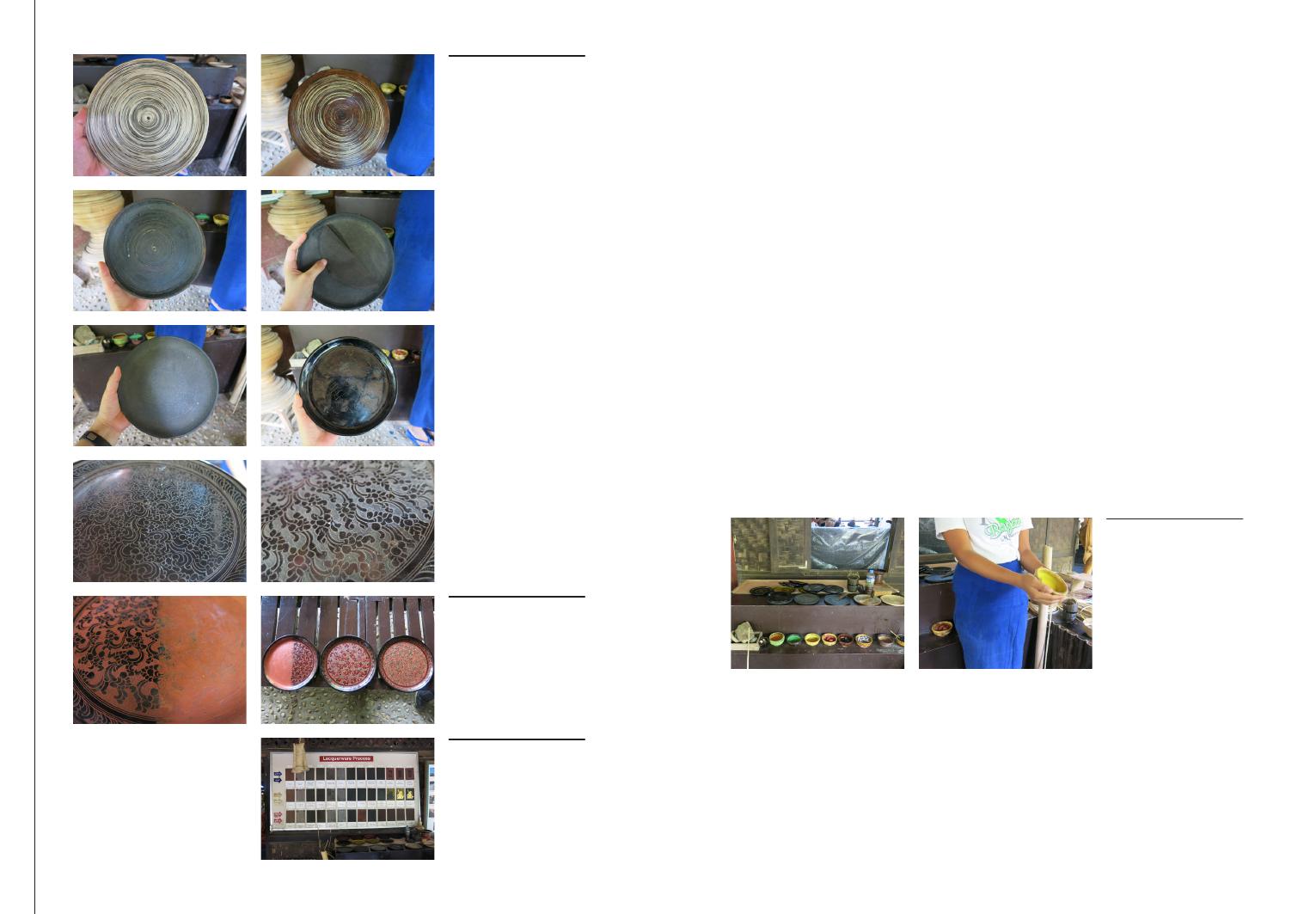
3) Engraving and coloring
The engraving technique characteristic of Myanmar lacquerware
involves direct incisions on the surface of an object using a sharp
metal tool instead of making rough sketch with a pencil of the like. The
whole picture is not engraved at once but is done in steps by staff of
different levels. People who design and incise scenes such as palaces,
monasteries, and forests are called yun hsin. Those who are in charge
of detailed images such as clothes, face, appearance, and flower petals
are called yun kwei and consists of women who have nimble hands.
Once the picture has been engraved, a separate team of staff is formed
to add color to the incised lines.
The work of coloring the incised lines is always carried out in the order of
red, green and yel ow (or orange). The workers are never confused about
this order. In addition to the four colors, other colors are developed by
mixing pigments together or adding indigo.
Once a color is completely dry, acacia adhesive (or acacia resin) is
applied overal . When this is dry, a coarse textured cloth is used to
remove the pigments on the surface other than the incised lines. This
process is cal ed yun hpaw, which means ‘to open/reveal the design.’
This process is carried out for each color as the acacia adhesive works
as a seal to prevent colors from getting mixed (Ma Thanegi, 2013).
Fig. 13
Lacquering process.
Fig. 14
Stages of completing
lacquerware.
Fig. 15
Surface characteristics
according to number
of lacquer coating and
material.
Fig. 16
Materials for coloring.
4) Other materials
(
1) Clay decoration
A distinguishing technique for decorating lacquerware surface is clay
decoration. Lacquer is mixed with ash made from burned animal bones
or wood to make a clay-like material, which is cal ed thayo. This material
is transformed into a thin thread, which is used and attached in pieces
on the surface of the lacquerware to express embossed decorative
patterns.
78
79
Yo
ng J
ae C
hu
ng | J
ia Y
u | G
yu H
yu
k C
ho | S
eo
ng E
un K
im
A S
ur
ve
y a
nd S
cie
nti
fic a
na
lys
is o
f n
at
ura
l a
dh
es
ive
s i
n M
ya
nm
ar
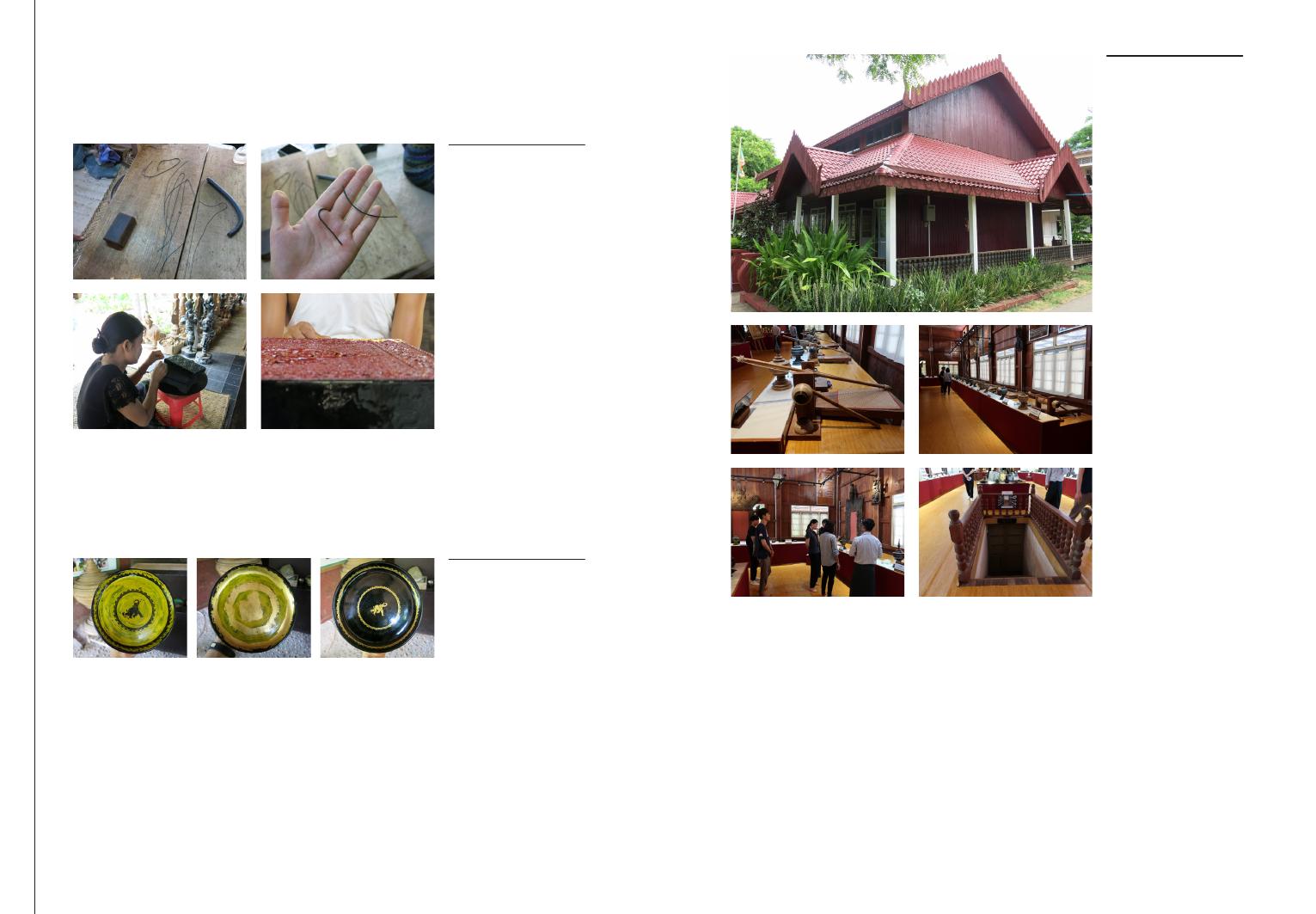
Wood ash is usual y used in modern times, and ash made from burned
nipa palm leaves after they have removed of the thick bark is considered
good quality ash. Thayo is used when fine work is needed. Otherwise, dry
feces of cow is sometimes mixed instead of ash.
Fig. 17
Clay decoration made
from using lacquer and
ash.
Fig. 19
Exhibition hall in the
Lacquerware Museum.
Fig. 18
Gilt techniques using
yel ow pigment.
(
2) Gilt decoration
Gold leaf or gilt is used to decorate the surface of lacquerware with
gold. A yel ow pigment is applied to the area not applied with gold for
enhanced adhesion effect. After the gold-leaf is completely attached,
the yel ow coat is washed off with water.
2. Research on lacquerware museum
The Lacquerware Museum is located on the campus of Lacquerware
Technology College and exhibits various lacquer-related tools and
materials. Entrance to the basement drying room is in the center of the
exhibition hall.
Outside the Lacquerware Museum, a map showing lacquer plantation
sites and lacquerware production sites is displayed along with actual
lacquer trees (Melanorrhoea usitata) being cultivated. Myanmar is
currently planting lacquer trees in 21 cities, including Inlay and Nat Ma
Taung. Lacquer workshops are operated in four cities: Mandalay, the
ancient capital city of Bagan, Kyauk Kar and Kuankion.
80
81
Yo
ng J
ae C
hu
ng | J
ia Y
u | G
yu H
yu
k C
ho | S
eo
ng E
un K
im
A S
ur
ve
y a
nd S
cie
nti
fic a
na
lys
is o
f n
at
ura
l a
dh
es
ive
s i
n M
ya
nm
ar
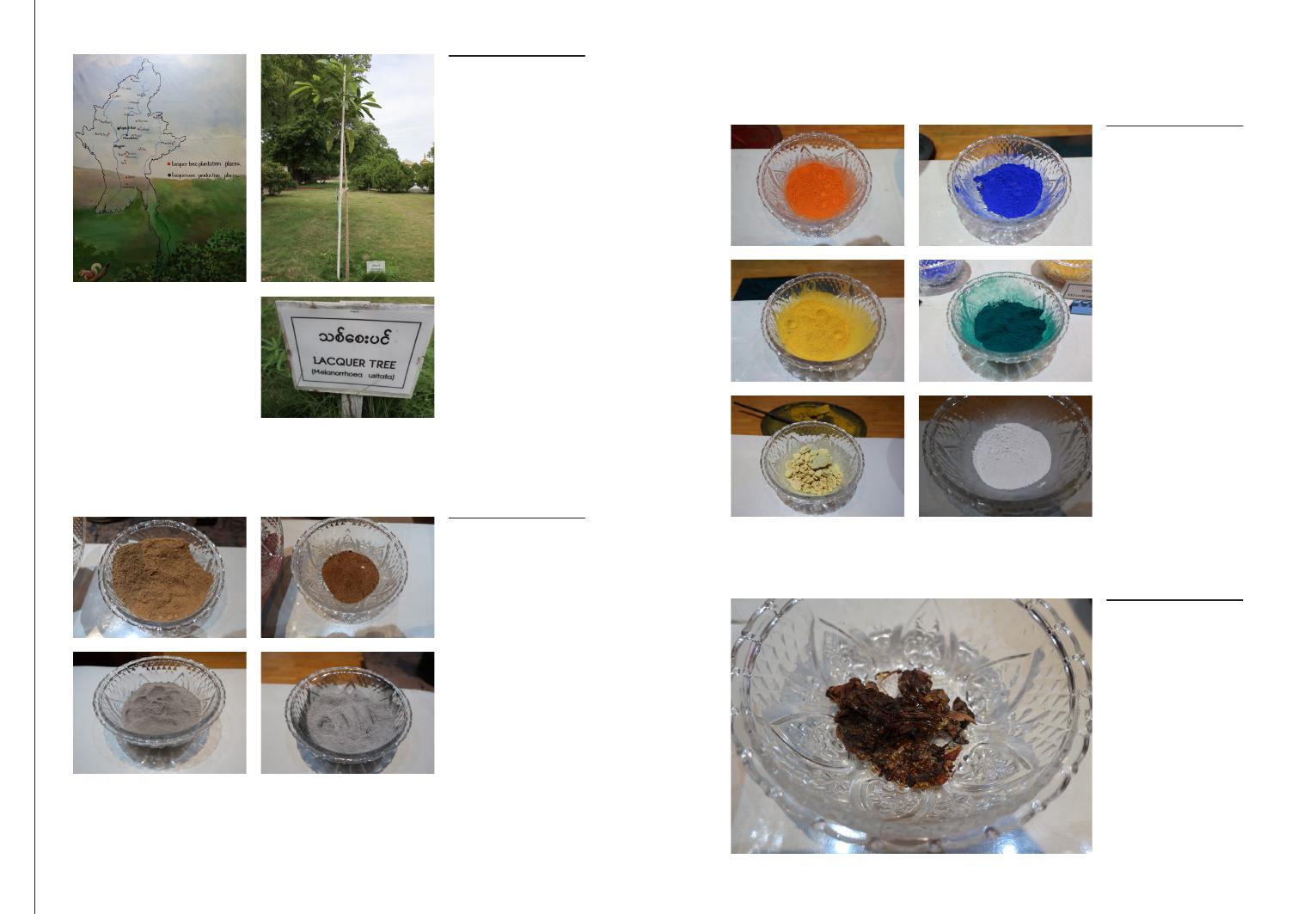
In the exhibition hall inside
the Lacquerware Museum,
models showing each stage
of lacquerware production
and actual materials used in
lacquerware are displayed
a l o n g w i th ex p l a n a ti o n
about the materials.
Materials mixed with lacquer for application include sawdust, clay
powder, animal bone-ash, charcoal powder and so on.
According to the displayed items and descriptions, materials used for
coloring include vermilion pigment is used for red, indigo for blue, yellow
orpiment and chrome yel ow for yel ow, and a mixture of yel ow orpiment
Fig. 20
Map of lacquer tree
plantation sites and
lacquerware production
sites and lacquer tree
growing the Lacquerware
Museum.
Sawdust
Bone-ash
Clay powder
Charcoal powder
Fig. 21
Materials mixed with
lacquer for application.
Fig. 22
Materials used for coloring.
Fig. 23
Neem resin.
and indigo for green. Judging from the particle and color of the
pigments and dyes, the displayed items did not appear to be traditional
natural materials.
Vermilion
Yellow orpiment
Chrome yellow
Indigo
Titanium oxide
Yel ow orpiment & Indigo
In addition, neem resin collected from neem tree was exhibited along
with models showing each stage of lacquerware production.
82
83
Yo
ng J
ae C
hu
ng | J
ia Y
u | G
yu H
yu
k C
ho | S
eo
ng E
un K
im
A S
ur
ve
y a
nd S
cie
nti
fic a
na
lys
is o
f n
at
ura
l a
dh
es
ive
s i
n M
ya
nm
ar
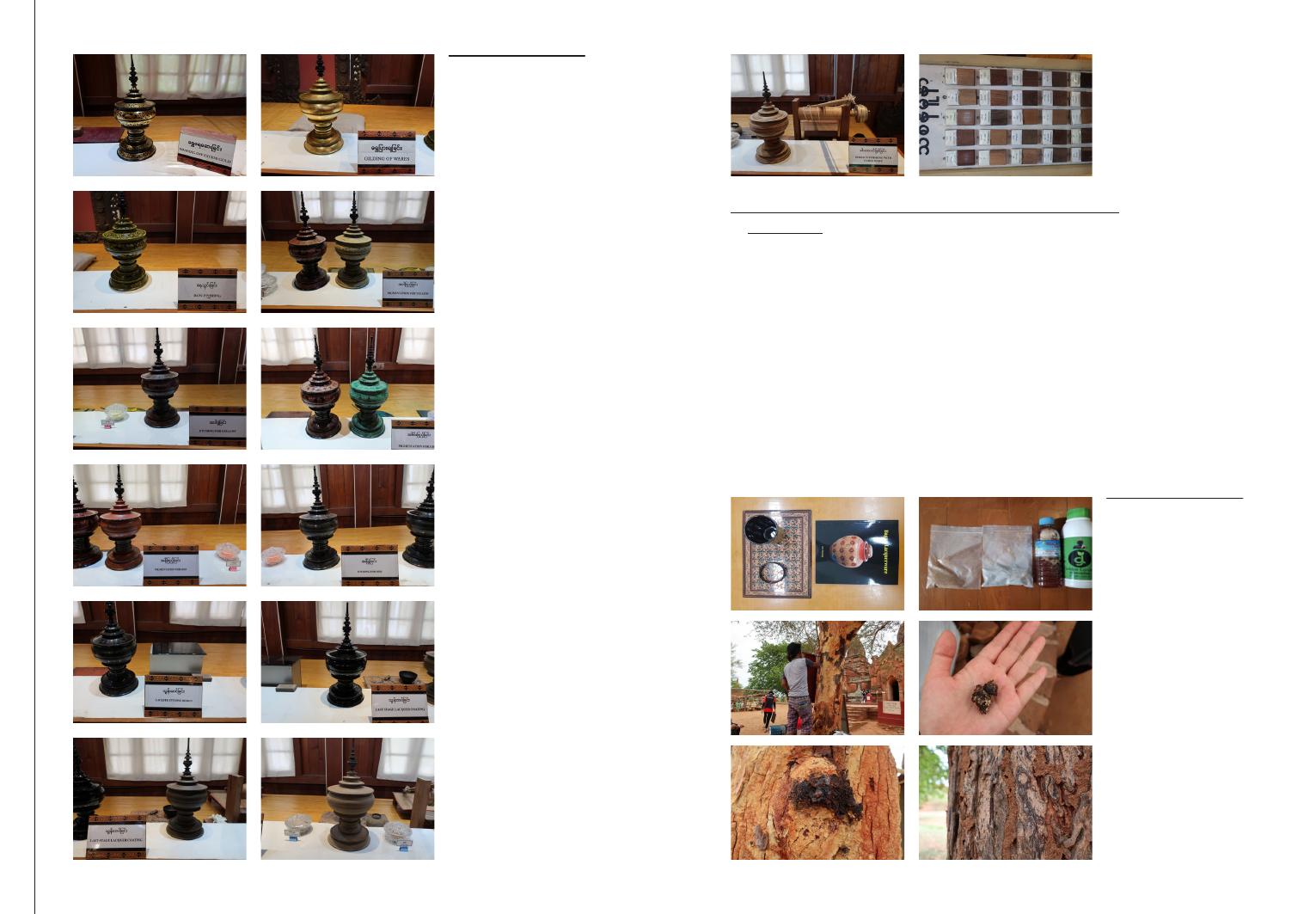
Fig. 24
Models representing each
stage of lacquerware
production.
Fig. 25
Collected materials.
1. Collection of Myanmar lacquer materials
Lacquerwares currently sold in lacquerware workshops were purchased
and used as specimens for analysis. The specimens collected were
bamboo tray, bracelet and drinking cup. As comparison data, lacquer,
acacia resin, and neem resin, which are actually used in Bagan
lacquerware workshops were col ected from a large lacquerware
workshop in Bagan.
In addition, with the help of a staff working for the Department of
Archaeology of Bagan city, resin was harvested directly from one of the
native acacia tree growing in Bagan. All natural materials were col ected
with permission of the Department of Archaeology
Ⅲ
Scientific analysis of Myanmar traditional lacquer
materials.
84
85
Yo
ng J
ae C
hu
ng | J
ia Y
u | G
yu H
yu
k C
ho | S
eo
ng E
un K
im
A S
ur
ve
y a
nd S
cie
nti
fic a
na
lys
is o
f n
at
ura
l a
dh
es
ive
s i
n M
ya
nm
ar
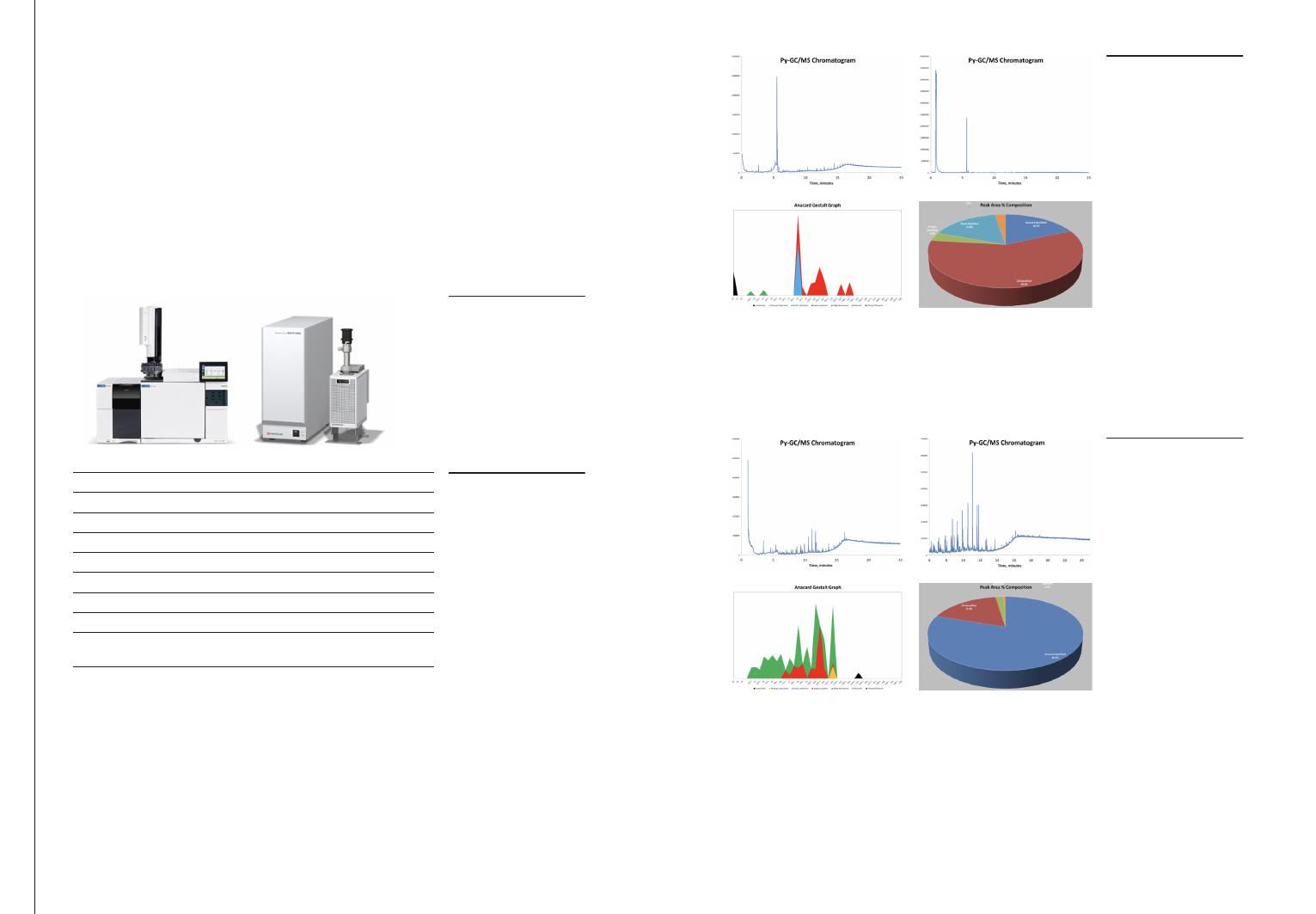
2. Scientific analysis
(
1) Conditions of analysis
Materials in liquid state were respectively applied on a slide glass
and left to dry and transform into a film before analysis. As for the
lacquerwares, a part of them were cut out with a small tool and used for
analysis, In addition to Myanmar materials, two types of Korean lacquer
(
raw and refined) were analyzed for comparison. The equipment and
conditions used for the analysis are shown below. Analysis results were
interpreted according to the data analysis and interpretation protocol
for lacquer (Recent Advances in Characterizing Asian Lacquer report) by
the Getty Conservation Institute using AMDIS (Automated Mass Spectral
Deconvolution and Identification System).
(
2) Analysis results of Korean lacquer
Analysis results of Korean lacquer samples indicated that the main
component of both raw and refined lacquer samples was Urushiol
derived from Korean native lacquer tree. Because the samples were
diluted materials, large amount of fatty acid compounds derived from
oil were identified.
(3) Analysis results of collected materials
①
Lacquerwares produced at lacquerware workshops
The results showed marked differences from that of Korean lacquer. The
main component identified was thitsiol which is found in lacquer from
lacquer trees native to Southeast Asia.
②
Acacia resin
A variety of compounds found in proteins, cel ulose, tannins, etc. were
identified in large amount. It was judged that various analysis conditions
are necessary for more accurate analysis.
Item of condition
Details
Pyrolyzer
550℃
Oven
40℃ (for 2min) → 320℃ (20℃/min)
Inlet
320℃ (50:1)
Gas
He gas (>99.999%, 1ml/min)
m/z
33 to 600 amu
MS Source
230℃
MS Quad
150℃
- Pyrolyzer : 3030D, Frontier Lab, Japan
- GC/MS : 3890A/5975C, Agilent, USA
Fig. 26
Equipment used for
analysis (pyrolysis-gas
chromatography-mass
spectrometry).
Fig. 27
Analysis results of Korean
lacquer.
Fig. 28
Analysis results of
lacquerware produced at
lacquerware workshop.
Table 3
Conditions applied for
analysis
<Raw lacquer>
<Refined lacquer>
<Black piece>
<Brown piece>
86
87
Yo
ng J
ae C
hu
ng | J
ia Y
u | G
yu H
yu
k C
ho | S
eo
ng E
un K
im
A S
ur
ve
y a
nd S
cie
nti
fic a
na
lys
is o
f n
at
ura
l a
dh
es
ive
s i
n M
ya
nm
ar

Fig. 29
Analysis results of acacia
resin.
Myanmar is one of the most famous countries in the world for its
Buddhist remains. Traditional arts and crafts of Myanmar have been
preserved relatively well due to various political reasons that prevented
the nation from communicating with the outside world for about 26
years since 1962. In particular, the traditional lacquer technique called
‘
yun/yunde’ remains intact to this day. The aim of this study was to
document the traditional lacquer technique of Myanmar and to analyze
the components of lacquer used in lacquerwares today by collecting
materials and conducting a scientific analysis.
One of the major characteristics of Myanmar traditional lacquer
technique is the engraving technique and the clay decoration, which
are used on the surface of lacquerware to express relief. Myanmar
traditional lacquerware is also characterized by the use of tree sap other
lacquer as adhesives and sealants, such as acacia resin and neem
resin.
As a result of investigating various lacquerware workshops, it was
found that the base materials are made to be very light with the use of
bamboo strips and horsehair. According to the 2018 research findings on
Laos traditional lacquerware, plant leaves were used with adhesives to
make the base materials for lacquerware. In contrast to such practice in
Laos, it was found that a unique way of stacking bamboo strips without
using adhesives has been adopted in Myanmar lacquerware and that
this unique technique features the use of grooves and assembly. To fil
the fine holes in the base material, a base coat is applied on the surface,
which is then sanded with sandpaper. This technique was common in
Asia including Korea that traditional y used lacquer technique.
The species of lacquer tree growing in each region differs, and the
components of lacquer sap vary depending on the natural habitat. The
species of lacquer tree natural y growing in Korea, China, Japan and so
on is Rhus verniciflua which contains urushiol as its main component.
Ⅳ
Conclusion
Rhus succedanea Linnaeu containing laccol as its main component
is native to Vietnam and Taiwan. The species of lacquer tree naturally
growing in Myanmar, India, Cambodia, and Thailand is Melanorrhoea
usitata which contains thitsiol as its main component (Rong Lu, 2015). As
a result of analyzing the lacquer col ected from and currently used by
lacquerware workshops in Myanmar, thitsiol was identified as the main
component.
When the lacquering process is completed, patterns or pictures are
incised on the surface with a sharp metal tool. After the engraving
process, the lacquerware is colored with acacia resin and pigment.
At this time, the acacia resin serves as a seal to protect the surface,
preventing the pigments sequentially applied from getting mixed.
In addition to engraving technique, Myanmar lacquerware is also
characterized by clay decoration. The material for clay decoration is
made from mixing lacquer with animal bone or wood ash. The mixture
is made into a thin thread which is used in pieces on the surface of
lacquerwares to express embossed carving.
This study is meaningful in that it documented the traditional lacquer
technique of Myanmar and confirmed the use and characteristics of
related materials. It is expected that the findings of this study will be used
in various ways in future studies on Myanmar traditional lacquerware
that have not been studied extensively until now. Furthermore, the
findings of this study may be useful in conducting comparative studies
on lacquer by period and region by comparing Southeast Asian lacquer
materials and techniques.
88
89
Yo
ng J
ae C
hu
ng | J
ia Y
u | G
yu H
yu
k C
ho | S
eo
ng E
un K
im
A S
ur
ve
y a
nd S
cie
nti
fic a
na
lys
is o
f n
at
ura
l a
dh
es
ive
s i
n M
ya
nm
ar

References
Korean International Cooperation Agency, 2014.
Fourth Quarter Construction
Report on Myanmar.
Thanegi, Ma. 2013.
Bagan Lacquerware.
UNIDO, 2014.
Diagnostic Study on a Lacquerware Cluster in Bagan and Nyang-U,
Myanmar.
Lu, Rong & Muyakoshi, Tesuo. 2015.
Lacquer Chemistry and Application, Elsevier
90
Yo
ng J
ae C
hu
ng | J
ia Y
u | G
yu H
yu
k C
ho | S
eo
ng E
un K
im
A S
ur
ve
y a
nd S
cie
nti
fic a
na
lys
is o
f n
at
ura
l a
dh
es
ive
s i
n M
ya
nm
ar

2. Research Methodology
In order to construct the database for Asian-Pacific traditional materials
and technique and serve the data as open source, the results of previous
field surveys should be examined. This research aims to discuss how
to collect, categorize, register and manage the surveyed data for DB
construction.
1) Research Design
The research focuses on fundraising the budget for database and website
construction for Asian-Pacific traditional materials and technique. So the
table of contents is as fol ows.
01
머리말
02
데이터
03
데이터베이스
04
누리집
05
맺음말
▶
연구 개요
▶
연구 방향
▶
데이터 관리
▶
데이터 수집 유형
▶
데이터베이스 정의
▶
구축방법
▶
데이터베이스 관리
▶
SW사법 대가산정 가이드
▶
아카이브 사이트 사례
▶
아시아, 태평양 전통재료 및 기술공법 누리집 개설 방향
▶
데이터베이스와 웹사이트
▶
사용자 제작
Data refers to facts or values col ected through simple observation or
measurement. It includes all the raw figures before processing such as
the furniture in the room, the width of the closet and the brightness of
the bulb.
1. Defining the Data
Defining the data is the basis to determine the data owner. So the scope
and qualification requirements of data must be clearly defined and
indicated in working process so that users can understand the meaning
of data. In addition, data definition must enhance users’ understanding
by delivering what data name alone cannot express. There are three
things to consider in defining the data.
First, it must be described from the view of a third party who does not
know related tasks so that the data user can understand the meaning of
data. Second data value must be accompanied with defining the data,
when it is difficult to deliver the meaning of data. Lastly, data names
must be described without using abbreviations or terminology.
Ⅱ
Data
KNUCH, Dept. of Heritage Conservation
and Restoration, Graduate School
of Cultural Heritage
Prof. Young Jae Kim
Researcher. Junghee Lee
Researcher. Byeongsu Ryu
Researcher. Mikyong Kwon
Researcher. Jihyeon Lee
1. Research Overview
This research will discuss how to provide the digital data on the
disappearing traditional materials and technique. The data
had been collected and accumulated through technical field
surveys for conservation and restoration of Asia-Pacific cultural
heritage.
The goal of the research is to build the archiving website for
constructing database and sharing the data with heritage
professionals throughout the world. In cooperation with UNESCO,
it is expected to support research and professional training
activities in the fields of heritage conservation and restoration.
The research project of UNESCO chair programme will lead
Korea National University of Cultural Heritage to serve as a hub
for Asian-Pacific heritage related fields through technical fields
surveys, training programs and students exchange activities in
architecture, textiles and conservation science.
Fig. 1
The Background of DB
Construction for Asian-
Pacific traditional materials
& technique
The Construction of
Database for Asia-Pacific
Traditional Materials
and Technique
92
93
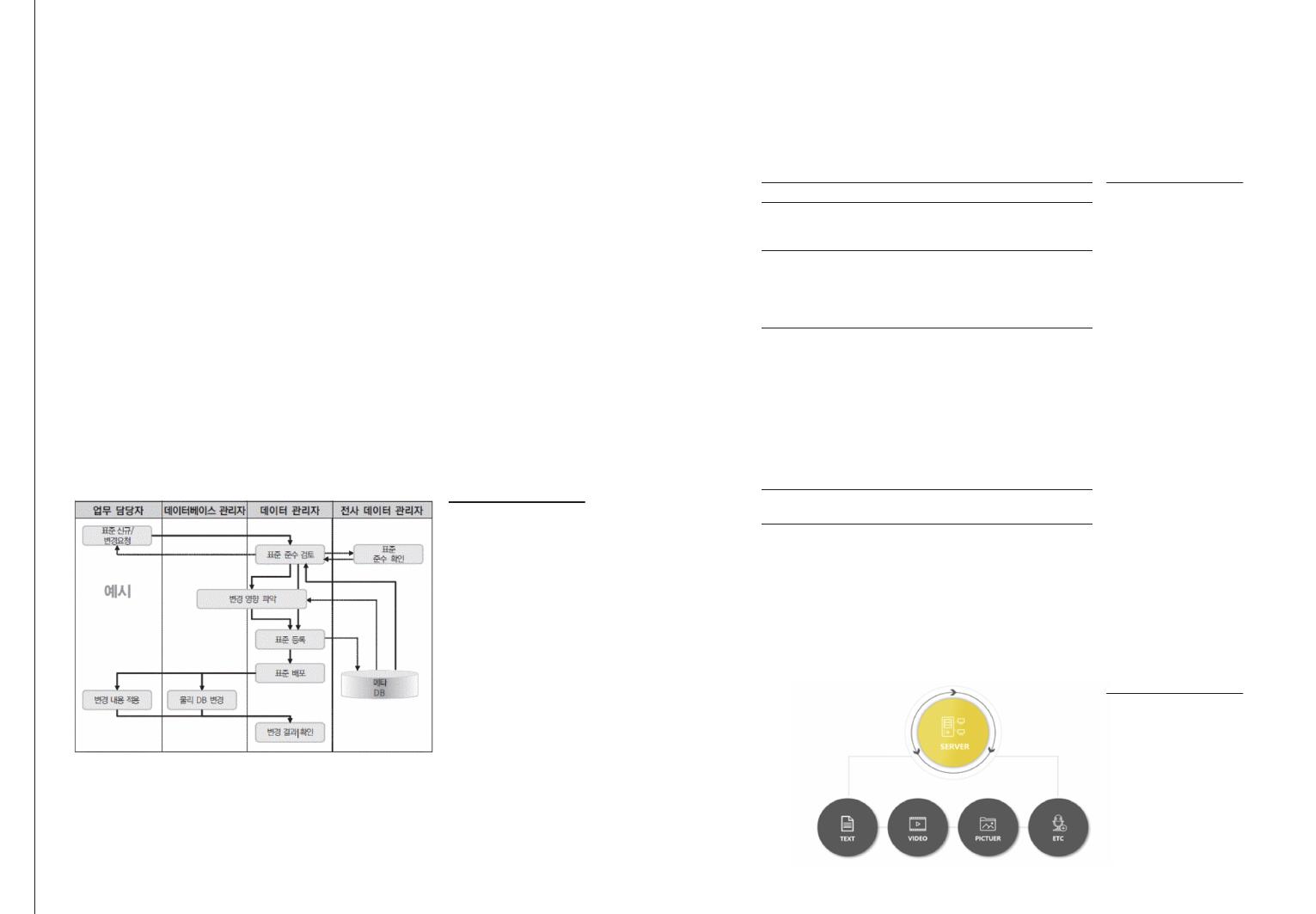
2. Managing the Data
1) The Overview of Data Standards Management
After defining and standardizing the components of data, the
management process based on data standards must be established
and operated.
2) The Types of Data Standards Management Process
Among many processes for data standards management, the essential
ones are as fol ows : The process to deal with the new requirements
of data standards while operating and developing the existing data
standards. The process to analyze the impacts on related elements,
models, and programs when data standards are changed or deleted.
The process to check and verify whether the rules of data standard are
being applied correctly.
3) The Components of Data Standards Management Process
(
1) Process : It ensures that defined data standards are correctly
applied. It monitors compliance with the data standards and take
countermeasures. It defines the overall business process when
data standards are changed or deleted.
3. Collecting the Data
The data types col ected through the field surveys on Asian-Pacific
traditional materials and technique are classified into text, video,
photographs etc. Data classification is based on digital file extension
and the characteristics of data. The surveyors must submit all the data
col ected during the survey to the data manager who must register the
data on the database without exception.
Fig. 3
Data Change
Management Process
(
Source: DBguide.net)
(
2) Task
- Standard New/Change Request : The person in charge requests a data
manager to add or change data standard items (standard terminology,
terms, domain, etc.). If there is no standard terms or domain constituting
standard terminology, a new request for the standard terms or domain
is requested.
- Standard Compliance Review : A data manager reviews the request for
compliance with the standards and feeds the results back to the person
in charge. The conformity and redundancy of terminology must be
checked when verifying compliance with the standards.
(
3) Role & Task
Role
Task
Business Person Requesting standard new and change requests
Applying changes as instructed by a data
manager
Database
Manager
Cooperating to identify the impact of change
and sub mitting an evaluation report
Applying changes as instructed by a data
manager
Verifying data : notifying the result of application
Data manager Reviewing new and changes requested by a
business person and checking compliance
Establishing a revision plan after analysing and
reporting the impact of change
Compliance check, meta DB standard
registration
Disseminating new and changed standards
after registration on the meta DB
Checking the result of change after instructing
the person in charge and a database
administrator
Enterprise data
manager
Proposing the data standard guidance at the
enterprise level
Table 1
Role and Task
(
Source: DBguide.net)
Fig. 4
Types of the Col ected Data
94
95
Th
e C
on
str
uc
tio
n o
f D
ata
ba
se f
or A
sia
-P
ac
ific T
ra
dit
io
na
l
M
ate
rials
and
T
ec
hn
iq
ue
Yo
un
g J
ae K
im | J
un
gh
ee L
ee | B
ye
on
gs
u R
yu | M
iky
on
g K
w
on | J
ih
ye
on L
ee
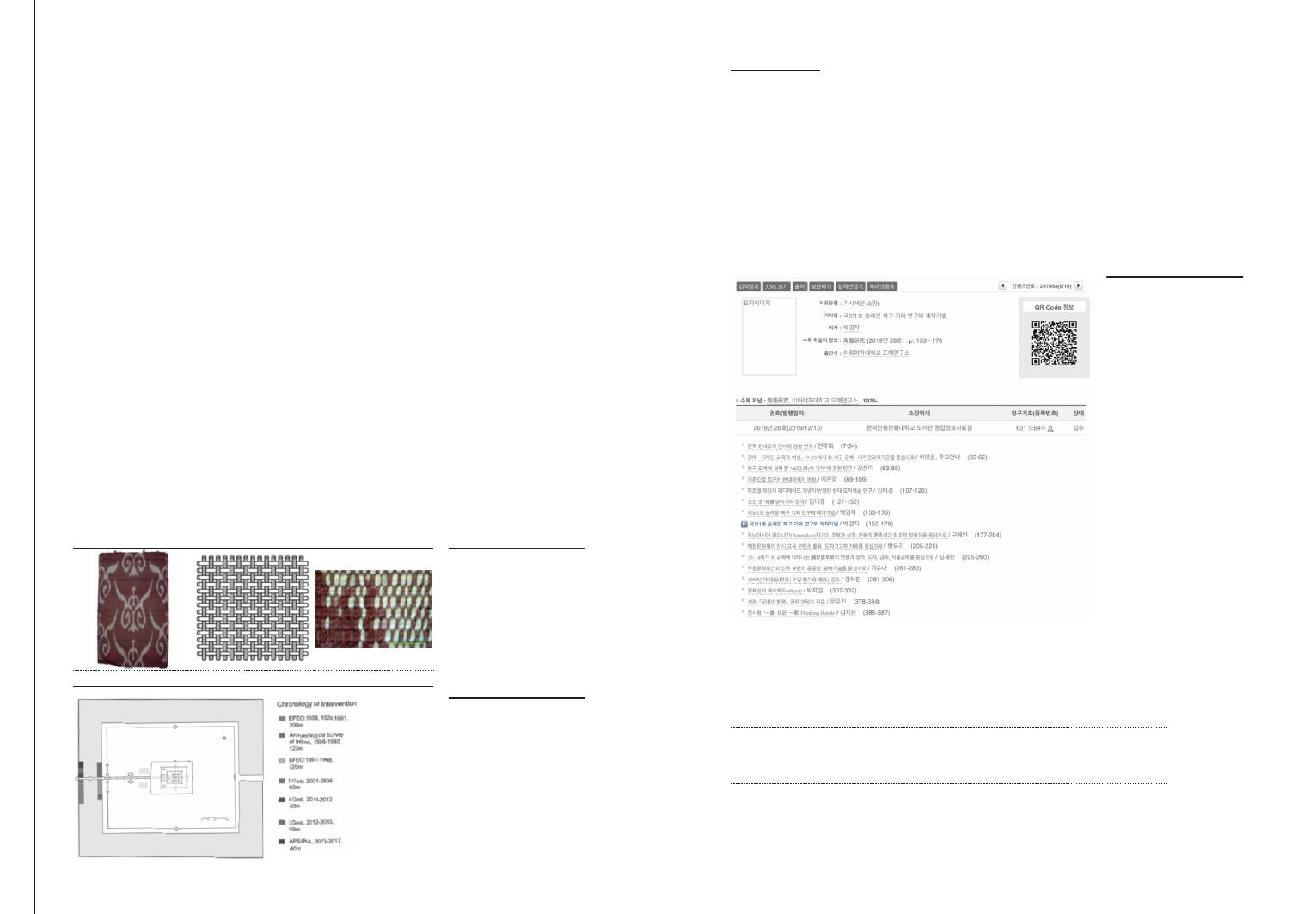
1) Text
Text refers to the materials printed on paper in the form of documents
and the data which can be recognized as text on a computer, including
books, brochures, reports, etc. The Col ections like pamphlets, brochures,
etc. can be serviced in the form of scanned image.
2) Video
Considering the characteristics of traditional materials and technique,
video is very useful to record the skil s, experience and knowledge of the
artisans like human cultural assets. Since video is more effective than
image and text in delivering information, it must be serviced on the
archive website to be planned in this research programme.
3) Photo Image
This includes the photos taken by researchers and all the collected
images.
4) Et cetera
All data types except text, photo and video are classified as the etc.
where the data with the same format is sub-classified under the
same name. For example, drawings are classified into the etc., but it is
reclassified into “drawing”.
아드라스
조직
: 평직
세부(
30배)
Fig. 5
Data Type – Photo, Drawing
Fig. 6
Data Type– Drawing,
‘
Angkor Wat floor plan’
Fig. 7
Academic Information
Center
Korea National University of
Cultural Heritage
1. Database
1) Metadata
Metadata is defined as structured or semi-structured information that
enables to produce, manage and use records. That is, metadata is for
efficient search and use of the target data among a large amount of
data. It is easy to understand when you think of a book card or tag which
is based on title, author or classification code as a list of books in a
library.
Ⅲ
Database
✓
Descriptive metadata
✓
Administrative
metadata
✓
Structural metadata
The data for searching information resources
like a book card.
The data for easy management of resources
with managing access to when and how data
was created.
The data for describing the type, record and
components of data.
The Types of metadata include descriptive metadata, administrative
metadata, and structural metadata.
96
97
Th
e C
on
str
uc
tio
n o
f D
ata
ba
se f
or A
sia
-P
ac
ific T
ra
dit
io
na
l
M
ate
rials
and
T
ec
hn
iq
ue
Yo
un
g J
ae K
im | J
un
gh
ee L
ee | B
ye
on
gs
u R
yu | M
iky
on
g K
w
on | J
ih
ye
on L
ee
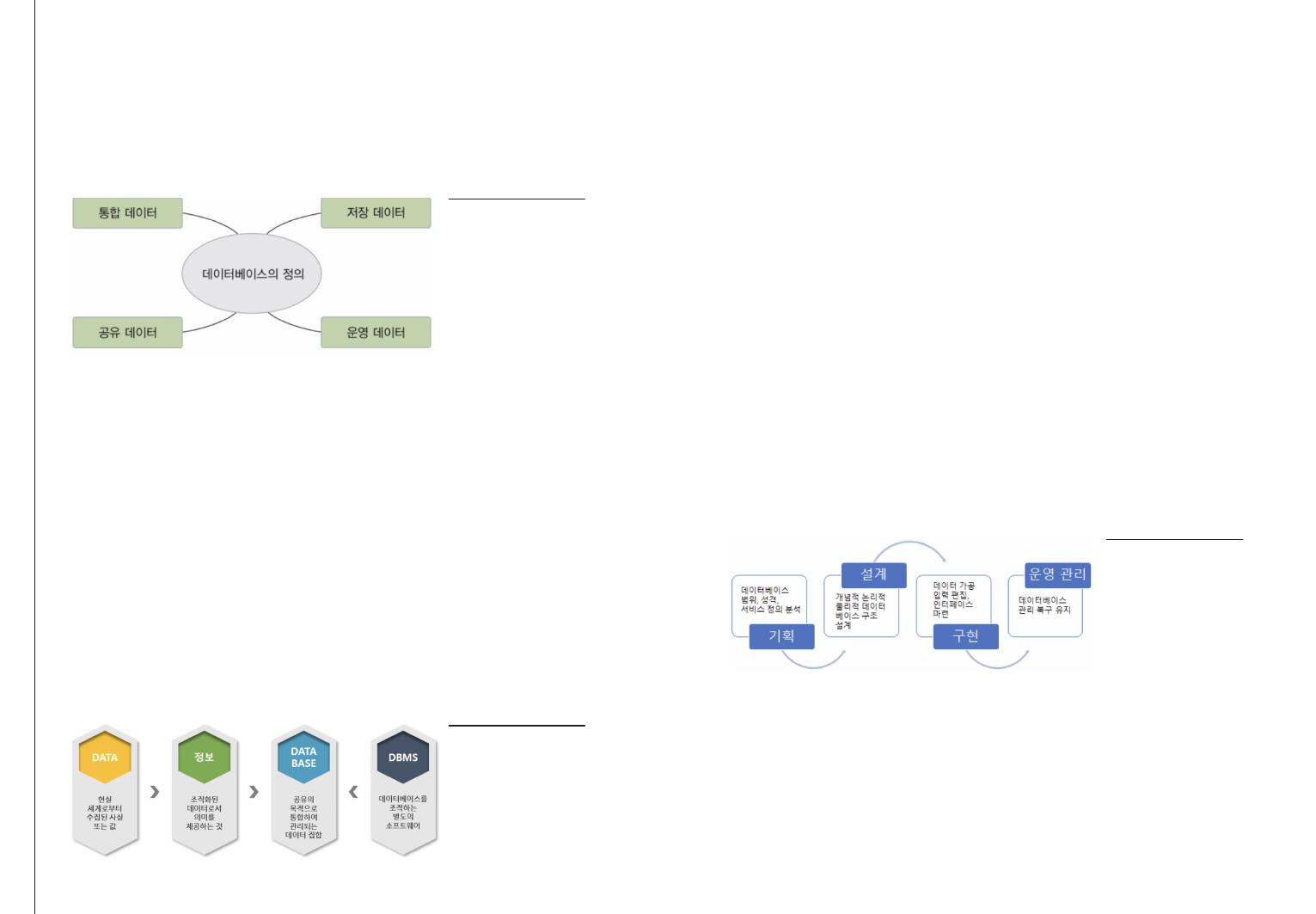
2) Database
(
1) Definition
Database is defined as a set of operational data that is integrated and
stored so that processed data can be shared and used by multiple
users. It can be specified in four ways : sharing, integration, storage, and
operation.
1) Planning
Database planning process is the stage that defines all matters related
to database construction. In the planning stage, the target of database
construction is selected, and the market demand survey and economic
feasibility analysis are conducted. This leads to defining the scope,
features and service of database. For the effective use of database in
the information market, marketing strategies are established and in-
depth researches on database copyright, construction cost, and quality
control are also conducted.
(
2) Characteristics of database
Database has four characteristics.
▶
Real-time access is possible
It must be able to respond to the user's data needs in real time.
▶
Continuous change is possible
Data must be inserted, deleted and modified continuously to maintain
the accuracy of data.
▶
Simultaneous sharing is possible
It must be serviced for multiple users at the same time.
▶
Reference to the contents is possible
It must be able to refer to content rather than stored address or location.
2. DB Construction Process
Database construction process consists of four phases, which are
planning, design, implementation, operation & maintenance. In the
planning phase, the scope, characteristics, and service of database
are defined. The second phase is logical and physical structure design
based on conceptual DB modeling. In the stage of implementation, data
is registered and processed with interface with search system. In the last
phase of operation & maintenance, database is managed, repaired and
recovered.
Fig. 9
Definition of Database
(
Source:Yeonhee Kim,
Introduction to Database,
Naver Encyclopedia)
Fig. 10
Definition of Data and
Database
Fig. 11
DB Construction Process
▶
Integrated data
Database does not al ow data redundancy where duplicate data exists.
▶
Storage data
Database must be stored on the computer-accessible medium, since
most data is processed by a computer,
▶
Shared data
Database is the public data that can be owned and used by multiple
users in a particular organization.
▶
Operational data
Database is to run an organization and to perform its main functions,
which requires consistency.
The software that manipulates database is called database
management system (DBMS). DBMS is responsible for integrating, storing
and managing data for the organization.
98
99
Th
e C
on
str
uc
tio
n o
f D
ata
ba
se f
or A
sia
-P
ac
ific T
ra
dit
io
na
l
M
ate
rials
and
T
ec
hn
iq
ue
Yo
un
g J
ae K
im | J
un
gh
ee L
ee | B
ye
on
gs
u R
yu | M
iky
on
g K
w
on | J
ih
ye
on L
ee

(
1) Defining the Scope, Features and Service of Database
The scope of database is limited by the definition of the specific purpose
for which database is to be built. The stage of database definition
covers data content, format, scale, data analysis method, the degree
and processing method of analyzed data, the content, format, size of
information, and searching method. The scope of work and use are also
defined with a series of processes for building the database.
Defining the features of database depends on the purpose and scope of
the database for the user's effective use of the col ected and analyzed
data. It is defined by data format(medium), data items, DB service
method, usage paths, etc.
(
2) Copyright
In the database planning stage, database-related copyright analysis is
needed.
The Copyright in a database is given to the database creator, who
has collected, selected, analyzed, processed, and accumulated the
information. In general, the database creator becomes the copyright
holder. Copyright includes economic rights for the owner’s use of the
property and moral rights for the protection of personal interests such
as honor, reputation, etc.
When building a database, the copyright of source data must be
protected. In the case of reproducing copyrighted work, there is a
possibility of illegality. Therefore, when collecting and accumulating
original data in a database, it is necessary to check the copyright
of data. If the copyright of source data is recognized, the database
creator must obtain permission from the copyright holder to use the
copyrighted work.
2) Design
Database design process can be divided into conceptual model design,
logical architecture design, and physical structure design. Conceptual
model design simplifies, abstracts, and conceptualizes the information
structure that a database wants to represent. It often applies the Entity-
Relationship (E-R) model. The logical architecture design uses a data
model to implement the data obtained through conceptual modeling
into the database. In general, conceptual modeling and logical
modeling are not clearly distinguished, which are collectively called
data modeling. Physical structure design involves selecting the structure
and form of data record, file storage, and record approach according to
logical architecture design.
3) Implementation
Database implementation is the stage to construct a database
specifical y. In this stage, the data to be built into the database is
collected. Data processing work to classify, index and abstract data is
carried out for easy and convenient use. The software is designed and
instal ed to perform storage and search function through data input.
Software implementations include in-house development, outsourcing,
and the purchase of a commercial database management system
(
DBMS). In the case of a large database for a large number of users, it
is desirable to purchase a commercial DBMS with high reliability and
functionality, and utilize its development tools, applications, and utilities.
On the other hand, if a small database or simple search function is
needed, the development of in-house software is advantageous
for implementing the system specification. Until now, database
implementation has been recognized only as the process of writing a
program or installing a system. In practice, however, what is important
at the implementation stage is collecting, processing and registering
the data. This is because the adequacy of data col ection is directly
related to the quality of the database being built. In addition, data
processing must be able to satisfy the user's demand for diverse and
advanced knowledge by not only editing, arranging, or sorting, but also
summarizing, extracting, and classifying the data with professional data
analysis.
Fig. 16
Example of SQL Statements
for Implementing
Relationship
(
Source: Naver Encyclopedia)
100
101
Th
e C
on
str
uc
tio
n o
f D
ata
ba
se f
or A
sia
-P
ac
ific T
ra
dit
io
na
l
M
ate
rials
and
T
ec
hn
iq
ue
Yo
un
g J
ae K
im | J
un
gh
ee L
ee | B
ye
on
gs
u R
yu | M
iky
on
g K
w
on | J
ih
ye
on L
ee

3. Database Management
1) Database Management System
In the past, the file system was used as a software for data management.
It is the information processing system that has been used for a long
time. The file system provides functions to create, delete, modify, and
search files for data management. It is installed with the operating
system. The system manages application-specific data in a separate
file. The file system has the advantage that it does not cost a separate
purchase. As each application requires a separate file, it has the
following problems.
The data with the same content is stored in multiple files.
The application is dependent on data file.
Simultaneous sharing, security and recovery of data files is limited
Application development is not easy.
The primary solution to these problems is to integrate and store
data. However, there is still a need for something new that manages
integrated data and handles the data common to all applications, while
providing the function of simultaneous sharing, security and recovery.
And an alternative to this is the database management system.
Database management system is defined as the software system that
manages the database shared by all applications, which is the mediator
of applications and data.
Basical y database started from the concept of data storage. However,
the development of DBMS is essential to use application programs for
data storage, search and management.
The essential functions of DBMS include definition function that defines
the most appropriate database structure to support various data
needs of multiple users in a single database, manipulation function
that supports DB user interface and control function that maintains the
accuracy and safety of database contents.
Definition
function
Defining and modifying database structure.
Manipulation
function
Inserting, deleting, modifying, and searching data
Control
function
Maintaining the accuracy and safety of data
Table 2
Key Features of Database
Management System
(
Source: Naver Encyclopedia)
Table 3
Advantages &
Disadvantages of
Database Management
Systems
(
Source: Naver Encyclopedia)
Database management system has many advantages, but it is not
suitable for all situations. The following are the disadvantages of
database management system.
Database management systems can be developed for
its own system environment or purchased in commercial
package. Self-development can provide the most suitable
system for the desired environment. But due to the time,
cost, and reliability, the commercial DBMS suitable for
requirements is usual y purchased.
Database management system can be divided into three
generations, which include network DBMS, hierarchical
DBMS, relational DBMS and object-oriented DBMS.
Network DBMS and hierarchical DBMS used in the 1960s
and 1970s belong to the first generation. A representative
network DBMS is the Integrated Data Store (IDS) developed
in the early 1960s. The Information Management System (IMS)
developed in the late 1960s is a representative hierarchical
DBMS.
Relational DBMS, which has been in use since the 1980s,
belongs to the second generation. Its technology has
been continuously expanded and the performance has
been improved. It is still widely used and the representative
relational DMBS is Oracle❶, MS SQL Server❷, Access, informix,
MySQL, etc.
Advantage
Disadvantage
Data redundancy can be controlled. High cost is required.
Data independence is ensured.
Backup and recovery methods
are complex.
Simultaneous data sharing is
possible.
There is a vulnerability due to
centralized management
Data security is improved.
Data integrity is maintained.
Data standardization is possible.
Recovery from failures is possible.
The cost for application development
is reduced.
102
103
❶
❷
The Oracle from
Oracle Corporation is a
representative relationship
DMBS. There are four
product families: Enterprise
Edition, Standard Edition,
Standard Edition 1, and
Personal Edition. Enterprise
Edition is ideal for enterprise
environments that require
high performance,
scalability, security, and
reliability to develop large
database systems.
Microsoft's MS SQL Server is a
representative relationship
DMBS. There are four
product families: Enterprise
Edition, Business Intelligence
Edition, Standard Edition,
and Express Edition.
Enterprise Edition is used to
build large data centers or
develop high performance
data warehouse solutions.
Business Intelligence
Edition offers exceptional
capabilities for browser,
data decomposition and
integrated management
based on data exploration
and visualization.
Th
e C
on
str
uc
tio
n o
f D
ata
ba
se f
or A
sia
-P
ac
ific T
ra
dit
io
na
l
M
ate
rials
and
T
ec
hn
iq
ue
Yo
un
g J
ae K
im | J
un
gh
ee L
ee | B
ye
on
gs
u R
yu | M
iky
on
g K
w
on | J
ih
ye
on L
ee

Advantage
Disadvantage
MsSQL
- The product price is low.
- Optimal function and
performance can be
obtained in Window NT.
- It’s central to Microsoft’s
“
Total Solution” strategy.
- Database function is simple.
- Microsoft is not a major DBMS
company, so its
development prospects are
uncertain.
- There is not enough DBMS
experts.
- Database function is simple.
Oracle
- Many users exist.
- Product excel ence was
proven.
- The instal ation on PC
and the mainframe level is
available.
- The strong support for the
3rd party is possible.
- The distributed processing
function is excel ent.
- A lot of hardware resources
is needed to operate DMBS.
- DBMS management is
complex.
- The price is higher than
similar DBMS products.
- Some features of the
product are hard to learn.
Table 4
Advantage and
Disadvantage of
Representative DMBS
Programs
Table 5
Database Quality Criteria
2) Database Management
Continuous and efficient operation following database construction
plays a big role in successful database. Database operation is classified
as the post-processing stage of database construction process. But
it covers the whole mechanism that supports the operation and
maintenance of database.
Database operation and maintenance phase includes database quality
management and monitoring, database recovery measures against
disasters and unexpected events, security enhancements, continuous
maintenance, and lastly database overall evaluation. Operation
and maintenance are typically the longest phase in the time and
performance cycle of database construction and development.
(
1) Quality Management
The quality of database service refers to the desired state of media,
means, method, and source support in the process of data service to
users. In other words, it is not the data itself but the concept of service
that encompasses completeness, accuracy, speed, convenience,
comprehensibility, ease of use and diversity. The quality of database
service can be assessed by several criteria. The general quality criteria
are summarized below.
(
2) Monitoring
Database has goal and performance level to achieve and must be
constantly monitored to check if this is being achieved. If any problems
or deficiencies are found during the monitoring process, tuning action
should be taken and corrected immediately.
There are three ways to monitor database performance, and the optimal
method is selected according to conditions and environment. The first
and most basic method is to record database operation records either
directly by computer or manual y by operator. The second method is to
install the sensor in the computer input/output channel for information
recording or to output contents according to program instructions. The
third one is to survey the user's satisfaction with the service .
(
3) Recovery
Recovery refers to restoring database to its state before problem
occurred.
Problems include hardware failures due to disk or power corruption,
data entry errors, program errors, computer viruses, system problems,
and operator errors.
Therefore, database management system should provide backup, log,
checkpoint, and recovery manager function to recover the database
when problem occurs.
(
4) Maintenance & Repair
Database maintenance is the process of adding, removing, and
modifying the structural features of database to cope with changes
Category Quality Criteria Core Values
Database
Data
quality
Accuracy
Whether data in the database is the same
as the actual value
Completeness Whether it contains important objects and
attributes from the real world that need to
be represented
Currentness
Whether it was updated with the most
recent data
Consistency
Whether two or more data are inconsistent
Database
Service
Quality
Searchability
The speed and sophistication of search
Ease of Use
Database accessibility and output
information utilization through interface
User Support
Suitability of training, documentation, help
services, etc. for users
104
105
Th
e C
on
str
uc
tio
n o
f D
ata
ba
se f
or A
sia
-P
ac
ific T
ra
dit
io
na
l
M
ate
rials
and
T
ec
hn
iq
ue
Yo
un
g J
ae K
im | J
un
gh
ee L
ee | B
ye
on
gs
u R
yu | M
iky
on
g K
w
on | J
ih
ye
on L
ee

in the organization or the business environment, to correct errors in
database design and to improve the processing speed of database
application. This is to ensure that the developed database is used
continuously.
Database maintenance broadly involves testing, tuning, repairing,
and recovering device or module to maintain the optimal condition of
constructed database. Narrowly, it is limited to finding and correcting
various problems and adding new functions. These processes are
performed automatical y by a program or manually by a maintenance
worker.
(
5) Security
The Data stored in a database is shared and used by members of the
organization. If unauthorized outsiders invade the database and corrupt
the data, it takes a lot of time and money to recover the damaged
data. Therefore, control and security is required so that the database is
accessed only by the authorized users.
There are three types to secure database and protect data.
▶
Security in the physical environment
Database must be protected from the risk of natural disasters or
physical damage.
▶
Security through access authority management
The users with access rights are permitted to use the database. Only the
user whose account is issued can access the database. And the scope
of use and task must be limited.
▶
Security through Operation & Management
Even if a user uses the database within the authority, the user may be
able to violate the data integrity due to mistakes, so that the correct
constraints must be defined and control ed so as not to be violated.
4. Software Engineering Cost Estimation
Guidelines❸
The cost of database construction and management is
based on the SW Engineering Cost Estimation Guidelines.
The database construction cost covers the cost of processes
to preserve the original data source such as documents and
provide database service for the efficient use.
Digitalizing documents by text input method
Digitalizing documents by page-by-page scanning or photographing
Constructing metadata for the database service of document index
Digitalizing documentary materials
Digitalizing video and audio materials
Producing and processing specialized data contents for the advanced
data service
The database construction cost is calculated based on the degree
of data processing, which is divided into general process, specialized
process with experts, and additional process beyond the planned
construction period. The database construction cost is calculated as the
sum of direct labor costs, material costs, profits, and direct expenses. of
which the standard labor cost is reported in the guidelines.
What must be considered for database construction according to the
guide is as fol ows.
Archiving the original data source
- Storing the original source in one or separated place
Managing the import and export of the data source.
- Cataloging the data
Producing the data
- Scanning and editing
- Video editing
Producing the metadata
- Translation of the foreign data
- Production and input verification
Most of the heritage websites related to UNESCO Chair Programmes
have provided brief information to introduce the programme and
announce the news.
It was found that database construction or archiving service had not
been conducted in depth on those websites.
1. Archive Site Cases
1) Gugak Archive, Traditional Korean Music Archive
Ⅳ
Case Analysis of Heritage Archive Website
106
107
❸
Korea Software Industry
Association, 2019, Software
Engineering Cost Estimation
Guidelines (2019 revised
edition)
Th
e C
on
str
uc
tio
n o
f D
ata
ba
se f
or A
sia
-P
ac
ific T
ra
dit
io
na
l
M
ate
rials
and
T
ec
hn
iq
ue
Yo
un
g J
ae K
im | J
un
gh
ee L
ee | B
ye
on
gs
u R
yu | M
iky
on
g K
w
on | J
ih
ye
on L
ee
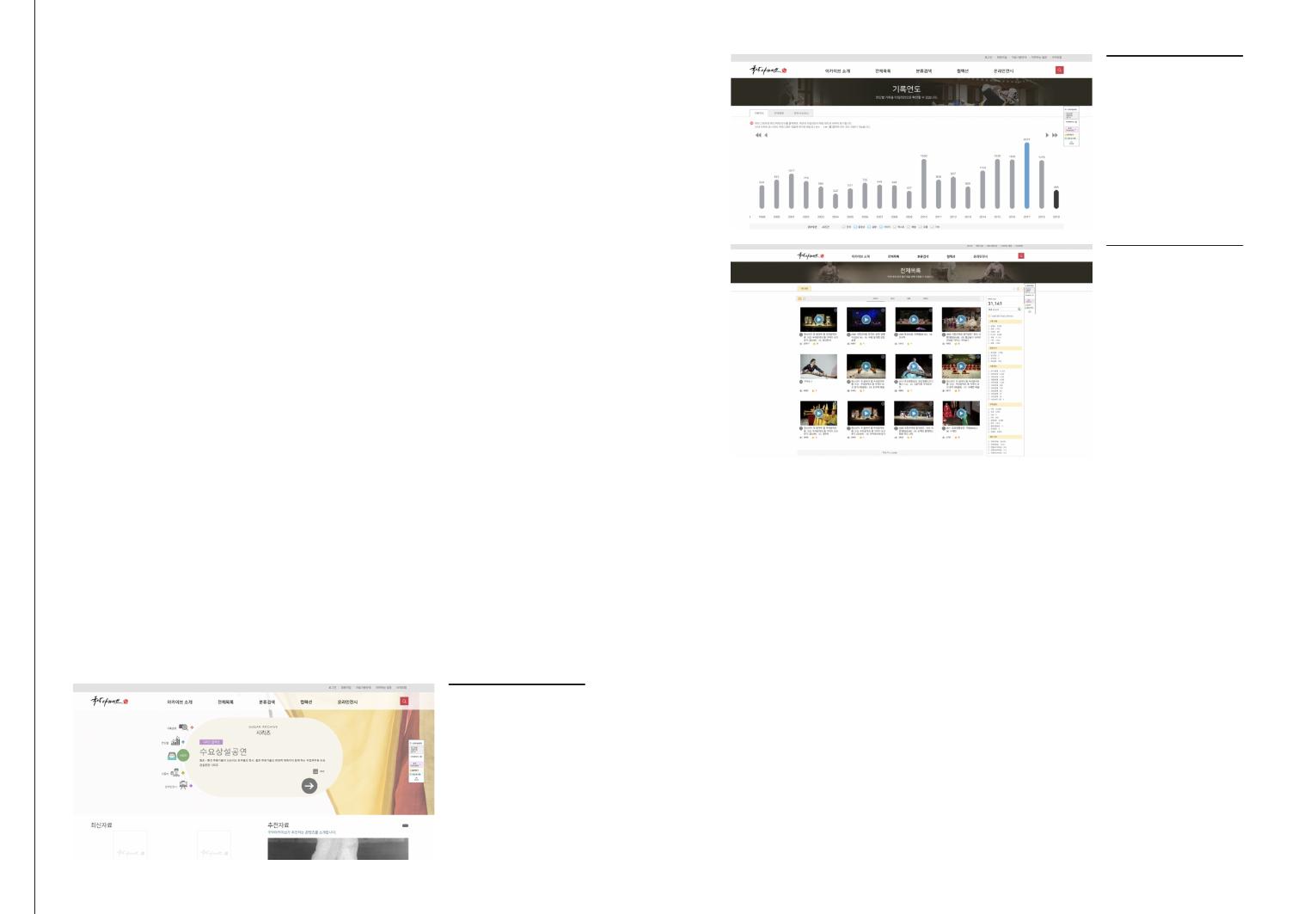
The Gugak Archive researches, collects, manages and conserve
intangible cultural heritage resources in the fields of traditional music,
dance, play and performance. It has 380,000 collections including
the results of more than 1,200 performances, research and education
activities conducted by the National Gugak Center and the records of
the private sector.
The Archive site provide the copyrighted data as open source on the
website after describing, categorizing and digitalizing the collected
records, of which the original and replicas are preserved safely and
systematical y in a constant temperature and humidity room.
The sitemap is composed of Archive Introduction, Al Listings, Categorized
Search, Col ection (photos), and Online Exhibit.
All Listings shows the list of the data arranged by view count, date, title
and accuracy with various filter criteria (record year, type, classification,
record agency, etc.). Categorized Search includes search by year,
search by traditional music classification and Korean traditional music
thesaurus. Through searching by year, end-users can view records such
as video, sound, text, composites and artifacts. Through searching by
traditional music classification, it is possible to make the list of dance,
folklore, folk music, banquet and Jeongak. Korean traditional music
thesaurus is a kind of dictionary which defines the relation of search
terms. If the end-user enter or select search term, the associated terms
(
synonym/ hypernym /hyponym) are extracted with increasing the
accuracy of search.
Col ection provides brief information about a donor and records. In
Online Exhibition, various thematic stories about Korean traditional music
are displayed online. If end-user login the site by membership signup,
the user can have his own library and browse the data conveniently
through browsing history record system.
Fig. 17
Homepage of National
Gugak Center Archive
Fig. 18
‘
Search by Year’ webpage
of National Gugak Center
Archive
Fig. 19
‘
Search by Type – Video’
webpage of National
Gugak Center Archive
2) Seoul Photo Archive
In order to record the history of Seoul, the Seoul Metropolitan
Government has collected, accumulated and digitalized the photo
images taken from various city places. And the data of the Seoul Photo
Archive are easily accessible, of which copyrighted images are available
and free of charge for non-commercial use.
The site map is simply and clearly organized by Categorized Search,
Photo Collection and Site-specific Photo. The homepage contains
statistical information on year and number of registered photo images.
Categorized Search is divided into Search by Year and Search by Topic
which is sub-categorized into economy, transportation, culture, etc.
Photo Col ection has the different classification system from Search
by Year or Search by Topic, where photo images are categorized by
specific name, place and concept. Site-specific Photo shows the image
data categorized by the administrative district of Seoul with the pop-up
photos on image map.
108
109
Th
e C
on
str
uc
tio
n o
f D
ata
ba
se f
or A
sia
-P
ac
ific T
ra
dit
io
na
l
M
ate
rials
and
T
ec
hn
iq
ue
Yo
un
g J
ae K
im | J
un
gh
ee L
ee | B
ye
on
gs
u R
yu | M
iky
on
g K
w
on | J
ih
ye
on L
ee
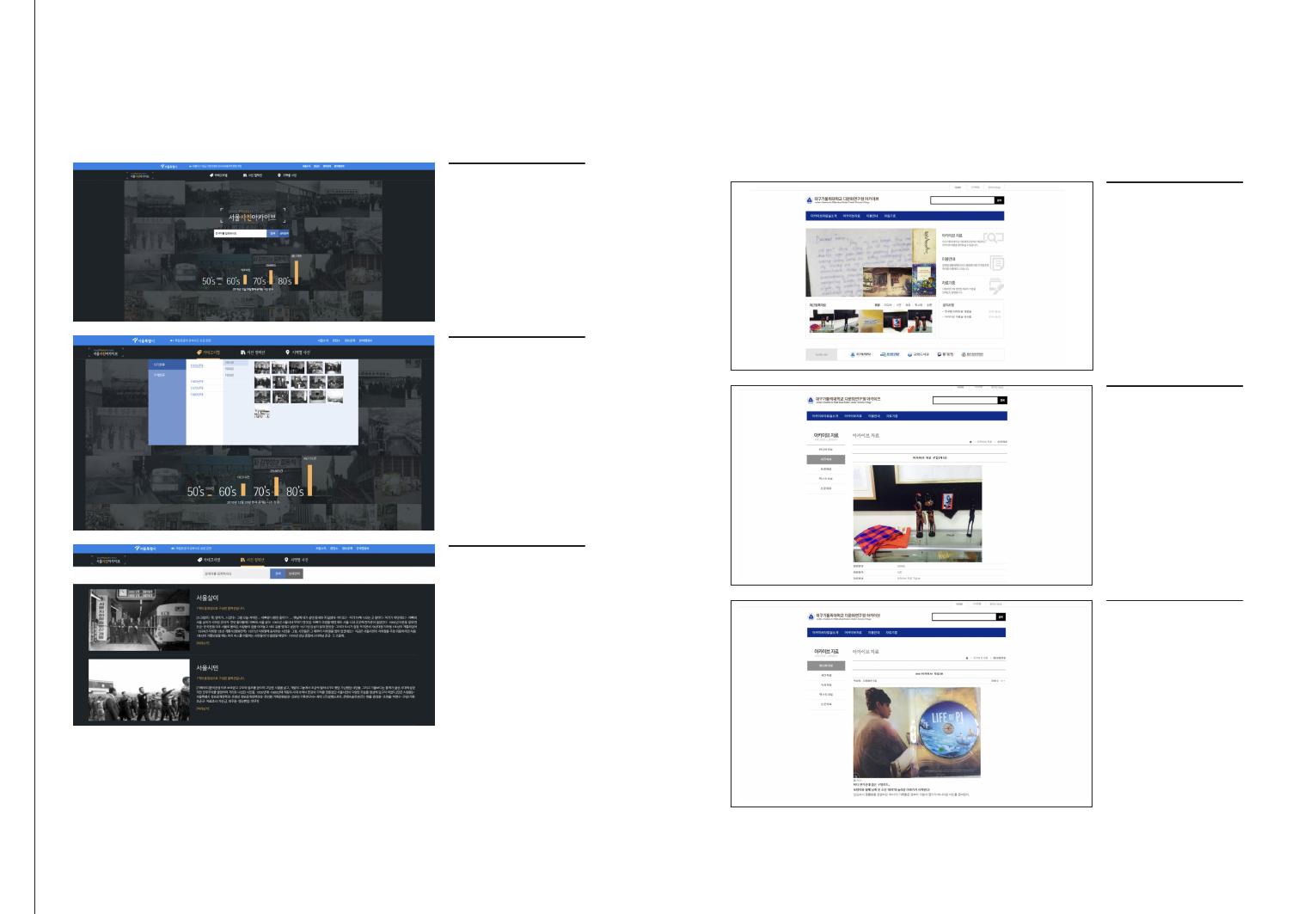
If the user types search terms into the search box, relevant information
including associated keywords, shooting year and map is displayed. The
search function can be used more conveniently with photo sorting and
viewing tools like color image, black & white image, the image with GPS
data, etc.
Fig. 20
Homepage of Seoul Photo
Archive
Fig. 23
Archive Homepage of
Institute for Multicultural
Studies
Fig. 24
Archive Video Data of
Institute for Multicultural
Studies
Fig. 25
Archive Photo Data of
Institute for Multicultural
Studies
Fig. 21
Photo Col ection of Seoul
Photo Archive
Fig. 22
Categorized Search Data
of Seoul Photo Archive
3) Archive of Institute for Multicultural Studies,
Daegu Catholic University
The Institute for Multicultural Studies has conducted the research on 『The
Value Creation of Multiculturalism in the Global World』 with 3 phases
of research process for 9 years since 2010. The archive was built with
the research data, which was col ected and categorized on the 1st and
2nd phase of research. The data was classified into types of media,
photographs, recordings, texts and papers. There is a limitation in the use
of data because the data is just uploaded without sufficient description.
Archiving on the website is ongoing but the database has not yet been
constructed.
110
111
Th
e C
on
str
uc
tio
n o
f D
ata
ba
se f
or A
sia
-P
ac
ific T
ra
dit
io
na
l
M
ate
rials
and
T
ec
hn
iq
ue
Yo
un
g J
ae K
im | J
un
gh
ee L
ee | B
ye
on
gs
u R
yu | M
iky
on
g K
w
on | J
ih
ye
on L
ee
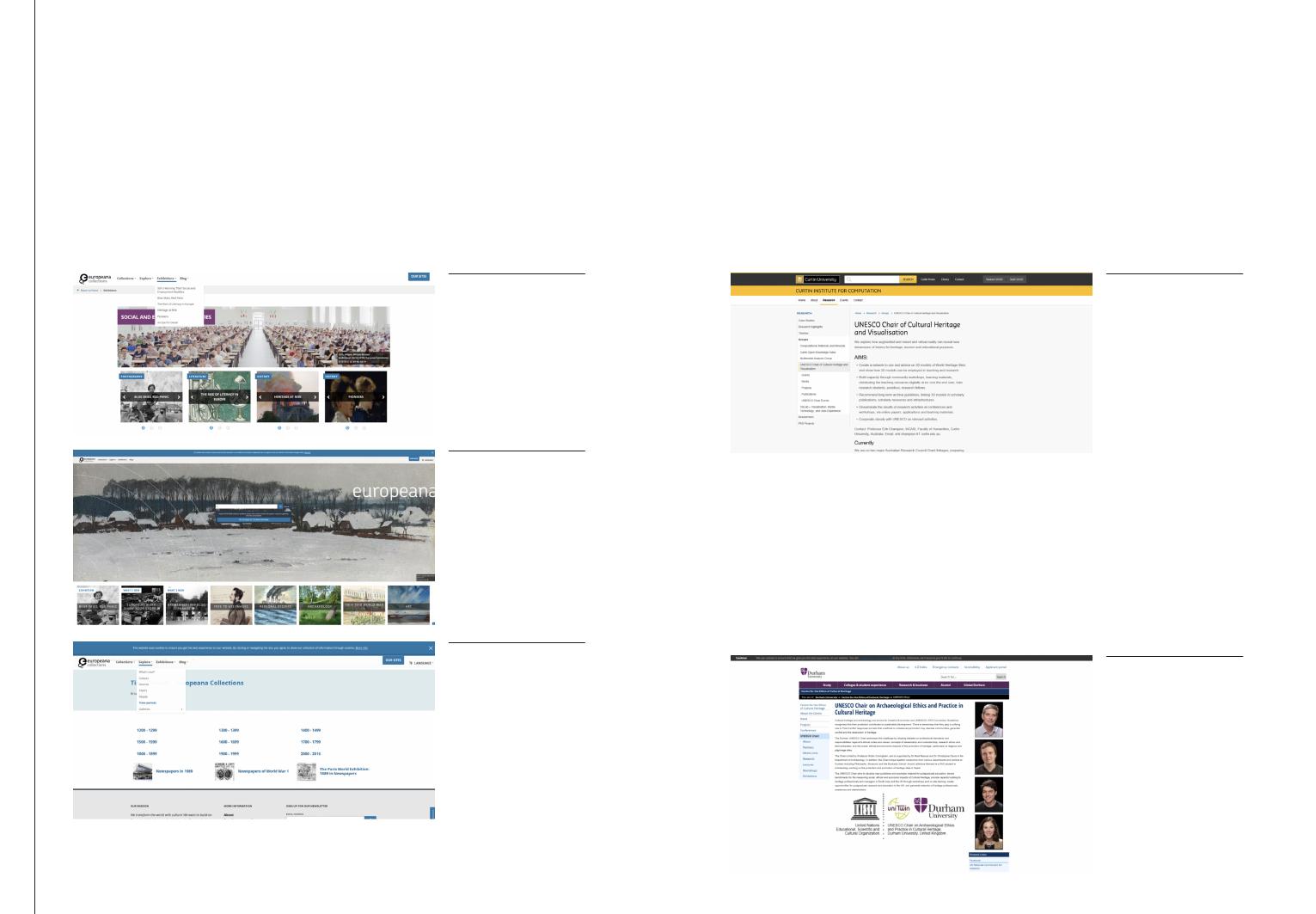
4) Europeana
Europeana is the European Union's electronic library project. The goal
of the project is to make Europe's rich cultural heritage, culture and
information more available and accessible through the worldwide
Internet. The user can access online more than 4.6 million books,
newspapers, videos, maps, and photos from more than 1,000 cultural
organizations in the European Union, including the British Museum, the
Louvre and the French National Library. The menu of the archive site
consists of Collections, Explore, Exhibitions, and Blog, where the archive
data is serviced in 27 languages.
5) Archive Website of Curtin University
The Archive homepage of the Curtin University introduces the UNESCO
Chair Programme in Cultural Heritage & Visualization and the research
on how augmented and virtual reality is used for heritage conservation,
tourism and education.
The menu consists of case studies, research highlights, themes, groups,
etc. The archive site has data and information about related researches.
But it provides the data only in text form, which leads to the lack of
diversity of data types.
6) Archive website of Durham University
The Center for the Ethics of Cultural Heritage Section of Durham
University‘s website provides information about the centre, news,
projects, conferences and unesco chairs.
The research information is linked to references and classified by project
for the convenience of search. However, it does not provide visual data
such as photograph, video or map.
Fig. 26
Archive Exhibitions of
Europeana
Fig. 29
Homepage of Curtin
University
Fig. 30
Homepage of Durham
University
Fig. 27
Homepage of Europeana
Fig. 28
‘
Explore by Time Periods’
Data of Europeana
112
113
Th
e C
on
str
uc
tio
n o
f D
ata
ba
se f
or A
sia
-P
ac
ific T
ra
dit
io
na
l
M
ate
rials
and
T
ec
hn
iq
ue
Yo
un
g J
ae K
im | J
un
gh
ee L
ee | B
ye
on
gs
u R
yu | M
iky
on
g K
w
on | J
ih
ye
on L
ee
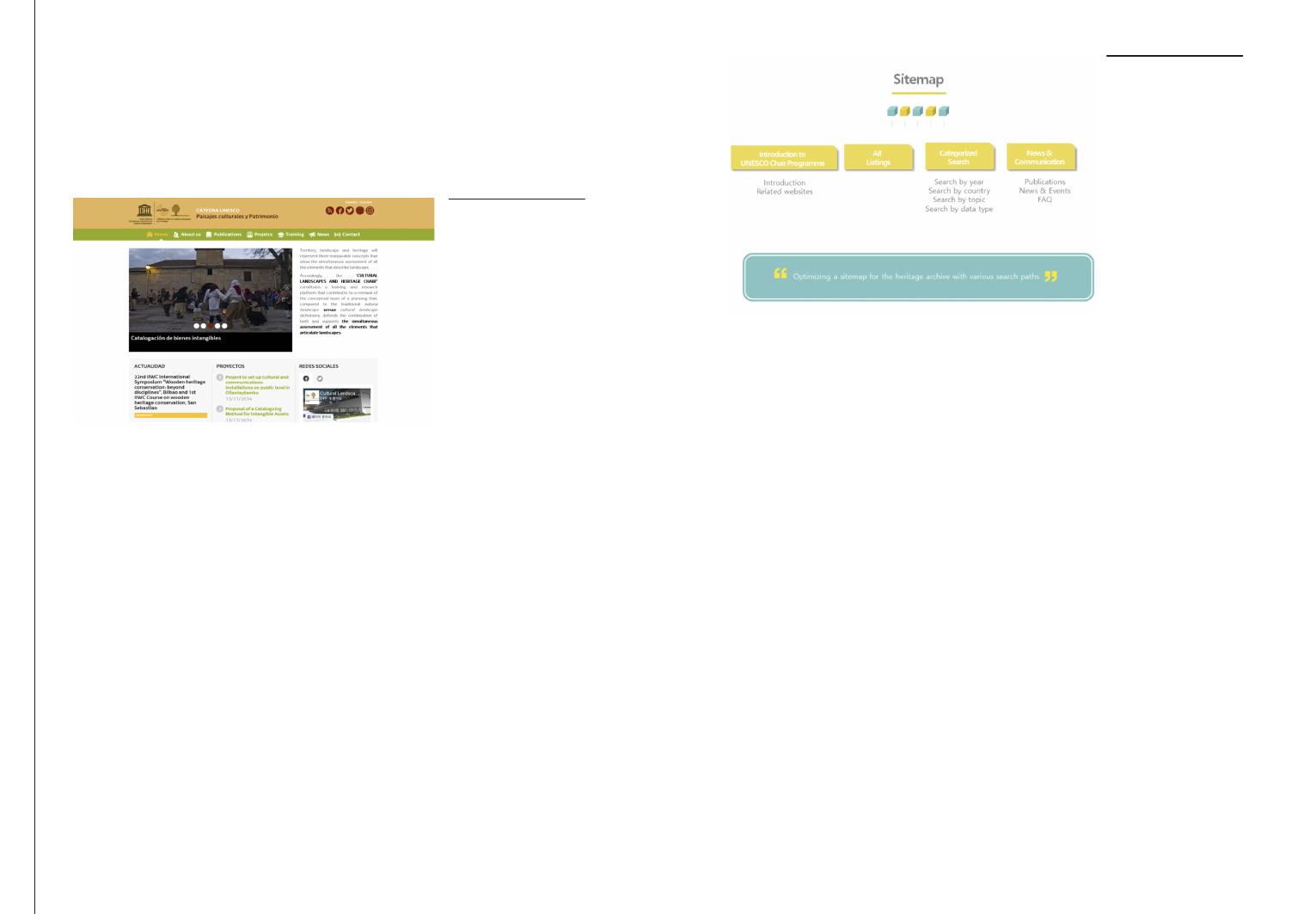
7) Archive Website of CATEDRA UNESCO
The archive website of CATEDRA UNESCO Paisajes Culturales y Patrimonio
provides information with the aim of raising public awareness for the
significance of cultural landscape and heritage conservation. The menu
items are About us, Publications, Projects, Training and News. It provides
only simple data such as papers and texts.
2. How to Design the Archive Website for Traditional
Materials and Technique
The research projects of UNESCO Chair Programme includes technical
fields surveys on disappearing Asian-Pacific traditional materials
and technique, DB construction & management, professional training
programs and conference for heritage researchers and practitioners.
The website for Asian-Pacific traditional materials and technique will
serve as the operation center by managing the performance of UNESCO
Chair Programme research projects such as research presentations,
theses and UNESCO Chair biennial reports.
The website will be designed to provide archiving service with the
sitemap for various search paths. The structure of sitemap is as fol ows.
The menu items are Introduction of UNESCO Chair Programme, All Listings,
Categorized Search and News & Communication. Introduction of UNESCO
Chair Programme introduces research projects and the websites related
to the programme. All Listings provides searching service with various
filter criteria (record type, record year, classification, record agency,
etc.). Categorized Search includes search by year, search by country,
search by topic and search by data type. News & Communication is
constructed with News & Events to announce conferences and training
programs for Asian-pacific heritage professionals, publications to share
the data of research presentation, theses and UNESCO biennial reports
and FAQ.
The direction of data service is to ensure accessibility to data, intuitive
search, continuity through all Listings with systematic filtering function
(
record year, data type, classification, data agency, etc.).
In addition, the website will be built for desktop and mobile device so
that the end-user can access and understand easily the data in any
access environment.
Fig. 31
Homepage of CATEDRA
UNESCO
Fig. 32
The Structure of Sitemap
114
115
Th
e C
on
str
uc
tio
n o
f D
ata
ba
se f
or A
sia
-P
ac
ific T
ra
dit
io
na
l
M
ate
rials
and
T
ec
hn
iq
ue
Yo
un
g J
ae K
im | J
un
gh
ee L
ee | B
ye
on
gs
u R
yu | M
iky
on
g K
w
on | J
ih
ye
on L
ee
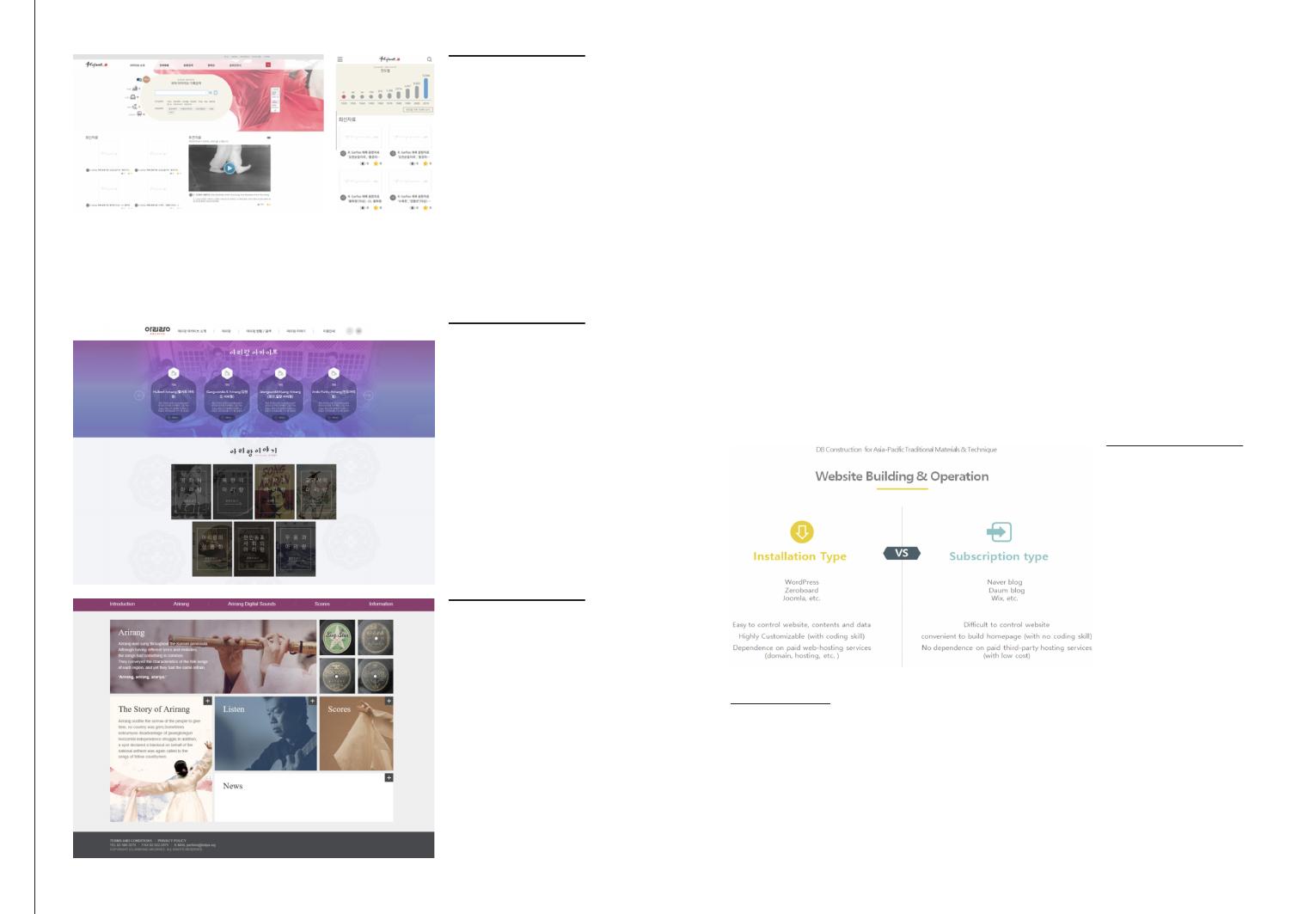
Fig. 33
National Gugak Center
Archive Site for Desktop
and Mobile Device
Fig. 34
Arirang Archive Website in
Korean
Fig. 35
Arirang Archive Website in
English
Fig. 36
The Types of Website
Building
Lastly the website is expected to serve as a hub for heritage related
fields by sharing research data in Korean and English and promoting
communication between worldwide heritage researchers and
practitioners.
3. How to Build the Archive Website
There are two ways to build a website, which are instal ation type and
subscription type. The installation type is a method of operating a
website by instal ing a server on a computer. The representative one
is WordPress. Approximately one-sixth of the world's websites uses
WordPress. The installation type is highly customizable, especially for
layout design, and also easy to control contents. But it requires the
expert with coding skills and additional paid third-party services like
domain, hosting, etc.
The subscription type uses the website builder like Wix. Naver blog is one
of the representative example. The subscription type is less customizable
than the installation one, where the user has some limited options in
layout design. But it is independent on additional third-party hosting
services with providing the server.
The instal ation type with flexibility and customization is considered to
be suitable to build the website for this research project. It is easy to
integrate because most of the installation web programs follow the
MySQL standard such as WordPress, Zero Board, etc.
This is the basic research on the archiving policy & procedure, which
is about collecting, validating, screening, categorizing, organizing,
describing, preserving, and servicing survey records. How to archive
technical field survey data and provide the data on heritage archive
websites was discussed in the case analysis of this research.
The guidelines were proposed to manage field survey results, use
Ⅴ
Conclusion
116
117
Th
e C
on
str
uc
tio
n o
f D
ata
ba
se f
or A
sia
-P
ac
ific T
ra
dit
io
na
l
M
ate
rials
and
T
ec
hn
iq
ue
Yo
un
g J
ae K
im | J
un
gh
ee L
ee | B
ye
on
gs
u R
yu | M
iky
on
g K
w
on | J
ih
ye
on L
ee
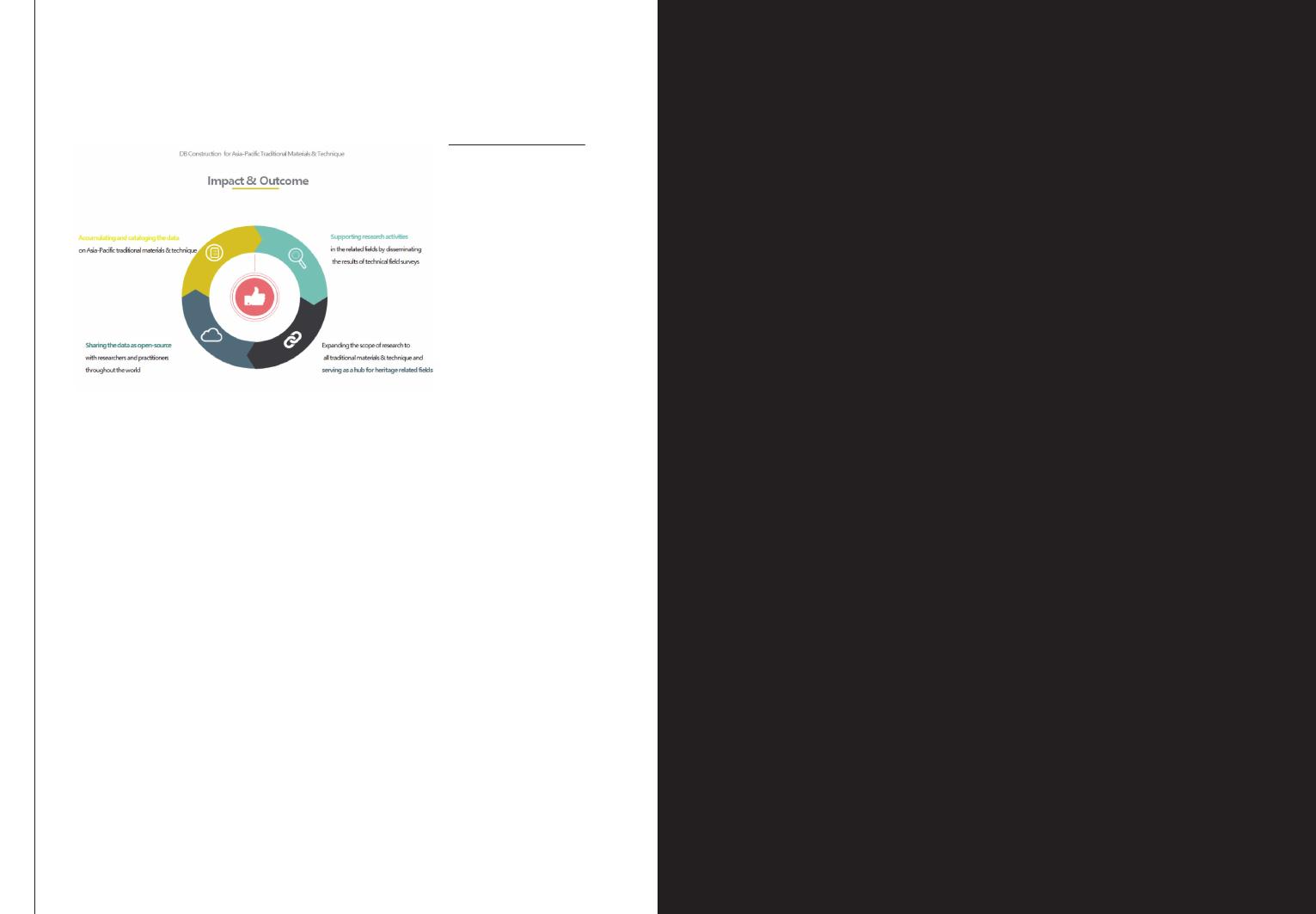
the digital data and operate the archiving website for Asian-Pacific
traditional materials and technique. It is expected to share the field
survey results as open-source data and support research activities in
the heritage related fields.
Fig. 37
Impact & Outcome
References
Yeonhee Kim, 2013.6.30, Introduction to Database, Naver Encyclopedia
Korea Software Industry Association, 2019, Guide to Estimating Software
Projects (2019 Revised Edition)
Telecommunications Technology Association http://www.tta.or.kr
119
118
Th
e C
on
str
uc
tio
n o
f D
ata
ba
se f
or A
sia
-P
ac
ific T
ra
dit
io
na
l
M
ate
rials
and
T
ec
hn
iq
ue
Yo
un
g J
ae K
im | J
un
gh
ee L
ee | B
ye
on
gs
u R
yu | M
iky
on
g K
w
on | J
ih
ye
on L
ee
Suggesting the Preservation and Management of Architectural and Urban Heritage
UNESCO Chair on Heritage Future: a presentation of our work 2017~2019
UNESCO Chair in Cultural Resource Management, Southeast University, China
Historic Urban Landscapes and Heritage Impact Assessments
Sustainable Cultures in times of transition
Suggesting the Preservation
and Management of Architectural
and Urban Heritage
KNUCH, Division of Architecture-
Landscape-architecture, Department of
Heritage Conservation and Restoration
Prof.
Young Jae Kim
Cities play an important role not only in sustainable
conservation and utilization (management) of intangible
and tangible cultural heritage but also in the development
of human welfare and health, social creativity and cultural
diversity. In this sense, a city can be recognized as an
important resource for the future. On the other hand, cities are
dynamic organisms. They are constantly evolving, adapting
to social structures and needs, and adapting continuously
to the physical structure. In the future, it is necessary to
develop an approach to preserve and manage the diversity
of cultural heritages in future cities and to adapt them to the
characteristics of changing and living cities.
Recently, the philosophical principle on the conservation and
management of historic cities has focused on operating an
integrated system of conservation and utilization rather than
protecting cultural heritage. Even conservation principles
related to urban heritage preserve cultural heritage in historic
cities, due to the conceptual change in value, based on
value of cultural heritage, cultural significance of cultural
heritage, and priorities, authenticity and integrity related
to development and preservation Principles continue to
evolve. With this in mind, this study deals with conceptual
definition and development of historic cities, development
of conservation management principles, and international
trends.
2. The Concept of Historic Cities
1) Etymology of the notion of ‘urban’
Ildefonso Cerda y Suner (1815-1876) is known as the founder of the term
'urbanism'. In the Barcelona Expansion Plan (1859), Cerda focused on the
major needs. The need for smooth transportation of goods, energy and
information, and the need for effective waste disposal, including good
sewage, and the need for greenery in people's environments, largely due
to the need for sunlight, natural lighting and ventilation (greatly affected
by sanitation).
Fig. 1
the word 'urbanized' to
artificially cultivate an
open area (rural area)
Cedar’s design believes in a network-centric approach ahead of his
time. His street layout and lattice plan were optimized to accommodate
large capacity sewers in consideration of pedestrians, carriages,
wagons, trams, urban rail lines, public sewers and private gardens to
prevent gas supply and frequent floods, and major amenities. The latest
123
122

technological innovations have been incorporated into his design, if they
can develop the driving force of better integration, and presented a new
concept, including a logical land reclamation system that is essential
to the success of his project. He chose the Latin “urbs” referring to the
‘
urbum’, and the legend that the Romans used plows (using sacred
bulls) to leave a range of settlements. If you fol ow this boundary, the
term ‘urbanized’ has been used in the sense that it is separated from
the previously open free place (furrow) and artificially developed. Thus,
'Urbanism' means a planned area associated with an urban area other
than an open area. On the other hand, the urban area includes an open
space that is ‘urbanized’, which is clearly part of the urban settlement.
The ninth-century Spanish city planner, Cerda, drafted a useful boundary
delimitation bill, created a detailed geomorphological survey map
around Barcelona, and produced a theoretical paper to support each
major project. He actually created several important words in Spanish,
including ‘urbanización’.
According to Cerda, other terms such as ‘city’ and ‘town’, which are
used as synonyms, are also discussed. But the word ‘town’ (ancient
English tun) is known to mean an artificial y created ‘enclosure’. Later
generations are distinguished from ‘villages’, which are general y
derived from ‘vil a (cottage house, italian)’ and which represent a
smal er resident population than the city. ‘City’ relates to the Latin word
‘
civis’, which means a townsman who is a resident of a city settlement. In
medieval times the city (derived from ‘civitas’) was a cathedral city and
was distinguished from a ‘normal' ordinary city. The archbishop, which
dominates other bishops, was called a ‘metropolitan’, and the place
of the metropolitan was called ‘metropolis’. In recent years, this word
has evidently meant ‘a very vast urban area’ surrounding the adjacent
municipalities around the metropolis. Urbs (polis in Greek), a city area
that has been around for centuries, are clearly distinguished from the
open territories of the surrounding rural areas. A landmark change in the
etymological concept is the result of industrialization and population
growth in the late 19th century. A suburban area is a suburban area
that is built mainly on the outskirts of an existing urban area. In the early
days, these areas were interspersed rather than rural, and there were
no distinctive service facilities comparable to urban centers. Over time
the suburbs provided many services and the quality of their homes was
highly appreciated.
2) Concept of Historic City
‘
History’ is defined in two ways: the transient progression of large-scale
human events and actions; this course is designed to gain knowledge
about human past.❶
Philosophy of history can be located under either of these
two, and would thus be cal ed ‘speculative’ when examining
the progression, or ‘critical’, i.e. the epistemology of historic
knowledge, when searching for knowledge of the human past.
Thus, ‘historic’ can be understood not as old, but as material for historic
subjects, that is, to be associated with a particular meaning and
ultimate value. From the cultural heritage point of view, the term ‘historic’
can be said to have been verified as a legacy. Likewise, urban areas of
diversity are the product of the process that is still underway. It reflects
not only existing circumstances such as the environment, economy and
social culture, but also the intention and necessity of other times. The
resulting urban structure reflects the diversity of human creative minds,
provides a specific identity for each region, connects each region, has
a systematic skeleton, and has a form of continuity. Being regarded
as ‘historic’ is not automatic, but is a result of continuity to seek true
value over time. Meanwhile, according to Patrick Geddes, the historic
city, along with ancient cities, monuments, old streets and homes, said
that the historic city, a “past world heritage,” could not be preserved as
it was, Since the physical structure of the ‘City of Evolution’ is not static,
‘
people in evolution’ adapt to ‘claims and demands’ within
the social structure.❷
The historic city area is an area where the people
concerned are recognized history and reality. This is an
area worthy of special care to monitor and control all the
changes that could compromise recognized properties,
and even a protected area.
For this reason, authenticity cannot be a fixed concept. Rather it means
evolving with the people and cities that develop together. Following
these consecutive thoughts, 'cities of evolution' can be composed of
equally true strata that can well reflect the claims and demands of
‘
people of evolution’. Thus, reconstruction can be understood as a layer
of truthfulness in the introduction of reconstruction in the historic city
landscape approach, just as other human interventions (which are
believed to be meaningful to people) have been in the past and are
124
125
❶
Audi, R. (ed.). 1996. The
Cambridge Dictionary of
Philosophy. Cambridge,
Cambridge University Press,
pp. 584f
❷
Geddes, P Cities in Evolution:
An Introduction to the Town
Planning Movement and
the Study of Civics. London:
Wil iams & amp; Norgate,
1915. p.214.
Yo
un
g J
ae K
im
Su
gg
es
tin
g t
he P
re
se
rv
at
io
n a
nd M
an
ag
em
en
t
of A
rc
hit
ec
tu
ra
l a
nd U
rb
an H
er
ita
ge

headed for the future. Understanding the authenticity as a dynamic
concept is also related to the understanding of the city as a living
organism that reflects the paradigm of historic city landscape.
3. Development on International Principles for Urban
Conservation
The basic principle of the conservation philosophy of archaeological
sites was the SPAB Statement in 1877, the Madrid Declaration in 1904,
the Athens Charter in 1931, and the 1964 Venice Charter showed the
ideological change of the perception of the preservation of the remains.
The SPAB was concerned with subjective restoration behavior and
presented guidance and handbooks related to this, and practical
examples of approaches. The Madrid Declaration discussed the
maintenance and meaning of the original function based on the SPAB
's point of view in restoring the monument. The Athens Charter and the
Venice Charter discussed the significance of the surrounding context
and the use of new materials such as concrete in restoration of the
repair, along with monuments before and after World War I . It should
be noted that the Venice Charter refuses to deal with archaeological
remains as individual independent entities and there is an increasing
frequency of use of terms related to city size in the International
Conservation Charter since the 1960s.❸
Concerning the “Venice Charter”, Article 1 , on conservation
and restoration, criticizes the reunification of the monuments
in the restoration of monuments. This was influenced by
Giovanoni’s “Carta del Resauro”, which covered the respect
of historical monastic depletion.❹
When he examined the repair and restoration of historic
structures before the appearance of “Venetian scene”,
Giovanoni tried to maintain the original materials and style
of the structure, although this is not common. At the time
of ancient times, the purpose of restoration was to improve
the function and artistic appearance of the building, and many times
the buildings were restored in the style of each era. Due to these causes,
many ancient buildings had various styles, despite this upheaval
situation at the beginning of the nineteenth century when the influence
of historicism was intensified, the ultimate goal of restoration was
related to the unification of culture. However, as the values of modernity
changed over time, the critique of the unification of the culture was
amplified as “specificity and relativity” which largely influenced on the
restoration theory later.❺
Gradual y, all ages and all forms were recognized as worthy of protection,
and as a result, the site of repair and restoration works preferred the
coexistence of various styles rather than the unification of styles. This
is the most modern concept that has emerged since the end of the
nineteenth century, and is associated with the aged value linked with the
times.❻
In the enactment of the Venice Charter, the Gumi region
has undergone a major change in the cultural preservation
movement. There has been a revision of the concept of
historical significance. Conservationists no longer focus on
historical monuments, like museum exhibits, but begin to
pay attention to historical sites that encompass cultural
heritage and the surrounding environment. The Article 14 of
the Venice Charter states deals with the preservation and
restoration of historic monuments and monuments, states
that the above provisions on preservation and restoration
work have been fulfil ed. This means that the second clause,
“
securing all scientific and technological means”❼
In the 1970s, the purpose of the reconstruction of historical monuments
and cities, which have been damaged for more than ten years after
the Second World War, and the enormous damage, is the principle
that can be applied to individual monuments respectively. On the
other hand, the place where the monument remains is extended not
only to archaeological sites, but also to historic villages and cities.❽
Historic ruins should be more widely recognized as a problem of urban
and regional planning, along with changes in social structure. In the
case of complex monuments for the preservation process of the ruins,
sociological and economic variables were sought to find appropriate
remedies for local communities. However, the contents of the Venice
Charter do not address the intangible and spiritual aspects of the
consideration of the local community and the cultural heritage, but as
mentioned in the preface to the Venice scene, "the integration of human
values" It is clear that the interpretation has had a considerable impact
on the charter, declaration, and recommendation.
Based on the Venice Charter, the Norms of Quito (1967) contains preservation
tools and measures based on cities that consider archaeological
integration as the basis for effective conservation.❾ Action 8d
requires the regulation of the area adjacent to the site (the
need for a buffer zone) as well as the provisions on “land use,
density and quantity relationship”. In 1972, the World Heritage
126
127
❸
❹
❺
L. Veldpaus, A.R. Pereira
Roders, B.J. Colenbrander,
Urban Heritage: Putting
the Past into the Future The
Historic Environment, 4 (1)
(
2013), pp. 3-18
Claudine Houbart, 2014.
"Deconsecrating a Doctrinal
Monument-Raymond M.
Lemair {1921-1997} and
the Revision of the Venice
Charter", Change Over Time
vol.4 no'2, The University of
Pennsylvania Press
Jukka Jokilehto, 2009, (A)
history of architectural
conservation, pp.26-29, 49,
162, 322.
❻
❼
❽
Ibid., p.25.
Article 14 states that
the above provisions
on conservation and
restoration work are to
be complied with, which
is related to the second
provision of "securing all
scientific and technological
means".
Petzet, M. 2009. International
principles of preservation.
Monuments and Sites, pp.20.
25.
❾
L. Veldpaus, A.R. Pereira Roders,
B.J. Colenbrander, Urban
Heritage: Putting the Past
into the Future, The Historic
Environment, 4 (1) (2013), pp.
3-18
Yo
un
g J
ae K
im
Su
gg
es
tin
g t
he P
re
se
rv
at
io
n a
nd M
an
ag
em
en
t
of A
rc
hit
ec
tu
ra
l a
nd U
rb
an H
er
ita
ge

Convention suggested the preservation of the historical
environment, the integrity of buildings and their components,
the social usefulness of monuments in the daily lives of living
communities. The 1973 ICOMOS proposed❿ that the diversity
of activities on the street (street) should be preserved by
maintaining a certain scale for the urban organization,
recognizing that this is due to regional characteristics.⓫ The
concept of adapting historical cities in a way that does
not destroy urban organization and urban structure was
advocated. In 1975, the European Charter of the Architectural
Heritage and the Declaration of Amsterdam was adopted
at the European Architectural Heritage Conference. In the
former, the practice of “integrated conservation”, which
includes the preservation of physical and social structures at
the core and in historical cities, becomes an important issue.
Integral conservation does not preclude the introduction
of modern architecture into areas with old buildings, if the
existing situation, style, form, size and scale are respected
in the use of traditional materials are used. To contrast, in
the latter, an approach to “integrated conservation” as a
measurement tool to ensure the continuity of heritage is
developed by defining the role of modern architecture in
archeological sites based on cooperation between legal,
administrative, financial and technical support systems.⓬
In the 1976 Nairobi Charter, focusing on the protection of cultural heritage
due to modern urbanization, the Charter proposed that all historical
areas and their surroundings be considered as a whole as a coherent
whole. Further, in 1979, the Burra Charter has a unique perspective
on archeological terms and defined the concept of “place” instead
of “monument”.⓭ Recognizing a monument as a place has expanded
the preservation notion of historic cultural environment by including
physical and social organization as well as archeological monuments.
According to the UNESCO Operational Guidelines (1980), the cultural
heritage devastated in World War II recognized that the grounds for
restoration were suggested in accordance with authenticity, especially
if they exist clearly in the original form.
Likewise, in 1982, the Dresden Declaration at the ICOMOS General Assembly
in Europe recognized the restoration as a complete restoration based
on the highly reliable evidence of the pre-destruction of monuments. In
1985, the Granada Convention developed the awareness of archeological
assets in order to achieve the protection of archeological sites and the
optimal management of cultural properties.⓮ As regards the
protection procedures under the statute, Article 4 requires
that each party to the convention. That is to say, it required
substantial changes that would damage the properties of
the building or land, such as demolishing plans, building
structures, new constructions, or buildings affecting the
building group or parts thereof. The protection through laws
on architectural heritages and their relevant sites should be
submitted to the competent authorities.⓯
The Yamato Declaration (2004) on the Integrated Approach
for the protection of intangible and tangible heritages
states that “authenticity cannot be applied to intangible
cultural heritage because it is constantly recreated through
generations.”⓰ Following the Vienna Memorandum (2005)
and the Declaration on the Conservation of Historic
Urban Landscapes (2005), Xi’an Declaration on the
Conservation of the Setting of Heritage Structures, Sites
and Areas (2005) emphasizes a cultural significance and
unique characteristics on each locality, Also, historic areas
have unique characteristics in meaningful relationships
with physical, visual, mental and cultural contexts and
environments.⓱ Therefore, it was suggested that appropriate
planning tools and strategies should be developed for the
conservation and management of the region that creates
the local environment. The Recommendation on the Historic
Urban Landscape (201 ) completed through the St Petersburg
Conference (2007), the Orinda Conference (2007), and Preliminary report
on the draft Recommendation on the Historic Urban Landscape (2010),
integrates historic remains with intangible and tangible values, and the city
was recognized as the accumulation of history. In the 1996 Mexico Mérida
World Heritage Conference, it was argued that the architectural heritage
was built on a dynamic concept and that the issue of preservation should
be addressed in a sustainable framework.
Fig. 2
Primary Changes from
Cultural Landscapes
to Historical Urban
Landscape
128
129
❿
⓫
⓬
⓭
⓮
⓯
⓰
⓱
International Council on
Monuments and Sites
(
ICOMOS). 1973. Resolutions of
the Symposium Devoted to
the Study of "The Streetscape
in Historic Towns" Lausanne,
Switzerland, 17th to 22nd
June 1973. http://www.
international. icomos.org/
publications/lausanne1973/
lausanne1973-10.pdf
International Council on
Monuments and Sites
(
ICOMOS). 1975. The Resolutions
of Bruges: Principles
Governing the Rehabilitation
of Historic Towns. http: // www.
international.icomos.org/
publications/93towns7k.pdf
R. Shipley, J. Kovacs, 2005,
Principles for the Heritage
Conservation Sector in
Canada: Lessons from the
International Experience,
Heritage Resources Center.
K. Taylor, Cultural heritage
management: a possible role
for charters and principles
in Asia, Int. J. Herit. Stud., 10 (5)
(
2004), pp. 417-433; R. Shipley,
J. Kovacs, Principles for the
Heritage Conservation Sector
in Canada: Lessons from the
International Experience,
Heritage Resources Center
(
2005)
Council of Europe. 1985.
Convention for the Protection
of the Architectural Heritage
of Europe
The Washington
Charter (1987), ICAHM
is the abbreviation
for the International
Scientific Committee on
Archaeological Heritage
Management.
Charter (1990), Nara (1994),
Krakow Constitution
(
2000), Articles 6 and 8-10
are particularly relevant
to topics on appropriate
new developments in the
historical environment.
International Conference
on Conservation "Krakow
2000." 2000. The Charter
of Krakow 2000: Principles
for Conservation and
Restoration of Built Heritage.
http://lecce-workshop.
unile.it/Downloads/The%20
Charter%20of%20 Krakow%
202000.pdf
UNESCO., 2004. Yamato
Declaration on Integrated
Approaches for Safeguarding
Tangible and Intangible
Cultural Heritage. UNESCO.
ICOMOS. 2005. Xi'an
Declaration on the
Conservation of the Heritage
Structures, Sites and Areas.
Article 1, Article 2, http://www.
international.icomos.org/
charters/xiandeclaration.pdf
Yo
un
g J
ae K
im
Su
gg
es
tin
g t
he P
re
se
rv
at
io
n a
nd M
an
ag
em
en
t
of A
rc
hit
ec
tu
ra
l a
nd U
rb
an H
er
ita
ge
It also recognizes social frameworks concerned with the environment,
economic activity, and cultural life, and that preservation methods
should be determined in the same sense as the community. This
emphasized the importance of social values according to regional
identity. Furthermore, in 2001, the Helsinki World Heritage Conference
proposed the possibility of cooperative coexistence in urban context
as a cultural heritage through suggestion that the connection between
conservation and development should also be established within social
framework and city. Recognizing the city as an accumulation of historical
stratification that continues to change over time with respect to the
place, it integrates the non-traditional values of the place. The Report
of the World Heritage Committee also speaks the role of international
documentation and regional policy on the heritage management
process. It has also addresses the role of international documents and
local policies on the heritage management process.
As a result, these international documents present the sequential
evolution of conservation ideology on the theoretical, scientific and
practical levels. Jokilehto examines the progression of the urban-scale
related terminologies pointing out that these terms are changing
from being explicitly appointed sites towards less defined names, from
monument (1930’s), setting (1960’s), historic settlements (1970’s), urban
areas (1980’s), places (1990’s) to landscapes and cities (2000’s).
5. Conclusion
Patrick Geddes said that a city is a living organism experiencing
experiences birth, growth, maturity, decline, decay and rebirth. The
history of human intervention is likened to the PALIMPSEST of the urban
landscape, which corresponds to the concept of 'context', which is often
referred to in architecture, and includes the conditions of buildings,
roads, Background, and so on. In the stratification of historic cities, some
strata can be maintained in good physical condition, but some strata
can be degenerated or disappeared by surrounding circumstances
such as hardening, neglect, natural disaster or armed conflict. Even if
the historic city is unfortunately destroyed, a new stratum may appear,
so the wheel of life is not over. Some may resemble the old to meet
the needs of contemporary society.�This stratification process reflects
the thinking that supports the recommendation for 2011 historic urban
landscape.
Fig. 3
Fig. 4
Fig. 5
(
left) the Yukjo geori
Avenue (Avenue of Six
Ministries) in Joseon
Dynasty
(
right) Present state of the
Gangwhamun Square
Reconstruction
Competition for the New
Gwanghwamun Square
(
the author’s work)
Based on the discussions so far, we can see that the international trends and
major issues of the historic city preservation and management principle
have continued to evolve and evolve with the methodological framework
of inheriting the past tradition and modifying it to the modern nature.
Therefore, the assemblage of “history + city + landscape” has confirmed
that the buildings, roads, and gardens that are placed on the cities based
on the city are constantly evolving and transformed like creature. It has also
confirmed that these accidents have been developed into a unified system
supporting the historic cityscapes through constitutions, declarations and
recommendations at numerous international conferences.
As in the case of the Gwanghwamun Square, the Sejongdaero Avenue
itself has been continuously changed in the balance of development and
preservation from the Joseon Dynasty, via the Japanese colonial period,
throughout the present. In the future, Sejongdaero Avenue should be a
meaningful place to accept the needs of citizens and provide rest, and
should be a space of organic networks that can tie the historic places and
various events around them.
Finally, the ongoing conservation and management principle is constantly
embracing global trends. Actively reflecting on the transition of this
paradigm and through the Urban Regeneration Initiative, we should
actively reflect on the problems we face the conservation rehabilitation
of architectural assets such as historical hanok (Korean-style houses),
revitalization of urban areas in the historical city, development around
cultural heritage, reconstruction, and the intervention of modern buildings
in the historic district.
130
131
Yo
un
g J
ae K
im
Su
gg
es
tin
g t
he P
re
se
rv
at
io
n a
nd M
an
ag
em
en
t
of A
rc
hit
ec
tu
ra
l a
nd U
rb
an H
er
ita
ge

UNESCO Chair on Heritage Future:
a presentation of our work
2017~2019
Linnaeus University, Sweden
Prof.
Cornelius Holtof
In 2017, Linnaeus University was awarded a UNESCO Chair on
Heritage Futures. This is one of eight UNESCO Chairs in Sweden
and the only one in Sweden in the area of culture.
Heritage futures are concerned with the roles of heritage in
managing the relations between present and future societies,
e.g. through anticipation and planning. Our work is dedicated to
developing professional strategies for enhancing how heritage
shapes the future. We ask questions such as: Which future do
we preserve the heritage for? Which heritage will benefit future
generations most? How can we build capacity in future thinking
(
futures literacy) among heritage professionals worldwide?
These questions are fundamental to the cultural heritage sector
but not often seriously considered. The protection of cultural
heritage and the desire to restore and reconstruct cultural
heritage are commonly based on a perceived need (often
explicitly formulated) to preserve the cultural heritage and
cultural traditions for the benefit of future generations. However,
it is not usual y asked which future generations are the intended
beneficiaries or why we believe the cultural heritage and the
cultural traditions we preserve will benefit them (Högberg et al
2017). Given that history has always been about change, that
our contemporary world is changing fast, and that society’s
resources are scarce with many pressing needs, we need to be
sure that we acting responsibly and sustainably in preserving
and managing the cultural heritage. It is not self-evident that
the cultural heritage we preserve will be appreciated and used
by future generations in the way we intend and hope. Our Chair
is therefore committed to capacity-building in future thinking.
We are guided by the spirit in which the Agenda 2030 has been
defining the priorities of global development and committed
the nations of the world to do their utmost in achieving the 17
sustainable development goals.
Over its first two years 2017-2019, the UNESCO Chair on Heritage Futures
at Linnaeus University has been engaging in an extensive programme
of national and international collaboration in research and training. We
presented our work and agenda on many occasions in Sweden and around
the world. We established contacts to various programmes and activities
in UNESCO, to the Swedish Delegation to UNESCO, the Swedish UNESCO
Commission, and began collaboration with other UNESCO Chairs in Sweden
and internationally. By now, our Chair and its agenda are widely recognized
in the global cultural heritage sector and beyond, and we have begun to
make an impact through training and academic research.
Our team currently consists of the fol owing:
• Dr Cornelius Holtorf, Chairholder and Professor of Archaeology,
Linnaeus University
• Dr Anders Högberg, Professor of Archaeology, Linnaeus University
• Dr Sarah May (affiliated), Senior Lecturer in Public History and Heritage,
Swansea University, UK
• Dr Annalisa Bolin, Post-doctoral Fel ow, Linnaeus University
• Dr Claudio Pescatore, Research Coordinator VINNOVA project,
Linnaeus University
• Ulrika Söderström, PhD student, Kalmar County Museum and Linnaeus
University
• Helena Rydén, Assistant to the Chair, Linnaeus University
Major landmark achievements to date have been
(
1) the completion of the international Heritage Futures Research
Programme (2015-2019) in which we had responsibility for investigating
how the uncertainty of the future is conceived and managed across
different domains of heritage (see https://heritage-futures.org and
Harrison et al forthcoming);
133
132

Over the past two years, the Chair established several new courses at
University level. One new course entitled “Heritage, the future, and how to
create a more sustainable society, 7.5 credits” was approved at Linnaeus
University in March 2019. The course was created by Anders Högberg
and Cornelius Holtorf and is designed for students at advanced level.
It addresses the following issues: How are heritage and future-thinking
connected with each other? What does it mean to preserve heritage
for the benefit of future generations? How can we plan for the future
in present-day heritage management? How might future society be
improved through heritage and become more sustainable? The course
has not been taught yet at Linnaeus University. Recently, a revised
version for undergraduate students has been designed. It will be taught
at the University of Poznan, Poland in spring 2020.
At Swansea University (UK), Sarah May developed a new course at
advanced level on “Toxic Heritage” (20 credits) and taught it during
spring 2019. The course is partly based on insights gained from the
Heritage Futures project and involves students considering how the
management of toxic waste and the management of heritage entwine
in the creation of futures.
In addition, we developed and carried out a range of training activities
for various audiences in our region in SW Sweden and beyond, involving
both students in higher education and professionals in the cultural
heritage sector. This included not only lectures, presentations and
supervision but also a card game and in particular very successful half-
day future workshops that we conducted on almost a dozen occasions,
mostly for professionals in heritage management and urban planning.
Education and Training
Research
(
2) the organization of two international workshops promoting
knowledge exchange and discussion within different domains of
heritage, with a view to influence policy development in two different
sectors: one on Information and Memory for Future Decision-Making:
Radioactive Waste and Beyond (Stockholm, May 2019), the other as
an ICOMOS University Forum on Thinking and Planning the Future in
Heritage Management (Amsterdam, June 2019); and
(
3) the development of Future Workshops as an effective training
method for professional capacity-building in futures literacy for
heritage managers and others.
Cornelius Holtorf (Co-Investigator), Sarah May (Research Associate),
and Anders Högberg (Affiliated Researcher) have been involved in
substantial research in the area of Uncertainty, which was one of four
themes in the AHRC-funded Heritage Futures research programme led
by Professor Rodney Harrison at University Col ege London, UK (https://
heritage-futures.org). Our work focused on how the uncertainty of the
future is conceived and managed across different domains of heritage
and conservation involving nuclear waste (mostly in Sweden and the
Netherlands), a space message (global, co-ordinated from the US), a
long-term storage site (in Austria) and a world heritage site (in the UK).
They are each managing deep time frames that reach into the distant
future. This work involved among others major contributions to the 19th
ICOMOS General Assembly held in New Delhi, India (2017) and the 4th
Association of Critical Heritage Studies Conference held in Hangzhou,
China (2018). This research also contributed to a number of significant
academic publications by members of the Chair (see references below).
Ulrika Söderström, supervised by Högberg, completed her Licentiate
dissertation as part of her ongoing Doctoral research which aims at
improving our understanding of how heritage and archaeological
knowledge can be applied in practice to meet the aims of Agenda 2030,
in particular Goal 11 on Sustainable cities and communities.
Cornelius Holtorf and Anders Högberg have been co-editing a
volume on “Cultural Heritage and the Future”, to be published with
Routledge in 2019/20. Cornelius Holtorf has also been editing a special
issue of International Journal of Cultural Property on Authenticity
and Reconstruction (to be published in 2020). The papers derive from
the ICOMOS University Forum pilot workshop on “Authenticity and
Reconstructions. A contemporary provocation: reconstructions as tools
of future-making” which Holtorf co-organised and which was held at
ICOMOS Headquarters, Paris in March 2017.
Cornelius Holtorf is currently Project Director of the project “Memory
across Generations”, funded by VINNOVA (Sweden’s Innovation
Agency) as a Stage 1 Chal enge-Driven Innovation. Claudio Pescatore
serves as Project Coordinator and Anders Högberg participates in the
project. Together we are aiming at establishing a common platform
for exchanging ideas among major stakeholders concerning the
management of cultural heritage and toxic waste, especially nuclear
waste. We are committed to knowledge exchange and capacity
building that will contribute to making long-term strategies for taking
134
135
C
or
ne
liu
s H
olt
of
UN
ES
C
O C
ha
ir o
n H
er
ita
ge F
utu
re
: a p
re
se
nta
tio
n o
f o
ur w
or
k 2
017
~2
019

Cultural heritage is commonly understood in positive terms. It is the
legacy of past generations that we value today and wish, in turn, to
transmit to future generations. Cultural heritage often expresses a sense
of tradition and belonging; it tends to be flavoured by a certain amount
of nostalgia. When such notions of cultural heritage are combined with
the imagery of nuclear power stations, we are immediately struck by a
strong visual tension. The silhouettes of nuclear power stations may be
a familiar part of our landscapes but they are associated with values
that could not be farther removed from nostalgia. They may remind
us of long-term health risks, environmental destruction, the power of
large corporations, and the arrogance of politicians. If anything, the
waste produced by generating nuclear power might in the light of this
juxtaposition be characterised as anti-heritage – it’s what contradicts
and ultimately threatens the values and emotions we associate with
heritage. But not all is as it seems at first glance.
Actual y, there are many similarities between nuclear waste and cultural
heritage. In fact, there are so many that we can say that nuclear waste
is a very particular form of cultural heritage:
• both nuclear waste and cultural heritage are ambiguous and may be
considered either as meaningless waste material from the past (best
discarded) or as something valuable and powerful (best kept);
• nuclear waste may not make people proud or provoke much nostalgia
but it is nonetheless part of the human legacy, precisely like other
examples of what has become known as ‘difficult heritage’, like
battlefields, concentration camps or sites associated with the Cold
War;
• nuclear waste and its repositories are material evidence of ‘Atomic
culture’ that not only – through the energy generated – contributed
to a distinct development of the global economy during the second
Research case-study: Nuclear waste as cultural
heritage
half of the 20th century but also – through the associated risks – led
to the emergence of the global environmental movement and a
widespread concern for the wel -being of future generations and our
ethical responsibilities on this planet;
• nuclear waste demands safe conservation to minimise future risks
just as cultural heritage demands safe conservation to maximise its
future benefits;
• both realms are concerned with objects but it is paramount to preserve
even relevant associated information about these objects so that it
will always be clear what they constitute;
• nuclear waste and cultural heritage are both best managed by experts
who possess the necessary knowledge and skills to handle them
responsibly in a secure environment;
• both realms are subject to legislation stipulating what may and may
not be done to nuclear waste and cultural heritage respectively;
• they are also both subject to ethical demands and responsibilities,
although these remain under constant reconsideration as
sensitivities and values evolve;
• they both demonstrate how local sites and processes are connected
to global policies and concerns (and vice versa);
• just like cultural heritage reminds us of our distant past, with the
oldest remains taking us back mil ions of years to the first emergence
of human beings, nuclear waste evokes distant futures, with some of
the material going to retain radioactivity for more than a mil ion years,
thus considerably extending and even challenging our ordinary
timeframes in daily life;
• both realms are ultimately concerned not with the longevity of
charged objects but with a concern for human welfare now and in
the future;
• they remind us in equal measure of the way in which nature and
culture, physics and society, biology and history, chemistry and art
are inseparably connected and dependent on each other;
• nuclear waste and cultural heritage are also both demonstrating
how tangible (material) and intangible (non-material) properties and
values influence and reinforce each other so that it makes little sense
to focus on one without the other;
• in both cases it has also become clear in recent decades that human
behaviour towards them is to a large extent dependent on particular
interpretations and values,
• so that some very contested meanings have come to the fore and
led to conflicts between different factions of people disagreeing with
each other,
• while also revealing how these perceptions and the resulting
care of toxic waste (and indeed cultural heritage) more sustainable
through innovation in collaborative practice and revised policy. This
work is based on an interpretation of long-lived toxic waste as a very
particular form of cultural heritage. The connection we see between
cultural heritage and toxic waste is unusual but central for our work
and therefore deserves more discussion. The fol owing section of this
presentation contains a summary of some of our work in that context,
focusing on nuclear waste in particular.❶
136
137
❶
A full version of this text will
be published elsewhere
soon.
C
or
ne
liu
s H
olt
of
UN
ES
C
O C
ha
ir o
n H
er
ita
ge F
utu
re
: a p
re
se
nta
tio
n o
f o
ur w
or
k 2
017
~2
019

conflicts are highly variable, changing over time, and to a large extent
dependent on particular socio-cultural contexts.
It can therefore be said that whether we are concerned with nuclear
waste or cultural heritage, we are in the same business of Heritage
Futures. Heritage Futures are concerned with the roles of heritage in
managing the relations between present and future societies, e.g.
through anticipation and planning. As discussed, nuclear waste can be
seen as a particular form of cultural heritage. It is being managed in
the present through planning and in anticipation of future events and
processes. The longevity and toxicity of nuclear waste raise profound
questions not only on the general responsibility of living generations for
their descendants’ interests but also on the challenges of addressing
concerns in the future that will be affected by parameters we know
nothing about. The creative inspiration deriving from long-term nuclear
waste management is the reason why the UNESCO Chair on Heritage
Futures at Linnaeus University has been developing research in close
collaboration with various partners and stakeholders in the nuclear
waste sector.
Sometimes, the most profound contribution University research can
make to society is adding additional complexity to the way we perceive
and manage certain issues, such as cultural heritage and nuclear waste.
In cases like these, it may very well be one role of academic research not
to provide all too simple solutions but to remind us of complexities that
our society will need to address in order to do justice to us being Homo
sapiens. Surely, we must aspire to display thoughtfulness in all decision-
making processes, thus avoiding unnecessary errors and mistaken
judgements.
With that in mind, let us consider a simple proverb that nevertheless
sums up a considerable amount of thinking and indeed wisdom, with
profound implications for how we ought to perceive and manage
nuclear waste and cultural heritage. It might be called the Paradox of
Social Time:
“
Nothing ages faster than the future. Nothing is
more difficult to predict than the past.”
This formulation poignantly reminds us of the surprising speed at which
perceptions of the future become dated. For example, futures described
in science-fiction novels and films from the 1960s now tell us much more
about the time in which they were written and made than about any
future we recognize today. Likewise, the optimism and unbroken trust in
technological progress at that time made society not worry at all about
major issues to do with nuclear waste, and certainly not in the way we
worry now. Clearly, the future isn’t what it used to be.
By the same token, over the last century narratives about the past have
changed in unpredictable ways. Today, it seems perfectly ordinary
that accounts of the past are connected prominently with issues that
were not on the agenda several decades ago, for example gender,
sustainability, multiculturalism and decolonisation. What will future
accounts of the past of nuclear waste be like? Nuclear technology is
relatively new, but within the timespan of only one generation expected
future pasts of nuclear waste have already managed to change
drastically. During the 1980s and 90s, nuclear waste was expected
to represent a past of shame and embarrassment which the future
was to be warned of. Accordingly, the first messages about nuclear
waste repositories designed to reach future generations intended to
communicate that “this is not a place of honour, you should not have
come here”. By now, the picture has changed. The sector speaks about
the challenge of maintaining or recovering records, knowledge and
memory, in short RK&M. In other words, the future past is no longer
connected with emotions and behavioural instructions but with a set of
facts providing information that is intended to help future generations
to avoid inadvertent exposure to radioactivity and make their own
knowledgeable decisions and judgments based on relevant information.
The Paradox of Social Time suggests that every generation will have its
own past and future. Therefore, future generations may not associate
the repositories we construct with waste nor may they share our
judgment that long-term radiation is one of the most profound threats
to human welfare. Future generations may not consider the cultural
heritage, which many value so much today, as a major asset either,
and instead they might even see it as an unwanted gift, as Sarah May
put it. Stories about the past will be linked to different kinds of evidence,
and they are likely to become significant for different reasons than
they are today. A few centuries onwards, nuclear waste repositories
from the 21st and 22nd centuries, if they are being remembered and
maintained at al , could become monuments of stories we cannot even
fathom today. Therefore, answering the question in my title – “what’s in
it for us?” – in relation to nuclear waste repositories and various (other)
forms of cultural heritage is anything but trivial, even on the literal level.
Concerning the management of records, knowledge and memory of
nuclear waste over long periods of time, it is very unclear what it may
138
139
C
or
ne
liu
s H
olt
of
UN
ES
C
O C
ha
ir o
n H
er
ita
ge F
utu
re
: a p
re
se
nta
tio
n o
f o
ur w
or
k 2
017
~2
019

mean to develop strategies that allow for continuous development,
change and renewal in the way our ‘nuclear waste’ will be conceived.
But such transformations of the perceived content of our repositories is
precisely what we can expect will occur over time.
Did I just relativize the risks associated with nuclear waste, suggesting
that maybe they are smal er than they seem to many of us today? Let
me make it clear that I do not doubt any of the physics or health science
that makes us all extremely concerned about living creatures being
exposed to radioactivity. My point is about human social and cultural
development over time.
Human legacies are passed on from one generation to the next but in
this process, they are also re-interpreted and frequently put to new uses.
A pyramidal structure that was a pharaoh’s grave at one time, may be
an international icon and tourist site in another. A detailed ship model
that once was a masterwork of craft could today be a half-forgotten
item of a museum col ection. In the same way, our nuclear waste will not
always and for all be nuclear waste.
The American artist James Acord (1944-2011) once said that “Nuclear
technology is like the music of Mozart – it belongs to us al ”. Acord was
a sculptor and the only private individual in the world who possessed
a license to own and handle radioactive materials. Originally exploring
how metal and stone may be combined in sculptures, he became
interested in radioactive substances and how they may be contained.
Acord saw radioactivity in terms of pursuing a very old human dream:
alchemists had been trying to turn one substance into another, for
centuries. Nuclear waste was radioactive because of exactly one such
process of transformation of one substance into another. Acord’s
radioactive art did not enter many gal eries or public places but it does
offer us a glimpse of how differently nuclear waste may be interpreted,
whether by artists in the present, politicians in 50 years or scientists
in 500 years. Various recent research outcomes, whether papers or
exhibitions and events associated with the “Nuclear Culture” project
(
https://nuclear.artscatalyst.org), have begun to manifest an emerging
richness of approaches to nuclear waste – far beyond physics and
nuclear engineering. The approach of the present paper, considering the
implications of interpreting nuclear waste as a special kind of cultural
heritage, fits into this context.
There are actually two more crucial affinities between cultural
heritage and nuclear waste that deserve to be discussed. Like nuclear
waste, cultural heritage is not scarce but abundant. Today, we have
protected far more archaeological sites than will probably ever be fully
appreciated by archaeologists or indeed others. By the same token,
present-day museum col ections are full and there are many items
whose future value is unclear. At the same time, ever more items are
to be accessioned while associated resources do not increase at the
same pace. Terms that are used to describe this situation (not the least
in the Heritage Futures project) are “profusion” and “storage crisis”.
We can only wish that there were plans for storing cultural heritage as
sophisticated and extensive as those for nuclear waste.
Even more significantly, like nuclear waste cultural heritage poses many
threats. To date many more people have died as a result of the way
cultural heritage has been employed in human hostilities than as a
result of exposure to nuclear waste. Recent conflicts and wars in the
Balkans during the 1990s, in Afghanistan and Iraq during the 2000s, in
Syria during the 2010s, and in Palestine and Israel for many decades are
prominent examples. In all these places, we have seen how particular
stories of the past and associated heritage sites have played an
important role in legitimizing violence and war. Such uses of history may
focus on seemingly justified territorial claims or on a desire to destroy
or save heritage sites strongly associated with distinct cultural values
and specific communities. Cultural heritage is deeply implicated in
many other political and social conflicts too, for example about racism,
colonialism and gender equality. Moreover, in the present we are
experiencing nearly on a daily basis how cultural heritage is used in
public life throughout the world to maintain social divisions between ‘us’
and ‘them’. Yet the truth is, in the words of Amin Maalouf, that “we are
all infinitely closer to our contemporaries than to our ancestors”. When
will we start celebrating human commonalities rather than cultural
diversity? Who is going to protect us from the political fal out of cultural
heritage?
In a unique collaboration between institutions managing cultural
heritage and nuclear waste in the Netherlands, some of these issues are
addressed in interesting ways, obliterating clear distinctions between
riskful nuclear waste and beneficial cultural heritage. COVRA is the
central organisation for radioactive waste in the Netherlands, located
near Vlissingen in the southwestern region of Zealand. COVRA’s HABOG
building for high-level radioactive waste treatment and storage is itself a
work of art and its outer appearance was designed by the artist William
Verstraeten. Over the course of a century (2003-2103), every twenty years
the outside facade is due to be repainted in lighter colours in order to
140
141
C
or
ne
liu
s H
olt
of
UN
ES
C
O C
ha
ir o
n H
er
ita
ge F
utu
re
: a p
re
se
nta
tio
n o
f o
ur w
or
k 2
017
~2
019

visualise the process of decay of what is stored inside. Similarly, the new
storage facility for depleted uranium was transformed by Verstraeten
into a large sundial marking the course of time. Nearby is the building for
storing low- and medium-level radioactive waste. Here you find not only
many drums fil ed with nuclear waste but also some museum artefacts.
Among them is a sample of radium prepared by the later Nobel Prize
recipient Marie Sk�odowska Curie (1867-1934) for experiments at Leiden
University. She carried the piece in her purse, not knowing about the
dangerous impact of radioactive radiation on human bodies, which
ultimately caused her death.
A decade ago, Hans Codée, then COVRA’s director, had heard a local
museum director lamenting the fact that his collection was running out
of storage space. This led to the creation of an intriguing col aboration
with the Association of Museums in Zeeland. Now, the gap spaces
in the large concrete hal s that house thousands of tons of nuclear
waste contain dedicated storage areas that are used by a number of
museums in the region to house some of their col ections. The service is
offered free of charge for one hundred years, which is longer than any
other storage arrangement involving Dutch museum collections (Codée
and Verhoef 2015). One object now being stored next to radioactive
waste is the decor model of a three-masted caravel, probably from the
16th century and the kind of armed ship used by the Dutch in colonial
trade relations with the Dutch East Indies, now Indonesia. Christopher
Columbus had been using similar ships during his transatlantic
explorations. Might it be more explosive and potentially harmful to
manage and interpret such an historical object than the drums
containing nuclear waste behind it? Narratives of colonial relations,
especial y when they are silenced or told selectively, may become toxic
as they can threaten core values in contemporary society such as
peaceful coexistence and equal rights and opportunities.
In COVRA’s approach, cultural heritage and nuclear waste are mutually
drawing attention to each other. But blending the two realms and
breaking down the various barriers between them also raises interesting
issues we may not have been aware of previously. It makes us wonder
about the cultural significance and variable meaning of nuclear waste
while it also makes us realize the rate of decay and indeed the risks we
are exposed to from cultural heritage and its interpretations.
In sum, combining cultural heritage and nuclear waste (as an example
of toxic waste) in relation to the future is less strange than it may at first
seem. Tying together these realms stimulates innovative perspectives
and approaches to each of them – not despite but because of the initial
tensions we perceive. Cultural heritage holds risks we probably should
guard us against. Nuclear waste is cultural heritage and its meanings
are variable. The future is being created in each present over again. This
kind of thinking that transgresses existing boundaries will be significant
in meeting our shared responsibility to make the world a better place.
Reaching the United Nations’ Sustainable Development Goals involves
many complex challenges that will require broad collaborations
between countries and indeed between sectors. The cultural heritage
sector can make significant contributions to this important work.
142
143
C
or
ne
liu
s H
olt
of
UN
ES
C
O C
ha
ir o
n H
er
ita
ge F
utu
re
: a p
re
se
nta
tio
n o
f o
ur w
or
k 2
017
~2
019

The coming two years of our work (2019-2021) will primarily be dedicated to
(
1) consolidating the establishment of the UNESCO Chair, building on
what we have achieved already,
(
2) an extension of our research into new areas (with our Post-
Doctoral Fellow Dr Annalisa Bolin and additional work in the Memory
across Generations project), and in particular to
(
3) the development of professional training courses and resources
to build capacity in futures literacy throughout the global heritage
sector, enhancing the ability of the sector to contribute to achieving
the Sustainable Development Goals.
Outlook
Appendix
During the first two years of its operation, the UNESCO Chair on Heritage
Futures published the fol owing works, among others:
Harrison, R., C. DeSilvey, C. Holtorf, S. Macdonald, N. Bartolini, E. Breithoff, H.
Fredheim, A. Lyons, S. May, J. Morgan and S. Penrose, with
contributions by A. Högberg and G. Wol entz (forthcoming) Heritage
Futures. Comparative Approaches to Natural and Cultural Heritage
Practices. London: UCL Press.
Högberg, A., C. Holtorf, S. May and G. Wol entz (2017) No future in archaeological
heritage management? World Archaeology 49 (5), 639-647. https://
doi.org/10.1080/00438243.2017.1406398
Holtorf, C. (2018) During the 2018 European Year of Cultural Heritage, the
heritage sector has much to learn from nuclear waste. The
European Archaeologist 55 (Winter 2017/18). https://www.e-a-
a.org/EAA/Publications/Tea/Tea_55/Debate/EAA/Navigation_
Publications/Tea_55/Debate.aspx#55_ nuclear
Holtorf, C. (2018) Conservation and heritage as future-making. In: C. Holtorf,
L. Kealy, T. Kono (eds) A contemporary provocation: reconstructions
as tools of future-making. Selected papers from the ICOMOS
University Forum Workshop on Authenticity and Reconstructions,
Paris, 13–15 March 2017. Paris: ICOMOS. http://openarchive.icomos.
org/1857/
Holtorf, C. (2018) Embracing change: how cultural resilience is increased
through cultural heritage. World Archaeology 50 (4), DOI: https://doi.
org/10.1080/00438243.2018.1510340
Holtorf, C. and L. Colomer (2019) What is Cross-Cultural Heritage? Challenges
in identifying the heritage of globalized citizens. In: C. Holtorf,
A. Pantazatos & G. Scarre (eds) Cultural Heritage, Ethics and
Contemporary Migrations, pp. 147-164. London and New York:
Routledge.
Holtorf, C. and A. Högberg (2018) Archaeology and the Future. In: C. Smith (ed.)
Encyclopedia of Global Archaeology, https://doi.org/10.1007/978-3-
319- 51726-1_2792-1 . Cham: Springer.
Holtorf, C. and A. Högberg, eds (forthcoming) Cultural Heritage and the
Future. London and New York: Routledge.
Holtorf, C., L. Kealy and T. Kono, eds (2018) A contemporary provocation:
reconstructions as tools of future-making. Selected papers from
the ICOMOS University Forum Workshop on Authenticity and
Reconstructions, Paris, 13–15 March 2017. Paris: ICOMOS. https://www.
icomos.org/en/what-we- do/disseminating-knowledge/icomos-
university-forum/52636-volume-1-icomos-university-forum-
workshop-on-authenticity-and-reconstructions-papers-12
Holtorf, C., A. Pantazatos and G. Scarre, eds. (2019) Cultural Heritage, Ethics,
and Contemporary Migrations. London and New York: Routledge.
May, S. (2019) Heritage, endangerment and participation: alternative futures
in the Lake District. International Journal of Heritage Studies, DOI:
https://doi.org/10.1080/13527258.2019.1620827
Söderström, U. (2018) Contract Archaeology and Sustainable Development.
Between Policy and Practice. Licentiate Thesis, Linnaeus University.
http://lnu.diva- portal.org/smash/record.jsf?pid=diva2%3A1239387&
dswid=-3083
145
144
C
or
ne
liu
s H
olt
of
UN
ES
C
O C
ha
ir o
n H
er
ita
ge F
utu
re
: a p
re
se
nta
tio
n o
f o
ur w
or
k 2
017
~2
019

UNESCO Chair in Cultural Resource
Management, Southeast University,
China
Southeast University,Nanjing, China
Prof.
WANG Yan
Prof.
DONG Wei
Nanjing, known as Jinling in ancient China, is the capital
of Jiangsu Province, which lies on the lower reaches of the
Yangtze River. The ancient city, surrounded by mountains and
the river, was the capital of ten dynasties. Southeast University
is one of the oldest institutions of higher learning in China. Its
origin can be traced back to 1902 and from 1927. School of
Architecture was the very first architectural program on the
university level (Figure 1).
Fig. 1
Location of Nanjing
SEU-UNESCO collaboration starts in 1998. SEU has three
UNESCO-related platforms for heritage conservation, namely,
SEU-UNESCO GIS Centre, UNESCO Chair in Cultural Resource
Management and Secretariat of UNESCO-ICCROM Asian
Academy for Heritage Management (AAHM). Asia and the
Pacific Historic City and Heritage Conservation Archives is
under construction.
Several research fields, such as the direction of urban heritage
conservation, the research of historical cities, the research on waterfront
urban agglomeration and the ‘Belt and Road’ historical city research
under the framework of UNESCO, are under the guidance of UNESCO and
Southeast University. Each direction has corresponding research results.
We have organised a series of thematic seminars. The themes comprise
‘
water and city’, ‘urban planning history and theory’, ‘early settlements
and cities’ and ‘UNESCO working meeting and cultural heritage
management’.
1. Waterfront urban agglomeration
‘
Frist International seminar on Water and Historical Cities: Interaction
and Morphological Transition’ was held in November 2015 in Nanjing. The
seminar invited experts from China, England, Belgium and Germany to
discuss the theme of ‘water and city’. We invited Prof. Roland Fletcher, the
director of Greater Angkor Project, from the Department of Archaeology,
University of Sydney, to give a keynote speech on ‘Low-Density Urbanism
and the Risk of Climatic Instability: the case of Angkor 9th–16th century CE’.
The experts from China discussed the interaction of water and city from
varied aspects. Prof. Chen Wei told the story about the city and the canal:
For River Town When Willow Down and Flowers Region-Mapping of the
Canal and Yangzhou City of the Tang Dynasty (7–10th century). Mr. Lin Liugen
gave a speech regarding ‘Archaeology of Early Settlements and Cities in
Jiangsu-Development of a Water Civilization’. Prof. Chen Wen discussed
water-sensitive cities and future development. Dr. He Zhining presented
a water city of liveable and endogenous attraction from sociology view.
Perspectives of the foreign scholars that discuss the interaction between
water and city were also diverse. In general, the scholars probed into the
theme of ‘water and historical city’ mainly from the historical changes,
environment, sociology, research method and so on.
Following first Asia–Europe seminar on urban development and water
management at Southeast University of Nanjing on the 28th–29th of
147
146
2. Historical cities
The International Forum on Planning History and Theory aimed to
provide an open platform for Chinese and foreign scholars to exchange,
cooperate and contribute to the study of interdisciplinary planning
history and theory from the perspective of innovation and international
vision. The forum would grasp the current urban planning discipline
from an international perspective, focused on the historical process of
urban planning and extensively study the planning ideas, development
contexts and practice of different regions, countries, periods and
personalities. The objective is to build a planning history and theory
system with universal significance. ‘The First Forum on International
Planning History and Theory’ was held on the 8th–11th of November 2019
in Nanjing. The forum invited Editor of Planning Theory Prof. Angelique
Chettiparamb, President of International Planning History Society (IPHS)
Prof. Christine Garnaut, Editor of Planning Perspectives Prof. John R. Gold,
Head of the Bangkok Centre and the Yangon Centre, Ecole Francaise
Extreme Orient (EFEO) Prof. Jacques P. Leider and experts from China.
They discussed the planning history, theory and ideas in China, Asia and
South Australia (Figure 3).
‘
Seminar on Early settlements and Cities’ focused on urban origin and
evolution in China. We have held five sessions in different early sites in
China, to explore the origin of Chinese cities and the protection and
development of heritage sites. The first seminar on ‘Early settlement
and urban civilization’ was held in Shimau, Shaanxi. The other four were
organised in the fol owing places, namely, Taosi in Shanxi Province, Erlitou
in Henan Province, Liangzhu in Zhejiang Province and Panlong Site in
Hubei Province (Figure 4).
Fig. 4
Seminar on Early
Settlements and Cities
Fig. 3
International Forum on
Planning History and
Theory
Fig. 2
First and second
international seminar on
water and city
November 2015, Ghent University host the second seminar focus on
Global Metropolitan Delta’s on the 29th–31th of March 2017 in Belgium.
The seminar attracted experts from China and Europe, where they
discussed the interaction of water and city from Global Metropolitan
Delta’s perspective on six sections: Historical Urban Water management
in China, Urban Water management in Europe, Urban Water
Management Compared throughout the world, Water-Urban Space
Network Developments, Practices and Governance of Urban Water
Management and Urban Water Experience (Figure 2).
Similar to those of the Yangtze, Pearl River, Mekong, Irrawaddy, Ganges,
Indus and Eurodelta—faced the same challenges with regard to climate
change, water management, irrigation and food production and (as
gateways to their hinterlands) transport and distribution. Moreover, as
intensive polynuclear urbanised regions of big and smaller cities along
the estuaries of the world-famous rivers, they had to deal with the
same kind of economic, mobile and environmental issues [1]. Therefore,
we focus on the waterfront urban agglomeration, and we will hold the
international seminar every 2 years.
148
149
W
AN
G Y
an | D
O
NG W
ei
UN
ES
C
O C
ha
ir i
n C
ult
ura
l R
es
ou
rc
e M
an
ag
em
en
t,
So
uth
ea
st U
niv
er
sit
y, C
hin
a
Southeast University also contributed to studies on the conservation
and inheritance of Chinese historic cities. Examples include the
‘
Planning of Suitang Luoyang National Historical and Cultural Park’,
‘
Planning of Suitang Luoyang National Archaeological Park’, ‘Study on
the Conservation and Utilization of Ancient Cities Based on Spatial
Information System’ and so on (Figure 5).
3. Urban heritage conservation
‘
UNESCO 2018 Expert Meeting on Strengthening Higher Education for
Cultural Heritage Management in the Asia—Pacific Region’ came to a
successful conclusion after 2 days of intensive discussions and reports
from the 3rd to 4th of November 2018. The main theme of the meeting
was the ‘Competency framework for the Management of World Cultural
Heritage sites’. On the 4th of November 2018, the second day of the
meeting, participants witnessed another landmark event, following
a seminar on the existing platform for education and training in the
management of cultural heritage in the Asia-Pacific region, UNESCO
formally decided to place the Secretariat of AAHM at Southeast
University in view of the outstanding contributions of the university (Figure
6).
In 2001, the AAHM was established by UNESCO and ICCROM, as
requested by the summary of the 19th session of the UNESCO World
Heritage Committee. The objectives are as fol ows: to bring into play
the advantages of many high-education institutions in the Asia-Pacific
region with a long history, advanced concepts and well-equipped
facilities within the framework of UNESCO; to improve the overall level
and capacity of heritage conservation management in the Asia-Pacific
region; to promote cooperation among relevant departments of various
countries. The AAHM promotes systematic research and training on
heritage conservation management in the Asia-Pacific region and
builds an international platform for education, research and exchange
on historic cities and heritage conservation. In June 2019, the secretariat
of AAHM moved to Southeast University.
According to the request of UNESCO and ICCROM, the secretariat
held the 2020 working meeting of the AAHM executive committee on
the 9th of January 2020. The purpose of the meeting was to promote
comprehensive, integrated and multidisciplinary research on various
cultural resources in different countries and to discuss relevant work in
2020. The meeting discussed the issues proposed by AAHM members,
AAHM flagship collaboration activities and focus areas in 2020–2021
and the planning that for short-, medium- and long-term. The meeting
confirmed the establishment of Asia Pacific Historic City and Heritage
Conservation Archives Centre and the inauguration of the first Asia
Pacific academic symposium on heritage management. The members
from Culture Unit of UNESCO Bangko, National University of Singapore,
Cultural Heritage Center for Asia and the Pacific of Deakin University,
Macao Institute for Tourism Studies, Tongji University, SouthWest
JiaoTong University, Peking University, Tsinghua University, Ahmedabad
University and four delegates from Korea University of Cultural Heritage
participated in the meeting. The meeting recognised activities
included international collaboration and training on ‘conservation
and development of historic urban areas with high density’, Nanjing
International design-studio on Conservation and development of Historic
districts and Nanjing youth forum for conservation and development of
historic cities (Figure 7).
Fig. 5
Fig. 6
UNESCO 2018 Expert
Meeting on Strengthening
Higher Education
for Cultural Heritage
Management in the Asia—
Pacific Region
Planning of Suitang
Luoyang National
Archaeological Park
150
151
W
AN
G Y
an | D
O
NG W
ei
UN
ES
C
O C
ha
ir i
n C
ult
ura
l R
es
ou
rc
e M
an
ag
em
en
t,
So
uth
ea
st U
niv
er
sit
y, C
hin
a
4. ‘Belt and Road’ historical city research under the framework
of UNESCO
Implementing China’s ‘Belt and Road’ national strategy, based on
the background of rapid urbanisation in Southeast Asia and the UN
sustainable development goals, the team of Prof. Dong Wei of Southeast
University conducted numerous field works on a series of Asian historic
cities, such as Mrauk U\Innwa in Myanmar, Hanoi in Vietnam and
Ahmedabad in India. The team was invited to provide technical support
and preparation for the official declaration of the World Cultural Heritage
in the ancient city of Mrauk U in Myanmar, supported by UNESCO and
NCHA. This project was the first to work on the world heritage nomination
and complete urban planning abroad (Figure 8).
5. Future
2020 working meeting of the AAHM executive committee made a great
success at the beginning of this year. In 2020, several main events wil be
launched in Nanjing.
(
1) China–Africa cultural heritage protection cooperation forum—
world cultural heritage protection during the process of rapid
urbanisation. The experience from China in urbanisation over the
past 40 years and the development momentum of African will
serve as an important basis for China–Africa cooperation. The
forum will focus on rapid urbanisation under the condition of
heritage conservation chal enges.
(
2) Opening ceremony of the Asia Pacific regional historic city and
heritage conservation archive centre and the first Asia Pacific
academic seminar on heritage management. The Asia Pacific
regional historic city and heritage conservation archive centre
main stores up the UNESCO prizes for cultural heritage conservation
in the Asia-Pacific region, the cities’ related historical archives
and so on. This centre provides a consulting, research, study and
communication place for scholars and experts from all over
the world. The first Asia Pacific academic seminar on heritage
management is an important opportunity for the centre to play its
role in international exchanges.
(
3) Nanjing international design camp for historic district
Fig. 8
Historic Cities and
Heritage Conservation in
Asia
Fig. 7
2020 Working Meeting of
the Executive Committee
of Asian Academy for
Heritage Management
(
AAHM)
152
153
W
AN
G Y
an | D
O
NG W
ei
UN
ES
C
O C
ha
ir i
n C
ult
ura
l R
es
ou
rc
e M
an
ag
em
en
t,
So
uth
ea
st U
niv
er
sit
y, C
hin
a

conservation and development, Nanjing youth forum for historic
city conservation and development. The planning bureau, Cultural
Relics Bureau and other departments will cooperate to carry out
the research block protection and renovation design, and specific
design strategies and schemes will be put forward according to the
requirements of urban development.
(
4) International training course on ‘conservation and development
of historic urban areas with high density’. International and
domestic wel -known experts are invited to give lectures, and
typical traditional blocks, such as Nanjing Yihe road, Nanpu hall,
Zhenjiang Xijindu and Suzhou Pingjiang road, are selected as
practical cases for on-site investigation and analysis.
Relying on international platforms, the UNESCO Chair of Cultural Heritage
Management and the Secretariat of AAHM, and taking full advantage
of the national ‘Belt and Road’ strategy, School of Architecture of
Southeast University will gradually promote cooperation with various
historical cities in South Asia and Southeast Asia, deepen the research
on historical cities and architecture in Asia with Chinese experience
and eastern thoughts, promote global cooperation and exchanges and
contribute to the deep internationalisation of Asian cities under the new
historical conditions.
Note:
Pieces of information are derived from conferences and studies.
[1] Second International Seminar on Water and Cities— Global
Metropolitan Delta’s.
Dr. WANG Yan
Lecturer, School of Architecture, Southeast University, China
Secretariat of UNESCO-ICCROM Asian Academy for Heritage Management
Prof. DONG Wei
Professor, School of Architecture, Southeast University, China
UNESCO Chair in Cultural Resource Management
Director, Secretariat of UNESCO-ICCROM Asian Academy for Heritage
Management
Director, Academic Committee of Urban Planning History and Theory, UPSC
Head, SEU Key Laboratory of Urban and Architectural Heritage Conservation,
Ministry of Education, China
155
154
W
AN
G Y
an | D
O
NG W
ei
UN
ES
C
O C
ha
ir i
n C
ult
ura
l R
es
ou
rc
e M
an
ag
em
en
t,
So
uth
ea
st U
niv
er
sit
y, C
hin
a

Historic Urban Landscapes and Heritage
Impact Assessments
RheinMain University of Applied Sciences
in Wiesbaden, Germany
Prof.
Michael Kloos
World Heritage Cultural and Urban Landscapes
and UNESCO’s paradigm shift towards sustainable
development
UNESCO´s decisions to include Cultural Landscapes as a
separate category of cultural sites into the World Heritage
Programme, to approve the Recommendation on the Historic
Urban Landscape and to use cultural heritage as a pillar of
sustainable development, have resulted in a paradigm shift
with regard to the implementation of the World Heritage
Convention.
Due to the introduction of the concept of Cultural Landscapes
in the year 1992, the Outstanding Universal Value of cultural
World Heritage sites was for the first time defined by the
mutual relationships between humankind and nature.
World Heritage now embraced non-monumental sites and
intangible associative values which social communities
attributed to them as cultural heritage. Additional y, vernacular
architecture could be recognized as cultural World Heritage
and customary law was consciously accepted as an
important management tool.
Most of these principles were similarly included in the 2011
Recommendation on the Historic Urban Landscape (HUL). In
the context of urban World Heritage properties, this caused
a shift from the previous emphasis on protecting designated
buildings or ensembles to a wider understanding of urban
heritage, which goes beyond the 'traditional' static values of
built heritage and includes social, aesthetic, ecological and
economical values so as to lay an “emphasis on continuity -
of relationships, values and management” (van Oers, 2011).
The impact of UNESCO´s landscape approaches and
paradigm shift towards sustainable development on the
tasks of heritage management
Instead of focusing on the conservation of isolated monuments,
ensembles or natural areas devoid of people, preservation strategies
now have to concentrate on both the preservation and the sustainable
development of inhabited areas on a wider scale with a high degree of
complexity. Consequently, this paradigm shift also generates a large
number of questions with regard to the management of transformations
in World Heritage properties and their surroundings. In particular new
theoretical and practical challenges have been raised regarding how
ongoing and sudden transformations in cultural World Heritage Cultural
and Urban Landscapes, and their environment, should be managed.
Due to development pressures in many of such properties the question
appears how to define the limits of acceptable change.
As a result, change management has now become a central challenge
in the implementation of the World Heritage Convention. Looking
through UNESCO State of Conservation Reports reveals why this is the
case. 47 % of all World Heritage properties are witnessing an increasing
pressure due to buildings and development, 35 % face problems due
to social/cultural uses of heritage (e.g. due to mass tourism), 33 %
suffer under unsustainable transportation infrastructure and 17% are
compromised by utility and service infrastructure (e.g. wind turbines).
Above al , however, 77% of all World Heritage Properties face problems
due to management or institutional factors (Veillon 2014). World Heritage
Cultural and Urban Landscapes are especially vulnerable with respect
to such transformations. London´s skyline is only one example which
demonstrates these issues. An increase in the number of high-rise
building in recent years has seen the skyline changed drastically, so
that even protected vistas from and to the city´s three World Heritage
properties have been modified irreversibly (Greater London Authority,
2012).
157
156
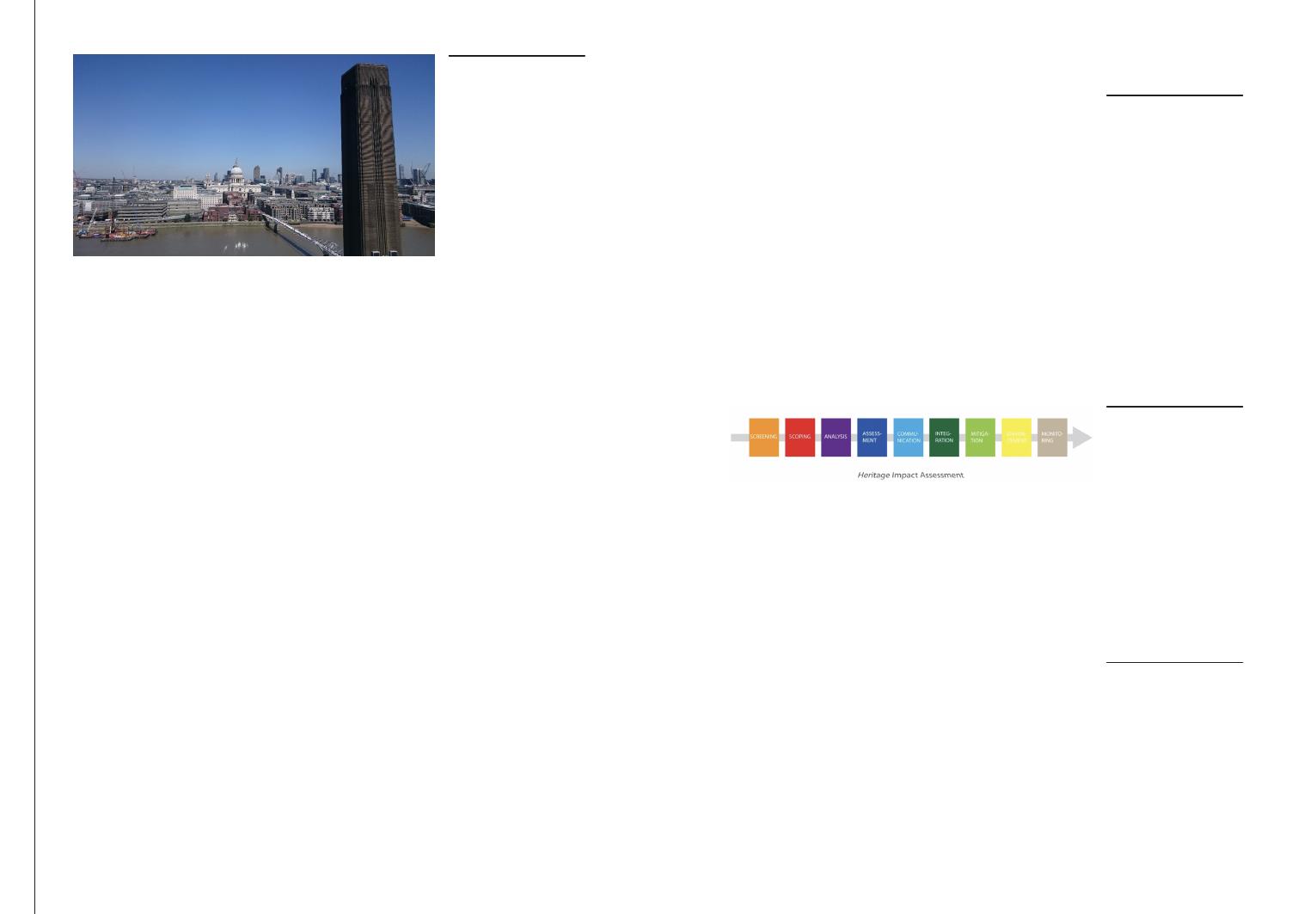
In recent years, various disputes il ustrated that such transformations in
or nearby World Heritage properties can easily lead to tensions between
both local communities and international decision-makers. An exemplar
of such conflicts was the removal of the World Heritage site Dresden
Elbe Val ey in Germany from the UNESCO World Heritage List, due to the
construction of the Waldschlösschen Bridge which took place against
the will of local and regional decision-makers of Dresden and the
Federal State of Saxony (Kloos, 2015).
It can be concluded that the paradigm shift in the implementation
of the World Heritage Convention has raised a large number of new
challenges for both urban and regional planning practice and heritage
management. This creates a need for effective tools that identify,
assess, evaluate and monitor changes and which support heritage-led
planning processes in World Heritage Cultural and Urban Landscapes,
and their surroundings. Thereby, a stewardship in line with UNESCO´s
overall strategy of sustainable development has to be activated.
Heritage Impact Assessments
– theoretical standards and challenges in praxis
In this context, the World Heritage Committee and ICOMOS increasingly
request State Parties to carry out Heritage Impact Assessments (HIAs)
in order to assess the impact of new interventions on the Outstanding
Universal Value of cultural World Heritage properties. Meanwhile, the
Operational Guidelines clearly state that "Impact assessments for
proposed interventions are essential for all World Heritage properties"
(
Operational Guidelines, 2015, para 104). In line with this development,
ICOMOS published Guidance on Heritage Impact Assessments for
Cultural World Heritage Properties in 2011 which is addressed to heritage
managers, developers, consultants and decision-makers, but also to
the World Heritage Committee and States Parties (ICOMOS, 2011). This
Guidance is going to be updated soon.
According to this theoretical background, HIAs should be
conceived as process-related studies comprised of various
steps that combine assessment with an in-depth analysis
of the Outstanding Universal Value of World Heritage
Properties. A crucial element of such studies is the scoping
process, where, inter alia, all relevant stakeholders must
be identified, the content, important subjects and issues,
and the time corridor of the study must be defined, and
potential risks concerning these factors must be discussed
within the stakeholder group. A second crucial aspect of
HIAs is the definition of potential mitigation measures in
case of negative findings, and the feedback of crucial
results into planning processes.❶ It is obvious that such a
complex planning process causes various challenges for
authors of HIAs. Especial y, interdisciplinary skil s are required
due to the large variety of different activities.
Visualizations as a tool to support Heritage impact
Assessments – the case of the World Heritage Property
“
Natural and Culturo-Historical Region of Kotor”
In particular, the generation of a constructive communication process
with and between various stakeholders is a crucial step during HIAs,
because this is the starting point to stimulate potential positive and
to mitigate potential negative impacts in World Heritage Properties.
Therefore, the former
UNESCO Chair in World Cultural and Urban
Landscapes ❷ at RWTH Aachen University in Aachen /
Germany has worked since 2005 on a methodology to
use precise computer-generated visualizations in order
to show and discuss planned transformations in UNESCO
World Heritage Properties with various stakeholders. This
methodological approach requires several research steps.
First of al , it is necessary to precisely investigate the formal
background of World Heritage Properties. Especially, their
Outstanding Universal Value (OUV) and the
Attributes
expressing this OUV in detail has to be analysed in a
transparent manner. To achieve this goal, it is necessary
❶
The
International Network
of Cultural Diversity defined
impact assessments as
the “process of
identifying,
predicting, evaluating
and communicating
the probable effects of
a current or proposed
development policy or
action on the cultural life,
institutions and resources
of communities, then
integrating these findings
and conclusions into the
planning and decision-
making process, with a
view to
mitigating adverse
impacts and
enhancing
positive outcomes”
(
Sangria / INCD, 2004,
emphasis added by the
author).
❷
This UNESCO Chair ceased
to exist in 2016 due to the
retirement of the former
Chairholder Prof. Kunibert
Wachten. It is currently
intended to establish a
new UNESCO Chair with
the same programmatic
approach at RheinMain
University of Applied
Sciences in Wiesbaden /
Germany.
Fig. 2
Basic steps in cultural
Impact Assessment
processes as defined by
the International Network
of Cultural Diversity (INCD)
(
© Michael Kloos)
Fig. 1
St Paul’s Cathedral is a
widely known symbol
of London’s skyline but
nowadays surrounded
by high-rise tower blocks
(
©Michael Kloos)
158
159
M
ic
ha
el K
lo
os
His
to
ric U
rb
an L
an
ds
ca
pe
s a
nd H
er
ita
ge I
m
pa
ct A
ss
es
sm
en
ts
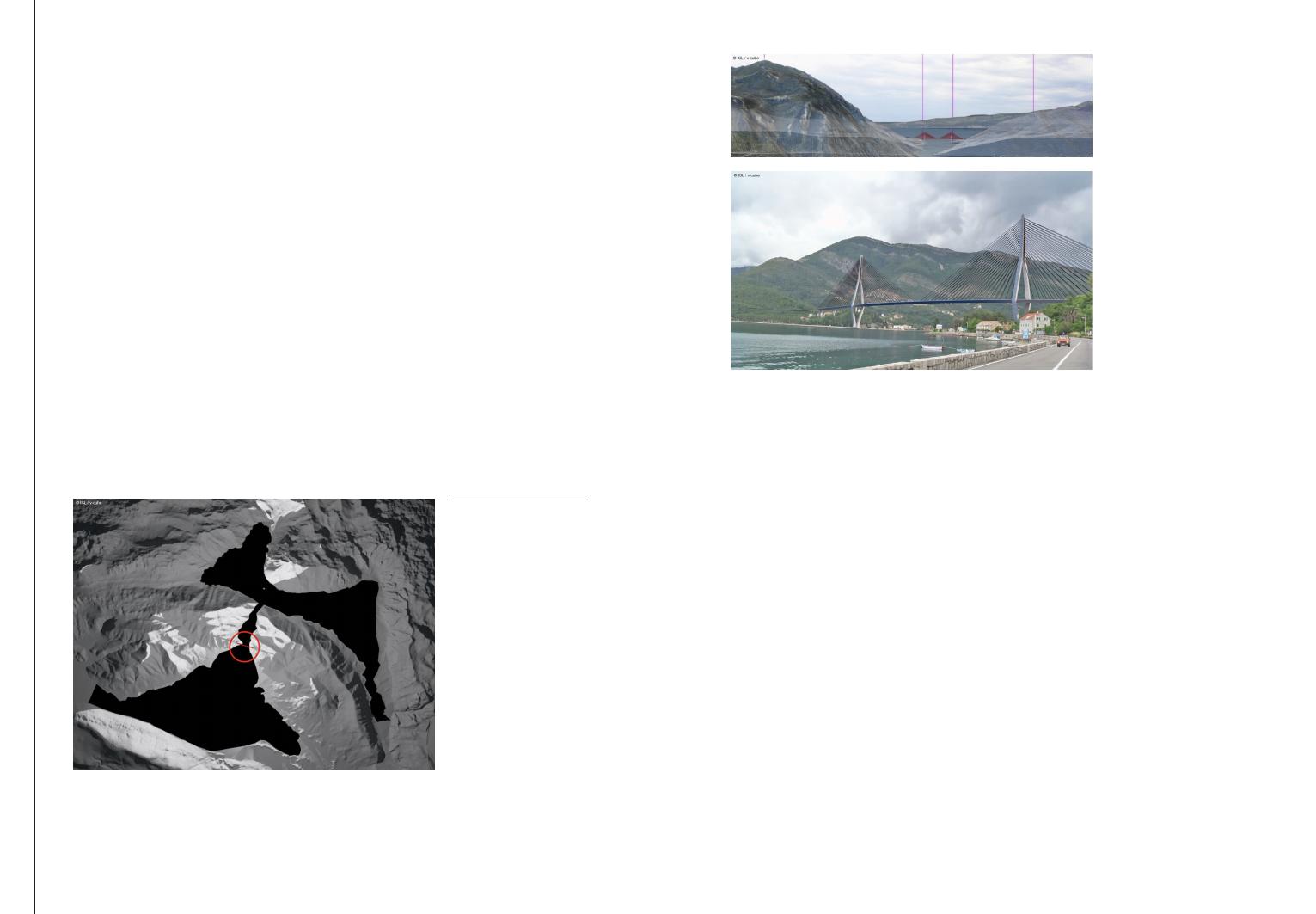
to carry out an in-depth analysis of the natural and cultural features
of the properties in investigation. This should result in clear outcomes
which traditional and present perception patterns are typical for such
properties. Afterwards, various viewpoints and view corridors can be
defined and documented with digital photographs and video shots.
Based on such a preliminary investigation, digital computer visualizations
can be generated which clearly show planned transformations in
UNESCO World Heritage Properties and their surroundings. An example
for this is the investigation of a planned bridge in the UNESCO World
Heritage Property „Natural and Culturo-Historical Region of Kotor“,
located in Montenegro (South-East Europe). Here, a virtual 3D computer
model, which was built up on basis of a large amount of data, was used
in order to show all potential vistas from and to the planned bridge
project. Based on the same computer model, visualizations were
generated to analyse the potential impact of the project on the OUV of
the World Heritage Property.
Based on these visualizations, it could be clearly assessed which impact
had to be expected by the planned new bridge. As a consequence,
recommendations could be provided how to mitigate negative impacts
and how to support the sustainable development of the UNESCO World
Heritage Property.
Heritage Impact Assessments as a pro-active tool to
combine heritage management with participatory urban
and regional planning processes – the case of Cologne
Cathedral (Germany)
However, HIAs can only be effective if it is possible to feedback such
recommendations into the future planning processes. HIAs should
therefore be considered as a tool to activate the stewardship of urban
and regional planning processes. Hence, it is indispensable to combine
HIA-processes with an effective communication and implementation
strategy.
In Cologne, it proved possible to achieve such an active contribution to
the city’s sustainable development with the help of a HIA. Here, it had to
be evaluated whether the so-cal ed ICE High-Rise Cluster – an ensemble
of five tower blocks planned in the immediate vicinity of Cologne
Cathedral on the opposite side of the Rhine next to Köln-Deutz railway
station – would have a negative impact on the OUV of this UNESCO World
Heritage Property. Prior to the assessment, in 2004, the UNESCO World
Heritage Committee had already included the cathedral on the List of
World Heritage in Danger. This decision caused considerable pressure to
assess the impact of the tower blocks on the OUV of the World Heritage
Property.
Similarly to the case of the „Natural and Culturo-Historical Region of
Kotor“, and based on a thorough cultural and historical analysis of
Fig. 3
a b c
Shading model of the
UNESCO World Heritage
Property „Natural and
Culturo-Historical Region
of Kotor“, generation
of digital computer
visualizations and
assessment of the
planned Verige Bridge
(
© v-cube)
160
161
M
ic
ha
el K
lo
os
His
to
ric U
rb
an L
an
ds
ca
pe
s a
nd H
er
ita
ge I
m
pa
ct A
ss
es
sm
en
ts
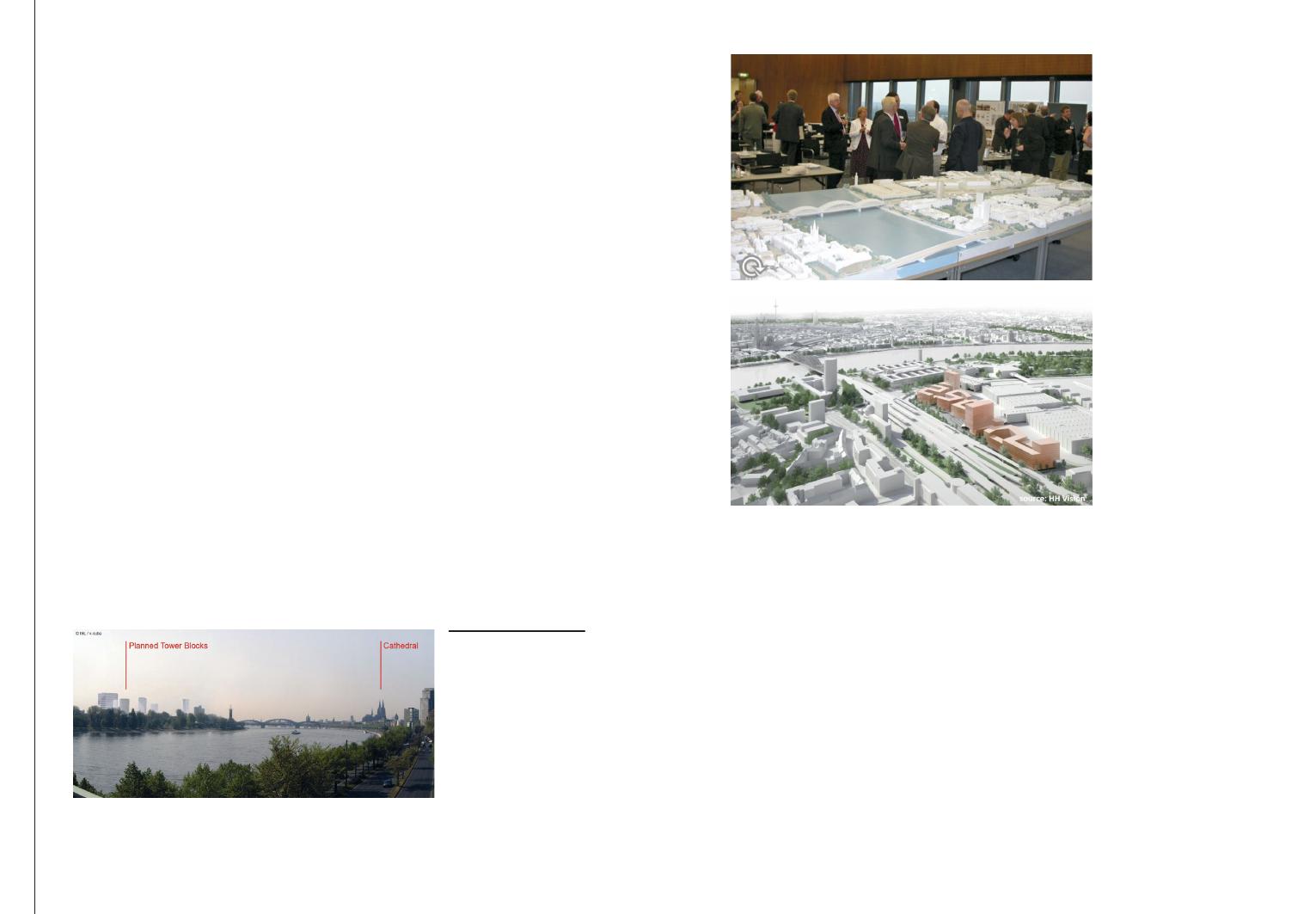
Cologne’s city structure and its distinctive silhouette, several of the
generated computer visualizations clearly showed that the dominance
of the cathedral’s characteristic silhouette would suffer under the
planned high-rise scheme. This referred especial y to habitual views
from the right bank of the Rhine, which were identified in the study as
an important element of the experience of Cologne’s city silhouette.
As a result, it was recommended that the ICE High-Rise Cluster should
be reviewed and the buffer zone around Cologne Cathedral should be
enlarged by a monitored zone in order to avoid similar conflicts in the
future (Kloos et al., 2005).
However, in parallel to this situation it gradually became clear that the
economic concept of the tower blocks had failed because potential
tenants were missing. This situation opened up the possibility for a
new general approach to resolve this situation. Based on a decision
of the Cologne City Council in December 2005, it was agreed that a
moderated workshop should be organized by the City of Cologne. This
workshop was meant to integrate some sixty representatives of relevant
groups of Cologne’s city population and three renowned urban planning
offices. The multi-stage workshop was organized as a cooperative
planning process with a time span of seven weeks. The three urban
planning offices were requested to present intermediate states of
their plans during three different sessions which were organized as a
mixed system of panel discussions and work in smaller groups. During
these sessions, the invited representatives acted as an expert panel,
providing recommendations and ideas for the elaboration of the various
design proposals. At the same time, the ideas and thoughts of the
representatives of Cologne’s city population were integrated during the
working sessions, thus generating a broad consensus concerning the
project.
This multi-stage cooperative workshop led to the result that the existing
planning scheme consisting of five high-rise tower blocks was replaced
by a more compact and lower ensemble of buildings. A particularly
interesting aspect of this result was that not only vistas to the Cathedral
could be preserved. The newly suggested planning scheme was also
far more flexible in terms of its use than the originally planned tower
blocks and therefore more efficient in economic terms. As a result,
Cologne Cathedral was removed from the List of World Heritage in
Danger by the UNESCO World Heritage Committee after the City of
Cologne had decided to carry out this new scheme. Meanwhile, the
concept has been further refined and it will probably be realized soon.
Hence, the compilation of the HIA and the cooperative workshop had
been important steps towards a solution aligning economic, societal,
ecological and cultural aspects. In general, the intensive discussions
about Cologne’s cultural heritage turned out to be a valuable
contribution for the city’s sustainable development.
Fig. 4
a,b
Visualization of planned
‘
ICE-Highrise-Cluster’,
workshop to modify the
originally planned scheme
and modified urban
development scheme
(
© v-cube, HH Vision)
162
163
M
ic
ha
el K
lo
os
His
to
ric U
rb
an L
an
ds
ca
pe
s a
nd H
er
ita
ge I
m
pa
ct A
ss
es
sm
en
ts

Conclusion: Challenges for educational activities with
regard to the practical use of Heritage Impact Assessments
in cultural World Heritage Properties
The above-mentioned case studies were intended to il ustrate that HIAs
can support the sustainable development of complex World Heritage
Cultural and Urban Landscapes. Particularly if they are used as a pro-
active tool combined with 'tailor-made' communication and process-
management strategies to elaborate and adjust interventions in early
stages of planning processes, HIAs can be effective to assess and to
mitigate potential negative impacts in such complex World Heritage
Properties.
However, it is also evident that the implementation of HIAs generates a
need for specific interdisciplinary know-how in several professional fields.
On the theoretical level, it has to be considered that scoping processes
have a large impact on the outcome and the quality of the studies. It is
therefore of fundamental importance that persons or teams in charge
are able to acquire the necessary capability to manage such scoping
processes. It is also necessary that HIA authors or teams in charge have
both a combined knowledge about cultural heritage in general and
World Heritage in particular and a secure understanding of urban and
regional planning processes and urban and architectural design. Since
visualizations are an effective tool to support communication processes
about transformations of UNESCO World Heritage Properties, it is similarly
necessary to build up know-how in computer aided architectural
design (CAAD). And final y, to stimulate the pro-active use of HIAs, it is of
particular importance to relate HIAs to effective and thoroughly planned
participation and communication strategies, which include all relevant
'players'. Therefore, also know-how in communication, mediation and
conflict management strategies is required for HIAs.
In general, the above-mentioned HIA case studies illustrated clearly that
due to the various procedural steps as well as the sectoral knowledge
that HIA studies have to include, authors of HIAs have to cover a wide
range of interdisciplinary skills. The education of heritage managers
must therefore contain a comprehensive understanding of these skills
not only on a theoretical but also on a practical level.
Against this background, RheinMain University of Applied Sciences in
Wiesbaden / Germany launched the new interdisciplinary Bachelor
Course Baukulturerbe / Architectural Heritage Conservation (B.Sc.).
Students are trained here for three years to acquire interdisciplinary
know-how from the fields of architecture, urban planning, heritage
management and cultural sciences. As historic structures and sites, as
well as cultural landscapes contribute substantial y to the distinctiveness
and identity of towns and regions, the practice-related study course
trains students by way of different course projects also to recognise
heritage values and to develop sustainable preservation, restoration
and conversion strategies. To supplement this basic educational level, a
new Masters Course Architectural Heritage Conservation and Adaptive
Devlopment (M.Sc.) will be started in Autumn 2020.
To support this new study programme, it is also planned to establish
a new UNESCO Chair which wil focus on research, education and
dissemination of know-how with regard to World Heritage Cultural
Landscapes and Urban Landscapes at RheinMain University. This
planned UNESCO Chair is meant to support and strengthen the know-
how transfer with regard to World Heritage Cultural Landscapes and
Urban Landscapes on the international level, especially from North to
South. Consequently, co-operations with other universities in various
regions of the globe will be an essential field of activities of the planned
UNESCO Chair.
At the international level, Impact Assessments were already fully
recognized, at the United Nations Conference on Environment and
Development held in Rio de Janeiro in 1992, as an instrument to
provide a framework for the integration of the principles of sustainable
development into national policies and programmes (IAIA 2015). Now
heritage specialists have to face the practical challenges resulting
from UNESCO´s paradigm shift. However, as has been shown, several
chal enges have to be tackled to guarantee the effectiveness of HIAs
and their practical implementation. Against this background, it is obvious
that educational activities have to be accompanied by scientific
research on HIAs is of crucial importance. Besides universities, also
decision-makers in charge of the implementation of the World Heritage
Convention, especially the World Heritage Centre, the Committee´s
Advisory Bodies and political stakeholders such as national Focal Points,
have to be included in such future research activities.
164
165
M
ic
ha
el K
lo
os
His
to
ric U
rb
an L
an
ds
ca
pe
s a
nd H
er
ita
ge I
m
pa
ct A
ss
es
sm
en
ts

Literature
Bandarin, Francesco and van Oers, Ron:
Reconnecting the City. The Historic
Urban Landscape Approach and the Future of Urban Heritage,
Oxford 2015
Greater London Authority:
London View Management Framework.
Supplementary Planning Guidance, London 2012
ICOMOS:
Guidance on Heritage Impact Assessments for Cultural World
Heritage Properties. A publication of the International Council on
Monuments and Sites, Paris 201
International Association of Impact Assessments (IAIA):
What is Impact
Assessment?, (http://www.iaia.org/publicdocuments/special-
publications/What%20is%20IA_web.pdf?AspxAutoDetectCookieSup
port=1 [Accessed 11 November 2015])
Kloos, M. et al.:
Independent evaluation of the “Visual Impact Study Cologne”,
Aachen 2005
Kloos, M. et al.:
Visual Impact Study of the Proposed Verige Bridge on the Bay
of Kotor, Aachen 2009
Kloos, M.:
Landscape 4. Landscape Ideas in Northern Europe and Visual
Integrity of UNESCO World Heritage Cultural and Urban
Landscapes. Aachen 2014. Ph. D. thesis electronical y published at
RWTH Aachen University. http://darwin.bth. rwth-aachen.de/opus3/
vol texte/2014/5078/
Kloos, M.:
Heritage Impact Assessments as a Tool to Open up Perspectives
for Sustainability: Three Case Studies related to Discussions
Concerning the Visual Integrity of World Heritage Cultural and
Urban Landscapes, in: Albert, Marie-Theres (Ed.): Perceptions of
Sustainability in Heritage Studies, Munich 2015
Kloos, M.:
Heritage Impact Assessments as an advanced tool for a
sustainable management of cultural UNESCO World Heritage
sites ‒ from theory to practice, in: Albert, Marie-Theres, Bandarin,
Franceso and Pereira Roders, Ana (Ed.):
Perceptions of Sustainability
in Heritage Studies No. 2, Cham 2017
Oers van, R.: Managing Cities and the historic urban landscape initiative --
an introduction, in: UNESCO World Heritage Papers 27:
Managing
Historic Cities, Paris 2010
Sagnia, B. K.:
Framework for Cultural Impact Assessment. International
Network for Cultural Diversity (INCD); Cultural Impact Assessment
Project. Dakar, Senegal. http://dmeforpeace.org/sites/default/files/
FRAMEWORK%20FOR%20CULTURAL%20IMPACT%20ASSESSMENT%20
%28INCD%29_2004.pdf [Accessed 20 December 2015]
UNESCO:
Convention Concerning the Protection of the World Cultural and
Natural Heritage, Paris 1972
UNESCO:
Recommendation on the Historic Urban Landscape, including a
glossary of definitions, Paris 201
UNESCO:
Transforming our world: the 2030 Agenda for Sustainable
Development, Paris 2015
UNESCO:
Operational Guidelines for the Implementation of the World
Heritage Convention, Paris 2015
Veillon, R.:
State of Conservation of World Heritage Properties. A Statistical
Analysis (1979-2013), Paris 2014
166
M
ic
ha
el K
lo
os
His
to
ric U
rb
an L
an
ds
ca
pe
s a
nd H
er
ita
ge I
m
pa
ct A
ss
es
sm
en
ts

Sustainable Cultures
in times of transition
Polytechnic Institute of Leiria
Prof.
Luísa Arroz Albuquerque
I would like to start by saluting the Korean National University
of Culture Heritage all those involved in the Unesco Chair
in Capacity Building for the Preservation and restoration of
Asia Pacific Cultural Heriatge. Thank you for this invitation,
the warmth reception and let me congratulate you for the
excelent session we had all day. It has been a moment of
shared learning and debate around these issues so relevant
to heritage, tradition and the future.
I will begin my presentation by quickly describing the context
in which our chair as appeared. The School of Arts and
Design of Caldas da Rainha has almost 1300 students and
is part of The Polytechnic of Leiria and develops research
and education in the areas of Fine Arts, Design (Graphic
Design, Interior Design, Industrial Design and Product Design
– Glass and Ceramics), Sound and Image and audiovisual
media, theatre and our scientific domain, composed by the
Masters in Cultural Management, created in 2010, and the BA
in Cultural Production and Programming, created in 2016. The
development of these higher education degrees and research
areas fol ows the development of cultural infrastructures
and institutions driven by the tourism boom that Portugal
has witnessed in the last few decades. We were the second
program designed in Portugal and the first being developed in
an arts and design school.
It was and has been our understanding that this professional
area of expertise should be developed not within the scientific
areas of economy and management, but within those
areas of arts and cultural history, has John Pick and Malcolm
Anderton (Anderton, 2002) so clearly declare in London in
1980 in the publication of Arts Administration, marking a break
with the essential y American tradition of situating the field
of cultural and arts management as an integrated area of
scientific management. The authors state that, more than
“
1) A thorough knowledge and personal commitment to the chosen
artist (s), art form or art forms, either contemporary artistic practices,
or heritage col ections and sites;
2) An equally profound and imaginative understanding of the cultural
history, consciousness, and social conditions of all possible audience
segments that can be attained by the chosen art (s).
3) The ability, using all legitimate social, political and management
skil s, and bearing in mind the most complete and up-to-date political,
legal and economic circumstances, to forge the best aesthetic
contract available, bringing together the arts and the largest and
most appropriate audiences in best possible circumstances.”
(
Anderton, 2002, p. 3)
So our scientific area at the Col ege of Arts and Design develops three
main lines of inquiry and research: (1) the first being the area of social
sciences, art and cultural history developing curatorial practice and
skills; and on the other, in the area of sociology, cultural policy and urban
management skil s, the exercise of this function requires a thorough
knowledge of the arts and cultural history and studies. The argument
is based, they claim, on the fact that aspects of cultural history are
far more relevant to the arts manager than practical knowledge of
management. Thus, they propose its holistic instrumental use as an
efficient approach to managing cultural organizations, emphasizing
the need to involve and inform all members of that same organization.
In this context, holistic management will include communication skills,
the ability to recognize the organizational character of the association,
company or institution, including its history and organizational memory.
In addition, Pick and Anderton highlight the importance of cultural
studies and cultural policies in these areas, given their strong impact
on cultural management practices. According to the authors, whatever
the context in which the cultural manager works, his work involves three
fundamental steps:
169
168

studies, developing a critical thought on cities and urban landscapes;
(
2) the second being in the area of management applied to the arts and
cultural sector; and at last, but not the least, (3) communication applied
also to the arts and cultural goods and products.
The theoretical framework of our chair emerges then out of a
multidisciplinar dialogue between different sicentific approaches and it
stipulates three main premisses: 1st – we need to foster change towards
sustainable cultures, and that conclusion derives from a critical reading
of contemporary culture; 2nd – arts and culture, or the field of cultural
production as Pierre Bourdieu it in the sixties (Bourdieu, 1993) , are a
fundamental cornerstone to the development and functioning of the
public sphere (Calhoun & Postone, 1993), and third, that culture is the 4th
pilar to sustainable development as stated in the Agenda 21st for Culture
of the United Cities and Local Governments. Al ow me to il ustrate these
premisses by proposing you on a critical reading exercise of three rather
distinct events of the last few years.
So, the first event is the refugee crisis and the reffusal or prohibition of
rescue in the mediterranean sea. I don’t know if you are aware of that
tragedy, but the numbers were, and still are, appal ing, with several
thousand drowned each year in the mediterranean sea. The crisis had
its peak with the wars on the middle east between 2012 and 2017. So
what does this event as to do with a comercial advertisement highly
broadcasted in Europe from 2015 onwards? Wel , nothing I should say. But
if we bear in mind the readings of publicity produced by Roland Barthes
in 1957 (Barthes, 1957), things might seem different. This methodology
allows us to see the narrative emerging in mass culture, a powerfull
message delievered in the form of a joke or a satyre, but that goes far
beyond that – connecting itself to the context in which each viewer
lives and acts and, obviously, votes. In this 30 second ad the elogy of
inequality is explicitly celebrated, staging a war between us and them
ending in a pile of corpses collapsing against an iron protected wall.
Inside there’s clean and fresh air, outsider a draught of dust. Why is the
critique of contemporary mass culture so urgently required? The first
and most obvious answer is that we need to create space for other
narratives to emerge, other ways of looking into the world and into
inequalities and social conflicts.
Our second premisse stipulates that culture and arts are critical
cornerstones to the development of cultural spheres, as defined by
Jurgen Habermas (Habermas, 1999). The world of letters, says Habermas,
by developing a critique of the arts and literature, e.g., a method
through which the value of each art or literary piece was discussed
and assessed and not inferred by its statutory representation of power
or religion, allowing therefore the development of instituting practices
anchored in the rational debate of an audience. The same type of
practices required in parliament and, therefore, fundamental to the
development of modern states. One can only fear the effects when
cultural arenas and institutions are given brand names of famous beers
or sneakers. . But that is another line of reflection and critique. For now, I
would like to ask you to look at the next two events.
So the second event is the fire in the National Museum of Rio de Janeiro
that occurred in 2018, destroying all the artifacts and col ections, but one:
a metheoryte, an object not made by human hand. And the third event
are the fires of the Amazonia Forest in 2019. As you should problably know,
the col ection of the National Museum of Rio de Janeiro gathered all the
antropological research and ethnographic objects of the primitive and
ancient tribes of Amazonas. It was the most important museum in South
America to study, know and identify the diversity of cultures and tribes, of
modes of living and beliefs. The destruction of these materials, objects
and knowledge surely feels that a second extinction was imposed on
to these long gone tribes and their living descendents, who, in their turn,
feel the deadly rage of fire too. Without cultural resources to connect to
and with no knowledge of the past, indigenous peoples and tribes are
being sent to oblivion.
Of course the causes that lead to such events are distinct in nature, even
in locations and plausible explanations. But if we look closer to each
one of them and to set of events, one can start to distinguish a pattern
that emerges in each one of these singular events. What pattern is there
to find? One that as no respect for human beings, for their artifacts
and their natural and wild environment: in the denial of rescue at sea
to migrants in violation of international conventions; by not protecting
and preserving the collections of the National Museum, a disrespect
for what men and women before us cherished, collected and thought
of as important to safeguard, study and give to future generations; in
the destruction of the Amazoniaa disrespect for our natural heritage.
Although the causes behind such events are different and cause-
effect correlations are nowhere to be found in this assortment of rather
distinct events, the pattern, however, in the modes of being and acting,
e.g., our culture are, in my humble opinion, cristal clear and give proof to
the statement of the Agenda 21st for Culture as 4th pilar for sustaibable
development.
170
171
Lu
ísa
A
rro
z A
lb
uq
uer
que
Su
stainab
le
C
ul
tur
es
in
tim
es
o
f t
ran
si
tion

Having in mind this theoretical framework, the purpose, programme and
aims of our Unesco Chair in Arts and Cultural Management, Cities and
Creativity, created in the past 5th December 2018, were developed in
the Masters of Cultural Management at the Colllege of Arts and Design
of Caldas da Rainha, Portugal to foster three main projects, which I wil
describe later.
The main objective of the Management of Arts and Culture, Cities and
Creativity Chair is to promote an integrated system of research, training,
information and documentation on the visual arts, arts management
and creativity. It thus establishes a platform for collaboration between
researchers of international excellence and recognition, faculty and
students of the Institute and other institutions in Portugal, as well as from
other regions such as Latin America and the Caribbean, Africa and other
regions of the world.
The goals are the fol owing:
O1 · Contribute to the strengthening of the cultural and creative
sector by strengthening skills and policies in these areas, notably
through the development of innovative higher education programs
and the implementation of research projects aimed at identifying
the knowledge and skill set considered critical in the field. context of
the creative economy;
O2 · Design and implement jointly with partners activities to
promote mutual understanding of identities, promoting positive
recognition of the creative force resulting from differences, and the
development of sustainable cities and communities;
O3 · Conduct training and learning activities to contribute to
the professional development of students of arts and cultural
management in the European Union, Ecuador, Brazil and Cape
Verde, promoting gender equality;
O4 · Promote networking, dialogue and the sharing of knowledge
and best practices among relevant stakeholders, including local
authorities, including through the establishment of a local cultural
policy web platform, organization of conferences and seminars,
publications and exhibitions;
O5 · Collaborate with UNESCO and current UNESCO Chairs on
relevant programs and activities.
These five main goals are materialised in three main projets: (1) the Arts
& Sustainability Forum, dedicated to the artistic practice and to the
promotion of the mobility of artists and partnerships with the Global
South; (2) an on-line editorial project – Hermes, that is going to be
launched in 19th of May 2020 to publish fundamental research in the
areas of curatorial studies, cultural management and mediation; and
finally, (3) the Living Cities Observatory, where the application of Caldas
da Rainha (where our school is located) to the Unesco Creative Cities
Network in the field of Craft and Folk Art was developed.
I will finish precisely by looking closer to this proposal developed under
our chair. I think it summarises and brings together the several steps of
our thought, elucidating the role of the Unesco Chair to the Sustainable
Development Goals and the 2005 Convention for the Promotion and
Preservation of the diversity of cultural expressions. In this application,
the chair designed a new set of cultural policies aimed at the city’s
cultural and creative sector of Ceramics. The need to develop a
comprehensive policy strategy came from the colapse of the many
factories that gave economic dynamism to the city and the region. In
the wake of 2008 global economic crisis action was needed to preserve
a five hundred year tradition in the city. The Ceramic industry of Caldas
dates back to the end of the 15th century, developing uninterrupted
activity ever since. During this period the city’s ceramic centre has
expanded throughout the west Portuguese region. The distinctive and
commercial y successful mark of the ceramics of Caldas da Rainha - a
type of earthenware fundamentally decorative inspired by naturalistic
motifs allowed the development of the main industries and factories of
the city. In the 19th century, the factory of Maria dos Cacos (1820-1853),
fol owed by the the work of Manuel Mafra (1853), as well as the smal
workshops of António de Sousa Liso, José Francisco de Sousa, José Alves
Cunha, Francisco Gomes de Avelar (Junior) and João Coelho César,
transformed the city into an active and dynamic productive centre, in
which the factory of Rafael Bordalo Pinheiro (1846/1905) ) has the main
stage. The tension between craftsman workshops and mass industry
endured throughout the twentieh century pouring into our times. The
industrial sector no longer has the expression once had in the structure
of employment generated in the city, representing around 13% of the
jobs effectively located in the city. Once compared with the national
employment structure, it emerges a specialization pattern in the sector
of ceramics, glass, building materials and other non-metallic mineral
products. Due to its historical importance and for its role in building
the modern identity matrix of the city, ceramics presents itself as an
important factor of distinction associated with the municipality: 2 large
172
173
Lu
ísa
A
rro
z A
lb
uq
uer
que
Su
stainab
le
C
ul
tur
es
in
tim
es
o
f t
ran
si
tion

and medium size industrial units (more than 50 workers), an estimate
of 17 small workshops and ateliers, 7 shops dedicated exclusively to the
commerce of ceramic goods located in the city's historical centre. Of the
6807 enterprises found at Caldas da Rainha, almost 3% are dedicated to
the arts, entertainment, sports and recreation activities, where almost
76% are individual enterprises.
In the creative field of arts and crafts one can first define three
different sets of groups distinguished by their role within this cluster
of activities: the first group is, then, associated with works within the
industrial dimension of this sector; the second group being those who
are engaged in learning and training activities for the ceramic sector,
including those developing R&D activities and projects; and finally, those
engaged in the artisanship of handcrafted ceramic goods, objects and
products. In this particular field one can broadly define three different
communities emerging from different sets of products created: the first
associated more with traditional arts and crafts products; the second
broadly defined by creative ceramics, that innovates and challenges
the city’s ceramic tradition, by incorporating design and contemporary
flare to handcrafted ceramic goods; and finally those where ceramics
becomes the medium of artistic expression.
From the outset the main challenge identified was the invisibility of the
craftsmen and women – the human gesture behind all handicrafted
objects – in the face of the massive scale of industrialised production, we
need strategies that render this gesture visible and valued in the context
of our global economy. So, in the context of a fast-driven globalization
and automatization processes, manual labour is condemned to
invisibility. Promoting and creating added value to the Cultural and
Creative Sector is then seen as one cornerstone of the development
strategy.
The second challenge addressed the frailty of the structure of
employment within this sector. To improve the livelihoods of artisans
and to promote sustainable jobs is seen as an important driver
for sustainable urban development. The third challenge aimed at
promoting knowledge and best practice sharing by developing
evidence-based cultural and sustainability policies involving many
global and local players within the Cultural and Creative Sector, creating
a research centre focused in (a) knowledge and best practice sharing
in cultural and sustainability policies in ceramic cities; (b) research and
public display of the many col ections owned by the city council; (c)
monitoring and evaluating impacts in pollution of water-related eco-
systems as a result of small and medium ceramic workshops activities.
Having in mind these challenges, the proposal in the domain of Craft
and Folk Art identified three main cornerstone projects:
1) develop and support in-depth research within the OBSERVATORY
LIVING CITIES in two main policy areas – culture and sustainability –
in ceramic cities in partnership with the UNESCO CHAIR in ARTS and
CULTURAL MANAGEMENT, CITIES AND CREATIVITY of the Polytechnic
Institute of Leiria and other European and Brazilian Cities. The main
aim is study, compile and compare in selected ceramic cities: (1)
sustainable-led practices in product design and management
in workshops and industries; (2) cultural policies aiming at the
strengthening of the cultural and creative industries. The outputs
of this R&D project are: written reports, books, field missions and the
development of a website for dissemination of results;
2) create, develop and support a CERAMIC HUB as a focal dynamic tool
to strengthen the cultural sector with workshops suitable for ceramic
activities, equipped with large communitarian ceramic ovens, a
concept store, for the creation of peer-to-peer sales strategy, and,
finally a smart management model of the city’s resources dedicated
to ceramics. It will also implement a programme for the mobility of
artists, both incoming and outgoing, based in good governance and
transparency policy practices; and it will create and support the
development of an ECO-POINT for the col ection of ceramic waste,
that will be responsible above all, to study, evaluate and monitor
possible pollution effects of water-related eco-systems resulting
from ceramic and artistic workshops in its washing, cleaning and
maintenance activities. Although in an early stage of development,
this R&D project will be developed in three main stages: (1) evaluate
the polluting effects of water disposals at small ceramic workshops;
(
2) monitor its impact in public sewage; (3) if needed, find easy-to-
implement solutions;
Of cross-cutting nature, the biennale MOLDA promotes a multidisciplinary
dialogue between the areas of Design, Music and Media Arts and the
craftwork in ceramics, supporting the dissemination of knowledge and
best practices sharing;
The expected long-term impacts of the strategy are: (1) a stronger
cultural and creative sector by the implementation of evidence-based
policies; (2) a significant improvement of labour conditions of craftsman;
and finally, (3) a reduction of the pol uting effects of the ceramic activity
174
175
Lu
ísa
A
rro
z A
lb
uq
uer
que
Su
stainab
le
C
ul
tur
es
in
tim
es
o
f t
ran
si
tion

developed in small workshops. The expected long-term impacts of the
strategy to be implemented fol owing the designation are:
1) the development of a set of evidence-based policies aiming at
two important cornerstones for sustainable urban development:
(
a) policies aiming and promoting sustainable urban cultures and
(
b) policies aiming at the strengthening of the cultural and creative
sector, headed by the Living Cities Observatory of the UNESCO Chair
in Arts and Cultural Management, Cities and Creativity in partnership
with European and Brazilian Cities;
2) foster the mobility of artists by implementation of a programme
that will support creative and artistic interactions, promoting gender
equality, South/North relationships and transparency in the decision-
making process;
3) enhance visibility by the creation of a Ceramic Hub with workshops
suitable for ceramic activities, community ceramic ovens, Concept
store and a cultural management steering committee to foster
assertive marketing;
4) study, monitor and reduce possible pol ution effects of water-
related eco-systems resulting from small ceramic and artistic
workshops, adopting a problem-solving research;
The chal enge to strengthen and improve this creative sector was
identified in the actions and meetings held to develop the strategic plan
of the city of Caldas da Rainha 2030. In that analysis one could identify
the growth potential of this creative cluster, but above all its potential
to bring to life, connect and be a driver for the improvement of living
standards, quality of life and social inclusion. Following this process,
the application was built by the UNESCO Chair in Arts and Cultural
Management, Cities and Creativity on behalf of the city council. In order
to identify the main threats and opportunities identified by the several
stakeholders and groups, six meetings were held to analyse and discuss
the main challenges in the four areas of sustainable development
strategies: environment, economy, social inclusion and culture. The
compilation of remarks and conclusions of this bottom-up consultation
process are then translated in the aims, goals and actions of this project.
The outreach, partners and initiatives of the proposed plan of action are
as follows:
1) the OBSERVATORY LIVING CITIES (OLC) is based in three field missions
in selected ceramic cities to develop in a study-case methodology
the research design and goals. The dissemination strategy is
based on the development of a website that compiles results. The
beneficiaries are, not only the city councils, but also all the ceramic
craftsmen that may find in-depth research and solutions for
sustainable management practices of their workshops.
2) the CERAMIC HUB will develop: (a) in the mobility of artists’ line of
action, three major exhibitions will be curated having in mind South/
North relationships to foster knowledge and best-practices sharing;
(
b) in the strengthening of cultural sector, it will assess, evaluate and
acquire community ceramic ovens to improve and enlarge revenues
of the creative investment made by artists; (c) in the smart marketing
strategy, will develop not only the peer-to-peer Concept Store, but
it will also develop commercial services and strategy consultancy
to craftsmen; (d) in the smart management of the city’s ceramic
resources, it will develop a platform for local institutions and entities
(
private, public and third sector) to align and coordinate services.
The main beneficiaries of these activities will be al those involved in
the process of creation – craftsmen, artists and designers working
on ceramic. Integrated in the Hub, the ECO-POINT for the col ection
of ceramic waste will provide services to craftsmen, artists and
designers to dispose any waste that may be the outcome of the
production. It will also lead the process to develop an R&D project
evaluating possible polluting effects of ceramic workshops: define
project milestones, project partners, main goals and outputs. The
main beneficiaries of this line of action are not only craftsmen, but the
municipality and the region in general.
The main initiative being prepared for 2020 and 2022 is MOLDA – The
Ceramic Biennale, that wil , has it did in the past, mobilise the city’s
cultural and educational institutions, the private and public sector as
well as civil society’s associations in the development of an ambitious
program, linking heritage, tradition, know-how and contemporary
ceramic practice in a festival dedicated to, but not limited to, ceramics.
Proposing exhibitions, conferences, seminars and creative workshops,
MOLDA’s programme is designed to foster internationalisation and
evolves in multitude of media, from film, to literature and music.
Designing tradition into the 21st century is or will not be an easy or fast
process. It is a slow process of creating the space for this cultural and
artistic expression to change, evolve and find its contemporaneity
176
177
Lu
ísa
A
rro
z A
lb
uq
uer
que
Su
stainab
le
C
ul
tur
es
in
tim
es
o
f t
ran
si
tion

within the tradition it brings forth. It is a process of allowing new ways
of shaping, seeing and experience the cultural and artistic objects
emerging from our culturally diverse times. Made by craftsmen and
women that can learn from the past and shape it for the future, it will
only endure if it is able to maximize the opportunities given by digital
networks. And it will only endure if it reduces its ecological footprint.
These are the hallmarks of our times. And finally, it is also a process
of preserving the know-how and the knowledge of its history and
importance to be passed on to future generations. But our aim is not to
freeze it in time or in ways of doing. Our aim is to create the sustainable
space that al ows it to happen and that values and preserves the human
gesture and creative freedom of which they are proof throughout the
chain of history. So that from the passage of our times and actions can
survive something more than a meteorite.
References
Anderton, M. e. (2002). Arts Administration. London, New York: E & F Son.
Barthes, R. (1957). Mythologies. Paris: Ed. de Seuil.
Bourdieu, P. (1993). The Field of Cultural Production. (R. Johnson, Ed.)
Cambridge, Oxford: Polity Press.
Calhoun, C. J., & Postone, M. (1993). Bourdieu - Critical perspectives.
Cambridge, Oxford: Polity Press.
Habermas, J. (1999). Teoria de la action comunicativa. Madrid: Santil ana S.A.
179
178
Lu
ísa
A
rro
z A
lb
uq
uer
que
Su
stainab
le
C
ul
tur
es
in
tim
es
o
f t
ran
si
tion

Role of Digital Cultural Heritage for the Sustainability in Cultural Heritage
Philosophical Study of the Restoration of Gongju-mok Site for the Sustainable
Conservation of the Ancient City, Gongju
The Analysis of Foreign UNESCO Chair Programmes
The Sustainable Conservation of UNESCO World Heritage Mireuksaji
Hwaryeongjeon Shrine Story to Become a Heritage Treasure
The Sustainable Conservation of Cultural Heritage

Role of Digital Cultural Heritage for
the Sustainability in Cultural Heritage
Korea Advanced Institute of Science
and Technology
Jaehong Ahn
Sustainability to ensure the sustainable future for all human beings
with scarce resources in limited spaces is now an important issue for
social development. The concept of sustainable development mainly
focused on economic development in the early days. And social and
environmental sustainability was generally regarded as the subordinate.
However the concept and policy of sustainability have changed
gradually. As its scope has expanded, cultural sustainability took the
position as a major sector of sustainability in the 1990s. This change in
perception led to the new perspective on the role of culture and heritage
in social development and the discussion of sustainability in the field of
cultural heritage.
Digital cultural heritage is attracting attention as the convergence with
digital technology becomes indispensable in the heritage fields recently.
Digital technologies are applied to all stages which include digitalizing
cultural heritage, construction heritage database and enjoying cultural
heritage. Digital technologies have a great impact on the conservation
and utilization of cultural heritage. Therefore, the impact and role of
digital cultural heritage needs to be addressed as the main issue when
discussing sustainability in the heritage fields.
Sustainability in the heritage fields can be discussed in two ways,
which are the sustainability of cultural heritage and the role of cultural
heritage for the sustainable development of society. In the digital
age, the use and importance of digital technologies has increased in
conserving, managing, archiving and accessing to cultural heritage.
Digital technologies enable the methods of analysis and conservation
which had not been possible before. And they broaden the range of
interpretation and understanding to extend the experience of enjoying
cultural heritage. Enjoying cultural heritage and understanding its
values raises the desire for conservation and contributes to heritage
conservation in a circular way.
The awareness about the important role of culture and cultural
heritage needs to be raised as the concept of sustainability expands,
Nevertheless, cultural heritage is still perceived as a negative factor to
hinder development, rather than as a positive one to support sustainable
development. For the sustainable conservation of cultural heritage,
conservation policies and implementation plans need to be established
to overcome the negative perception. The methods appropriate to the
contemporary digital era must be applied to raise the awareness about
the necessity of heritage conservation, to enhance the values of cultural
heritage and to develop advanced conservation methods. In this
context, the positive role and value of digital cultural heritage needs to
be discussed more actively for the sustainable conservation in the field
of cultural heritage.
183
182

Philosophical Study of the Restoration of
Gongju-mok Site for the Sustainable
Conservation of the Ancient City, Gongju
Cultural Heritage Administration
Sujeong Lee
185
184
Gongju-mok Site, where Gongju-mok was located in the Joseon
Dynasty, is the significant place of the ancient historic city Gongju.
From the ancient times to the modern times, there was the ruling
facilities to govern the area. In the Japanese colonial period, modern
medical facilities replaced the site, which changed the spatial function.
Displaying the historical timeline of the change the site has played an
important role in forming the identity of the ancient city Gongju.
This article aims at examining the framework for philosophical
consideration on the value-based assessment. It analyze the values
of Gongju-mok Site in the context of the historic ancient city, Gungju.
Based on this analysis, the ways how restoration will be reviewed for the
sustainable conservation of Gongju-mok Site.
The article highlights the importance of both tangible and intangile
elements of expressing values in deciding the way of restoration. is to be
discussed. Remaining elements that make up the values of Gongju-mok
are mostly intangible. So the focus must be on restoring such intangible
elements. It is necessary to consider how the restoration will show the
meaning of Gongju-mok, its role and function as governing facilities,
associated historical context and events and raise the awareness of its
significance.
The medical facilities built in the Site during the modern period is also
part of the historic layers, which must be included in the process of
restoration. Gongju-mok Site is the place where experienced constant
change by accumulating different historical layers. Therefore, Gongju-
mok Site should be restored to reflect such experience rather than
simply to freeze into a certain historical time.
In addition, the direction of restoration should be determined in
consideration of local identity and socioeconomic value formed around
the Gongju-mok site. The role of the site in consisting historic and
cultural context of ancient city as well as its urban planning should be
examined in decision-making.It should be discussed how the restoration
of Gongju-mok site can contribute to educational and socioeconomic
values.

The Analysis of Foreign
UNESCO Chair Programmes
National Research Institute
of Cultural Heritage
Taeyoung Kim
The UNESCO Chair Programme was launched in 1992, which more than
700 institutions in 116 countries participate in. The aim of the program is
to realize UNESCO's philosophy through collaboration and to act as the
intermediary for research and policy making in academia, civil society
and communities. In Korea, Seoul National University, Ewha Womans
University, Sookmyung Women's University, Kyung Hee University, and
Korea National University of Cultural Heritage are the participants of
the UNESCO Chair programme. The only program for conservation and
restoration of cultural heritage has been run by Korea National University
of Culture Heritage (KNUCH).
The program of Korean Traditional Culture University has been operated
since 2017 under the theme of “Capacity Building for the Conservation
and Restoration of Asia-Pacific Culture Heritage”. The program is to
conduct field surveys on traditional materials and technique, to provide
professional training course, to build expert networks and to construct
the database for the conservation of Asian-Pacific traditional materials
and technique. In the KNUCH UNESCO Chair Programme, international
conferences and heritage experts training courses were held. And field
surveys and heritage workshops were carried out in Cambodia. Despite
these achievements, theoretical study, case analysis, collaboration
with external institutions for the sustainable development of UNESCO
Chair Programme, and promotion of operational performances are
still insufficient. The purpose of this study is to analyze foreign UNESCO
programmes related to building heritage and to propose new programs
and plans for development of KNUCH UNESCO Chair Programme.
The UNESCO Chair Programmes for architectural heritage are carried
out in 8 countries except Korea where design-oriented researches are
the main for the conservation and effective management of historic
cities. The representative programmes are of Politecnico di Milano
in Italy and Université de Montréal in Canada. Politecnico di Milano
launched a master’s course in architectural design and history as part
of the UNESCO Chair programme in 2012 to train experts for conservation
and restoration of building heritage. The curriculum consists of studio-
oriented design projects. The goal is to cultivate architects who
understand the historical context. The UNESCO Chair Programme at the
University of Montreal's Environmental Institute focuses on international
cooperation through education and networks for sustainable
development in urban landscape design.
What the two universities have in common is international workshops.
The workshops aim at the cooperative relationship where the various
stakeholders work together to share common goals and find solutions.
Workshops are carried out through domestic and international
cooperation as well as local communities, and are operated based on
the collaboration of experts and students in related fields. This shows
that the goal of the UNESCO Chair Programme has been realized by
contribution of the programmes to international society as well as
communities. The websites for the UNESCO Chair Programmes were built
and information about the programmes is available online. This public
relations activity is the important factor that leads to public interest and
raises social awareness.
The international conference of KNUCH UNESCO Cahir Programme
is growing in size, but the scope of participation is still limited to
professionals. In contrast, the international design workshop at the
Université de Montréal in Canada fulfills the goals of the UNESCO Chair
Programme, in that architects, students, politicians and community
members on local and international level involve to discuss common
themes. It also actively communicates with the public through website
and social networking services. The construction and promotion of
website is also essential to contribute to the society for local residents.
187
186

The Sustainable Conservation of UNESCO
World Heritage Mireuksaji
National Research Institute
of Cultural Heritage
Jiwon Jeon
The Restoration and maintenance researches for the conservation of
Iksan Mireuksaji Temple Site have been conducted in earnest since
2013 after research planning phase, and now the main research is
underway. The whole research process is divided into basic research,
main research, and advanced research with progressively deeper levels.
Based on the research road map established on the basic research
phase (2008~2010), the fifth stage of main research is in progress. After
the completion of the main research in 2021, the advanced research will
be conducted by 2030.
The most difficult and ongoing controversial issue in conducting the
research is how to establish the identity in restoration and maintenance
of the Mireuksa Temple Site. This is because the contents of restoration at
the present time vary depending on the identity setting. And it leads to
the change in the historic perceptions of restored Mireuksa Temple Site
in the future.
The Mireuksa Temple Site was listed as a UNESCO World Heritage
Site in 2015 for its outstanding universal value. This means that the
Mireuksa Temple Site was recognized for its values global y as well as
domestically. The selection criteria of Baekje Historic Areas, including
Mireuksaji Temple Site, as World Heritage sites, are criteria i ) and (iii). In
other words, its outstanding universal value (OUV) was recognized as
a proof of important exchange in East Asian culture and as an unique
or exceptional evidence of cultural tradition or civilization, not as a
buddhist masterpiece of human creative genius. In this point of view,
Mireuksaji Temple Site should be restored and maintained to represent
historic layers more comprehensively than simply highlight the history of
Buddhism.
What should be absolutely avoided is the haste to finish the restoration
in a short period of time. Reconstructing the 1400-year-old architectural
heritage in 20-30 years may not properly represent its essential values
and may even damage it. Even if it takes 100, 200 or more years, the in-
depth and continuous research on values and significance must be
preceded and followed by restoration and maintenance in the optimal
way for the sustainable conservation of the Mireuksa Temple Site.
189
188

Hwaryeongjeon Shrine Story
to Become a Heritage Treasure
Suwon Hwaseong Museum
Dongmin Han
After the construction of the shrine for King Jeongjo was discussed,
Hwaryeongjeon Shrine was built on April 29, 1801 to the north of Hwaseong
Temporary Palace and the portrait of King Jeongjo was enshrined. The
main hall where the portrait was placed was called Unhangak Hall
where King Sunjo honored the filial devotion of his father and wrote down
Unhangak on the hanging board.
Unhangak Hall of Hwaryeongjeon Shrine is famous for its elegant
and dignified traditional wooden building. Hwaryeongjeon Shrine, built
in graceful and majestic taste under the king's motto of solidity and
simplicity, is a representative building of the Joseon Dynasty. Among the
other halls of Hwaseong Temporary Palace, including Bongsudang, it is
difficult to find a building that surpasses the magnificent and dignified
style of Unhangak Hal .
Unhangak Hall of Hwaryeongjeon Shrine, where the portrait of King
Jeongjo was enshrined with the hanging board written by King Sunjo’s
was the sacred place.
All the kings since King Sunjo had visited the place which became the
symbol of Suwon. Managing Hwaryeongjeon Shrine with Yungneung
and Geolleung Royal Tombs was one of the main tasks of Hwaseong-
yusu, the provincial governor of Suwon-bu Prefecture, and Suwon-
pangwan, the deputy governor. In particular, Hwaseong-yusu had visited
Hwaryeongjeon Shrine every five days, and incensed every first and 15th
day of a month by the lunar calendar. Regular ceremonies for the repose
of King Jeongjo had been held on his birthday and the ritual day on
December.
Hwaryeongjeon Shrine was designated as Historic Site 115 on January
21, 1963. Last year, three buildings of Hwaryeongjeon Shrine, Unhangak
Hall, Iancheong and Bokdogak, were listed as Treasures 2035. This shows
the significance of Hwaryeongjeon Shrine as the archetype of palace
architecture, which has been conserved in its original form of 1801. In order
to restore the originality of Hwaryeongjeon Shrine, Suwon has made great
efforts like representing the interior design of Unhangak Hall and replacing
the portrait of King Jeongjo with the original one.
Nevertheless, there are some issues that need to be improved. First of al ,
the hanging board ‘Pungwhadang’ must be replaced with ‘Hwahwajeon
Jaesil’ This is to restore the authenticity of Hwaryeongjeon Shrine.
Secondly, the Unhangak board written by King Sunjo must be hung on
the hall. At the time of the replacement of the Unhangak board in 2005,
it was not able to use the glass plate photo at the National Museum
of Korea. Now the glass plate photo made it possible to visual y check
the original hanging board written by King Sunjo, to engrave it and to
hang the represented board on the hal . This is the way to restore the
true meaning of hanging the Unhangak board written by KIng Sunjo on
Hwaryeongjeon Shrine in 1801. Third, the moving line in Hwaryeongjeon
Shrine must return to the original. Now visitors are embarrassed that the
front door of Hwaryeongjeon Shrine is closed. This is because visitors can
buy tickets and enter Hwaryeongjeon Shrine only through Hwaseong
Temporary Palace. The only way to Hwaryeongjeon Shrine is to pass
through Nakmanheon and Hyeopmun which is the side gate of the
shrine. It is uncourteous to enter the sacred space with looking at the
oblique angle. It is right to enter the main hall through the main gate,
Hwaryeongjeon Sammun. Lastly, in front of Hwaryeongjeon Shrine were
Hongsalmun and Hamabi, which symbolize the sacred place. Visitors had
to go through Hongsalmun and Sammun to enter Hwaryeongjeon Shrine.
They had to step into a sacred atmosphere while looking at the dignified
building, Unhangak Hall. Hamabi still stands in the original location but
Hongsalmun was moved to Hwaseong Temporary Palace. Hongsalmun
of Hwaryeongjeon Shrine needs to be relocated to its original position.
Proper representation of Hwaryeongjeon Shrine, the most sacred place in
Suwon, is the way for our future generations to inherit the significance of
the heritage treasure.
191
190

The Sustainable Conservation
of Cultural Heritage
Korea Research Institute for
Human Settlements
Beomhyeon Lee
There are no specific standards in the system for the management and
registration of modern cultural heritage. This leads to the demolition
of modern cultural assets or the removal of existing modern assets to
restore the cultural heritage that once existed.
Two years ago, a project was launched to conserve the cultural heritage
of Gwandeokjeong Hall and restore the surrounding area. This is the
urban regeneration project that brings about changes in the urban
system for the purpose of conserving the precious cultural heritage of
Gwandeokjeong Hall. Cultural heritage conservation with restrictions on
the property rights of residents requires various management measures
to improve the quality of life of residents.
It is necessary to interpret cultural heritage from the perspective
of sustainable urban development, not as a static resource, and
implement various conservation and management measures through
consultation with the residents. Cultural heritage is the common asset
and social insocial infrastructure which is shared with future generations.
So various management measures and sustainable management tools
are needed.
The cultural heritage in this article is limited to the concept of “Cultural
Heritage”, not “Cultural Property” under the Article 2 of the Cultural
Property Protection Act. Among cultural heritage, the focus will be on
modern cultural heritage, especially the modern cultural heritage linked
with cultural property. In the conservation of modern cultural heritage,
there are many cases in which demolition policy was chosen due to the
high cost of repair and maintenance. In oder to prevent further damage,
various sustainable maintenance measures must be prepared for the
restoration and utilization of historic sites. In-depth discussion on the
ways to conserve and restore modern cultural heritage are needed.
The development of the city comes from the past. It is no exaggeration to
say that the conservation and sustainable use of cultural heritage and
resources determines the rise and fall of city. When we forget the past
and think only about the advanced future, the city is easy to become
dry and stereotyped. So the conservation and management of cultural
heritage is an important issue from the perspective of comprehensive
urban management. We must recognize the value of cultural heritage in
our livelihood and make it a vehicle for urban development.
In the future, there will be various projects in the city. In particular, it is
expected that urban regeneration projects will be carried based on
communication with the residents through recognizing the significance
of cultural heritage and utilizing regeneration values.
193
192

de
sig
n b
y
as
cend
er
(
Sangim
H
O
NG
)